
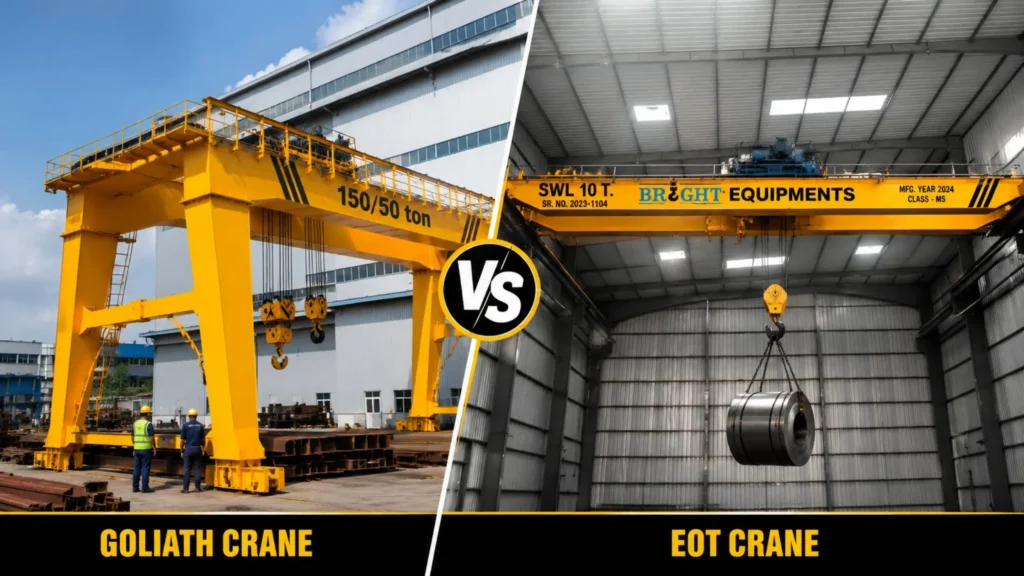
A Goliath crane (also called a gantry crane) runs on ground-level rails using two supporting legs, no overhead building structure is required. An EOT (Electric Overhead Travelling) crane is suspended from runway beams mounted on your building’s columns or walls. Choose a Goliath crane for outdoor yards, open sites, or facilities with no structural ceiling. Choose an EOT crane for enclosed factories and warehouses where the building can carry the runway load.
If you are evaluating material handling equipment for your facility, the choice between a Goliath crane and an EOT crane is one of the most fundamental decisions you will make. Both are electrically operated, both travel longitudinally, and both lift heavy loads, but their structure, application, installation requirements, and cost profiles are significantly different. This guide breaks down every key difference so you can make the right decision for your specific site.
What is an EOT Crane?
An EOT crane – Electric Overhead Travelling crane consists of a bridge girder (single or double) that spans across two parallel runway beams. The runway beams are mounted on the columns or walls of your building, typically near roof level. The hoist travels along the bridge girder, and the entire bridge travels along the runway, giving the crane full coverage of the floor area below.
EOT cranes are the most widely used industrial cranes in India. They are used across automotive plants, textile mills, steel fabrication shops, pharmaceuticals, cement, and general manufacturing. They are manufactured under IS 3177 and are available in capacities from 0.5 ton to 200+ tons with spans typically up to 32 metres.
What is a Goliath Crane?
A Goliath crane also called a full gantry crane, is structurally similar to an EOT crane in its bridge and hoist arrangement, but instead of being suspended from a building, it stands on its own two legs. These legs run on ground-level rails laid in a concrete track. Because the crane is self-supporting, it does not need a building structure to carry its load.
Goliath cranes are primarily used in outdoor applications: steel fabrication yards, shipyards, ports, precast concrete plants, and large open industrial sites. They are available in capacities from 5 tons to 500+ tons with spans that can exceed 50 metres. A variant called the semi-goliath crane has one side on legs (ground rail) and one side on a runway beam – used in partially open facilities.
Goliath Crane vs EOT Crane: Full Comparison Table
The table below compares both crane types across all key parameters. Use this as a decision reference for your procurement.
| Feature | Goliath Crane | EOT Crane |
| Support Structure | Two ground-level steel legs on rails | Runway beams on building columns/walls |
| Building Dependency | Independent – no building structure needed | Requires adequate structural building |
| Indoor / Outdoor | Primarily outdoor (open yards, ports) | Primarily indoor (factories, warehouses) |
| Foundation | Concrete ground-rail foundation required | Building columns carry runway load |
| Span Capability | Up to 50+ metres | Typically up to 32 metres |
| Capacity Range | 5 ton to 500+ ton | 0.5 ton to 200+ ton |
| Hook Coverage | Full area between ground rails | Full floor area under runway |
| Installation | Complex (civil + mechanical + electrical) | Moderate (runway beams + hoist) |
| Weather Exposure | High – outdoor components exposed | Low – protected inside building |
| Maintenance | Higher (weather damage, corrosion risk) | Lower (indoor, controlled environment) |
| Relative Cost India | Higher (legs + civil work + larger structure) | Lower for enclosed factory buildings |
| IS Standard | IS 3177 applicable | IS 3177 |
| Best Application | Steel yards, shipyards, outdoor fabrication | Automotive, textile, pharma, general industry |
Structure and Installation: What is the Real Difference?
EOT Crane Installation
Installing an EOT crane requires runway beams to be either embedded in the building structure during construction or retrofitted to existing columns with structural reinforcement. A structural engineer must verify that your building can carry the crane’s runway loads – this is a critical step many buyers overlook. The hoist is then installed on the bridge girder, and the full system is commissioned and load-tested to 125% SWL under IS 3177.
Goliath Crane Installation
A Goliath crane installation involves significantly more civil work. Ground rails must be laid in a properly designed concrete foundation that can carry the dynamic loads of a loaded crane in motion. The foundation design depends on crane capacity, soil bearing capacity, and span. After the civil work is complete, the legs, bridge girder, and hoist are erected and aligned. The total installation timeline for a Goliath crane is typically longer than an EOT crane of the same capacity.
When Should You Choose a Goliath Crane?
A Goliath crane is the right choice when:
• Your facility is outdoors: open yard, shipyard, fabrication site, precast plant, or port
• Your building has no overhead structure: or the structure cannot carry runway beam loads
• You need a very large span: beyond 32 metres, which is the practical limit for most EOT crane installations
• You need very high capacity: 5 tons to 500+ tons in a single crane
• You are handling long structural members: I-beams, pre-cast elements, ship sections, where ground-level travel is safer
• Your operation requires 360-degree access: from ground level without building constraints
When Should You Choose an EOT Crane?
An EOT crane is the better choice when:
• Your facility is an enclosed building: factory, warehouse, assembly plant, or workshop
• Your building structure can carry runway loads: verified by a structural engineer
• You need cost efficiency: EOT cranes are less expensive to install in buildings that already have the structural capacity
• Span requirements are within 32 metres: which covers the majority of Indian industrial facilities
• You need multi-crane operations: two EOT cranes can share the same runway with anti-collision systems
• Lower maintenance is a priority: indoor installation protects all components from weather
Semi-Goliath Crane: The Middle Ground
If your facility is partially open – for example, a shed with one open side or an extension to an existing building – a semi-goliath crane offers a practical solution. One side of the bridge girder runs on a runway beam mounted on the building structure; the other side runs on a ground-level leg and rail. This design is more economical than a full Goliath crane and works well for maintenance bays, dispatch areas, and partially covered fabrication yards.
Goliath Crane vs EOT Crane: Cost Comparison in India
Direct price comparison is difficult because both crane types vary significantly by capacity, span, and specification. However, the general cost relationship in India is:
• EOT crane (indoor, standard span): Lower installed cost when building structure is already adequate
• Goliath crane: Higher installed cost due to larger steel structure (legs), more complex civil work (ground rails + foundation), and longer installation time
• Semi-goliath crane: Intermediate cost – more than EOT, less than full Goliath
For any capacity above 50 tons or span above 32 metres, a Goliath crane is often the only practical option regardless of cost. Always evaluate total project cost – including civil work, structural reinforcement, and installation not just the crane supply price.
Frequently Asked Questions (FAQ)
1. What is the main difference between a Goliath crane and an EOT crane?
The main difference is in how the crane is supported. An EOT crane hangs from runway beams fixed to your building’s structure. A Goliath crane stands on its own two legs, which run on ground-level rails – making it completely independent of any building structure. This makes Goliath cranes suitable for outdoor and open-site applications where no overhead structure exists.
2. Is a Goliath crane the same as a gantry crane?
Yes, Goliath crane and gantry crane are two names for the same equipment. In Indian industry, “Goliath crane” is the more commonly used term. “Gantry crane” is the internationally used term. Both refer to a crane that travels on ground-level rails using supporting legs, as opposed to a crane that hangs from overhead runway beams.
3. Which is more expensive: a Goliath crane or an EOT crane?
A Goliath crane is typically more expensive than an EOT crane of the same capacity because it requires a heavier steel structure (supporting legs), more complex civil work for ground-level rail foundations, and a longer installation process. For enclosed buildings with adequate structural support, an EOT crane is almost always the more cost-effective solution.
4. Can a Goliath crane be used indoors?
Yes, Goliath cranes can be used indoors, but it is rarely practical. The ground rails require a dedicated concrete foundation track that reduces usable floor space. In most indoor applications, an EOT crane is more space-efficient and cost-effective. Goliath cranes are used indoors primarily in very large facilities – such as locomotive workshops or large defence plants – where the required span or capacity exceeds what an EOT crane can deliver.
5. What is the maximum capacity of a Goliath crane?
Goliath cranes can be manufactured for capacities from 5 tons up to 500 tons or more, depending on the application. High-capacity Goliath cranes are used in shipyards and heavy engineering plants for lifting entire ship sections or large fabricated assemblies. Standard industrial Goliath cranes in India typically range from 10 to 100 tons.
6. What IS standard applies to Goliath cranes in India?
IS 3177 (Electric Overhead Travelling Cranes and Gantry Cranes) covers both EOT cranes and Goliath (gantry) cranes. The same duty class classification (M1 to M8) applies to both. Suppliers must hold BIS certification under IS 3177 to supply compliant equipment for industrial use in India.
7. What is a semi-goliath crane?
A semi-goliath crane is a hybrid design where one end of the bridge girder is supported by a leg running on a ground-level rail, while the other end runs on an overhead runway beam fixed to a building structure. It is used in partially covered facilities or where only one side of the building has structural support capacity. It is more economical than a full Goliath crane and a practical solution for transitional or extension structures.