
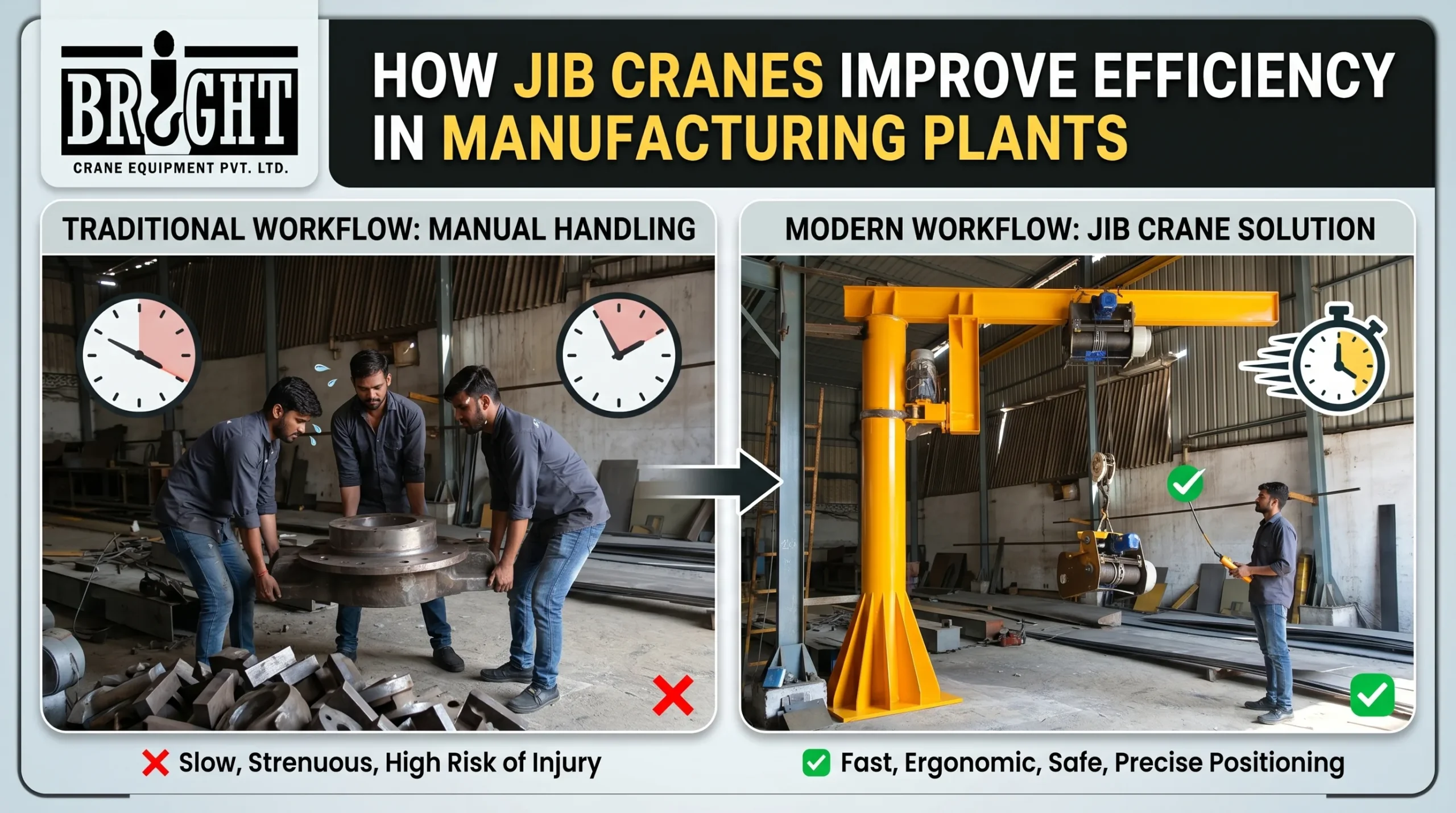
In today’s tough manufacturing world, downtime and extra manual work mean lost money. Jib cranes are a cost-effective way to boost material handling efficiency on the shop floor. The numbers show their effectiveness clearly.
Adding a jib crane can transform your team’s work, whether you run an automotive assembly line, an aerospace workshop, or a heavy fabrication unit. This guide shows how jib cranes boost efficiency in manufacturing plants. We’ll cover their mechanics, benefits, types, and real-world uses.
What Is a Jib Crane? A Quick Overview
A jib crane is an overhead lifting system comprising a horizontal arm – called the jib or boom – mounted to a vertical mast, wall, or structural column. A hoist (electric chain hoist or wire rope hoist) rides along the jib arm to lift, lower, and transport loads within a defined arc.
Unlike full-span EOT (Electric Overhead Travelling) cranes that cover an entire bay, jib cranes are engineered for workstation-level precision. They serve individual operator zones, making them ideal for repetitive lifting tasks at assembly stations, loading docks, or machining cells.
Types of Jib Cranes Used in Manufacturing
Knowing which type fits your setup is the first real step toward getting the most out of your investment. The main variants are:
1. Wall-Mounted Jib Crane
Fixed directly to a structural wall or column, this type works well where floor space is tight. It typically offers a rotation arc of up to 180–200°. The wall-mounted jib crane is a popular choice in welding bays and machining stations. It gives operators lateral reach while keeping walkways clear.
2. Freestanding / Pillar-Mounted Jib Crane
Anchored directly into a concrete floor via a steel mast, this variant provides a full 360° rotation, giving maximum coverage across the work cell. It’s a practical choice for central spots in a manufacturing bay or wherever wall mounting simply isn’t an option.
3. Mast-Type Jib Crane
Here, the mast is supported at both the top and bottom, which allows for taller lifts and heavier loads. You’ll commonly find this type in assembly areas with high ceilings and bulky components, think engine block assembly or heavy fabrication work.
4. Articulating (Double-Arm) Jib Crane
This one features two booms, an inner and an outer arm that pivot independently. That setup greatly expands the working radius, letting the operator reach into tight spaces that a rigid-boom jib simply can’t access.
Quick Comparison: Jib Crane Types
Different jib crane types differ based on rotation capacity, floor space impact, and typical usage areas. The table below shows how each type fits different layouts, including wall-mounted options for edge workstations and articulating models for tight or complex spaces.
| Type | Rotation | Floor Space Impact | Best For |
|---|---|---|---|
|
Wall-Mounted |
Up to 200° |
None |
Workstations along walls |
|
Freestanding |
360° |
Minimal (pillar only) |
Central bay positions |
|
Mast-Type |
Up to 360° |
Minimal |
High-clearance heavy lifts |
|
Articulating |
360°+ |
Minimal |
Confined spaces, extended reach |
7 Ways Jib Cranes Directly Improve Manufacturing Efficiency
Efficiency in manufacturing is determined by the speed and accuracy of the movement of materials on the shop floor. Jib cranes enhance efficiency through faster handling, accurate positioning, and minimizing human involvement.
1. Faster Material Handling Cycles
Jib cranes let operators lift and position parts in seconds rather than minutes. The quick swing and precise lift control cut out the delays that come with manual carrying or waiting for a forklift.
2. Precision Load Placement
Unlike forklifts or gantry systems, a jib crane allows inch-perfect positioning. This matters a great deal in assembly tasks where components need to be lowered onto fixtures or mounts with high accuracy.
3. Reduced Workplace Injuries
Manual lifting of heavy components is one of the leading causes of musculoskeletal injuries on the shop floor. Jib cranes reduce this risk significantly, lowering workers’ compensation claims and helping keep your team healthy and present.
4. Maximised Floor Space
A jib crane’s footprint is just the mast or wall bracket that the arm swings overhead. That keeps valuable floor space free for workbenches, machinery, and safe personnel movement.
5. Works Seamlessly with EOT Cranes
Jib cranes are often paired with double girder EOT cranes for facility-wide coverage. The EOT crane handles long-span transport; the jib crane takes care of precise workstation placement.
6. Low Maintenance Requirements
Jib cranes have a comparatively simple mechanical design. With fewer moving parts than bridge cranes, scheduled maintenance is straightforward, and that means less unplanned downtime.
7. Operator Ergonomics & Productivity
When workers aren’t worn out from manual handling, their focus, accuracy, and output quality naturally improve. Jib cranes translate directly into higher per-operator productivity across every shift.
Industry-Wise Applications of Jib Cranes
Jib cranes are used across many industries, depending on the load type, precision required, and available space. Here’s a closer look at how different sectors put them to work.
Automotive Manufacturing
In the automotive industry, jib cranes play a key role in engine installation, door-panel assembly, and moving parts along the production line. They place heavy assemblies exactly where workers need them, cutting cycle times at each station and improving safety for personnel handling large, uneven components.
Aerospace Industry
Precision is everything in aerospace. Jib cranes are used to lift and position wings, fuselage sections, and turbine assemblies both in manufacturing and MRO (Maintenance, Repair & Overhaul) operations. Their ability to manoeuvre within tight assembly jigs makes them genuinely indispensable. According to industry guidance from the U.S. Occupational Safety and Health Administration (OSHA), proper crane selection and operation are critical factors in preventing workplace fatalities in heavy manufacturing.
Heavy Fabrication & Welding
Welders rely on jib cranes to rotate and reposition workpieces without interrupting their workflow. When each welding bay has a wall-mounted jib crane, the operator can swing the component into the ideal welding position on their own, reducing setup time and improving weld quality.
Warehousing & Logistics
In warehouse settings, jib cranes mounted at loading bays speed up the loading and unloading of trucks considerably. Paired with a wire rope hoist or chain hoist, they can safely handle pallets, machinery crates, and bulk containers.
Construction Sites
On construction sites, jib cranes move materials to spots that are otherwise hard to reach, hoisting steel beams into place or lifting HVAC units to upper floors. Their flexibility makes them a practical solution when larger tower cranes aren’t financially justified.
Shipbuilding
Marine yards regularly use jib cranes to lift hull sections, propellers, and deck equipment during vessel construction. Freestanding models with 360° rotation help position large parts onto structures that are only partially assembled. The International Maritime Organisation (IMO) recognises proper lifting equipment as a key safety requirement in shipyard operations.
How to Choose the Right Jib Crane for Your Manufacturing Plant
Picking the right jib crane comes down to honestly evaluating what your facility actually needs. Here are the key parameters to work through:
Required Load Capacity: Start with the heaviest weight you’ll need to lift, factoring in the load itself, rigging hardware, and a safety margin. A common rule of thumb is to add 20–25% above the rated load.
Rotation Angle: Do you need full 360° coverage with a freestanding unit, or will a 180° wall-mount do the job for your workstation layout?
Jib Height (Under-Boom Height): Measure from the floor to the lowest point of the boom. This determines your maximum hook height once the hoist is attached.
Overall Height & Ceiling Clearance: Make sure the mast and boom won’t conflict with overhead obstacles like lights, sprinkler heads, or HVAC ducts.
Power Requirements: Will you need an electric hoist with variable speed control, or is a manual or pneumatic hoist sufficient for your application?
Mounting Constraints: Verify that your floor or walls can handle the base reaction forces the crane will generate.
Environmental Conditions: For outdoor use, corrosive environments, or hazardous (ATEX) zones, you’ll need appropriate materials and certifications.
When in doubt, always consult an experienced crane manufacturer. The team at Bright Crane Equipment conducts thorough site assessments before recommending a solution, ensuring you get a crane engineered precisely for your application.
| Feature | Jib Crane | EOT Bridge Crane | Forklift | Gantry Crane |
|---|---|---|---|---|
|
Coverage Area |
Workstation arc |
Full bay span |
Full facility |
Defined track |
|
Precision Placement |
95% |
85% |
50% |
80% |
|
Floor Space Used |
Minimal |
None (overhead |
High |
Medium |
|
Installation Cost |
Low–Medium |
Medium–High |
Low (purchase) |
Medium |
|
Maintenance |
Low |
Medium |
High |
Medium |
|
Best For |
Workstations |
Whole-bay handling |
Horizontal transport |
Outdoor/no-rail |
Why Choose Bright Crane Equipment for Your Jib Crane?
Not all jib cranes are built the same. Suppliers vary quite a bit when it comes to engineering quality, material grade, welding standards, and after-sales support. Here’s what sets Bright Crane Equipment Pvt Ltd apart as India’s trusted jib crane manufacturer:
Custom Design Capability: Every jib crane we build is designed around your exact requirements, load capacity, jib height, rotation arc, and working environment. There are no off-the-shelf compromises here.
In-House Manufacturing: Fabricated at our facility at 95, Pushpak Ind. Estate, Phase 1, Vatva GIDC, Ahmedabad, Gujarat, giving us full quality control at every stage of production.
Expert Installation Team: Our technicians manage the entire installation process, including commissioning and operator training, so your team is ready to be productive from day one.
Compliance & Safety: Our cranes are built to Indian Standards (IS) and follow leading global practices for design and structural integrity.
After-Sales Support: Dedicated service support keeps downtime to a minimum. You can reach us at +91 9327391266 or brightcraneequipment@gmail.com.
Trusted Across Industries: We work with clients in automotive, aerospace, construction, warehousing, and heavy engineering across India.
Conclusion: Invest in Efficiency with the Right Jib Crane
The evidence is clear: jib cranes are among the highest-ROI investments a manufacturing plant can make. By eliminating inefficient manual handling, reducing injury risk, and enabling precision workstation-level lifting, they directly accelerate throughput, protect your workforce, and contribute to a leaner, safer production environment.
Whether you’re setting up a new facility or optimising an existing one, the right jib crane properly specified and professionally installed will pay for itself many times over in reduced labour costs, fewer injuries, and higher output quality.
Frequently Asked Questions (FAQs) About Jib Cranes
What is a jib crane, and how does it work?
How much weight can a jib crane lift?
What are the main types of jib cranes used in manufacturing?
How do jib cranes improve efficiency in manufacturing plants?
Can jib cranes be used alongside EOT cranes?
What industries use jib cranes?
How do I choose the right jib crane for my facility?
Where can I buy a quality jib crane in India?
Ready to take the next step?
Explore our full range of jib cranes or contact our engineering team today for a no-obligation consultation.