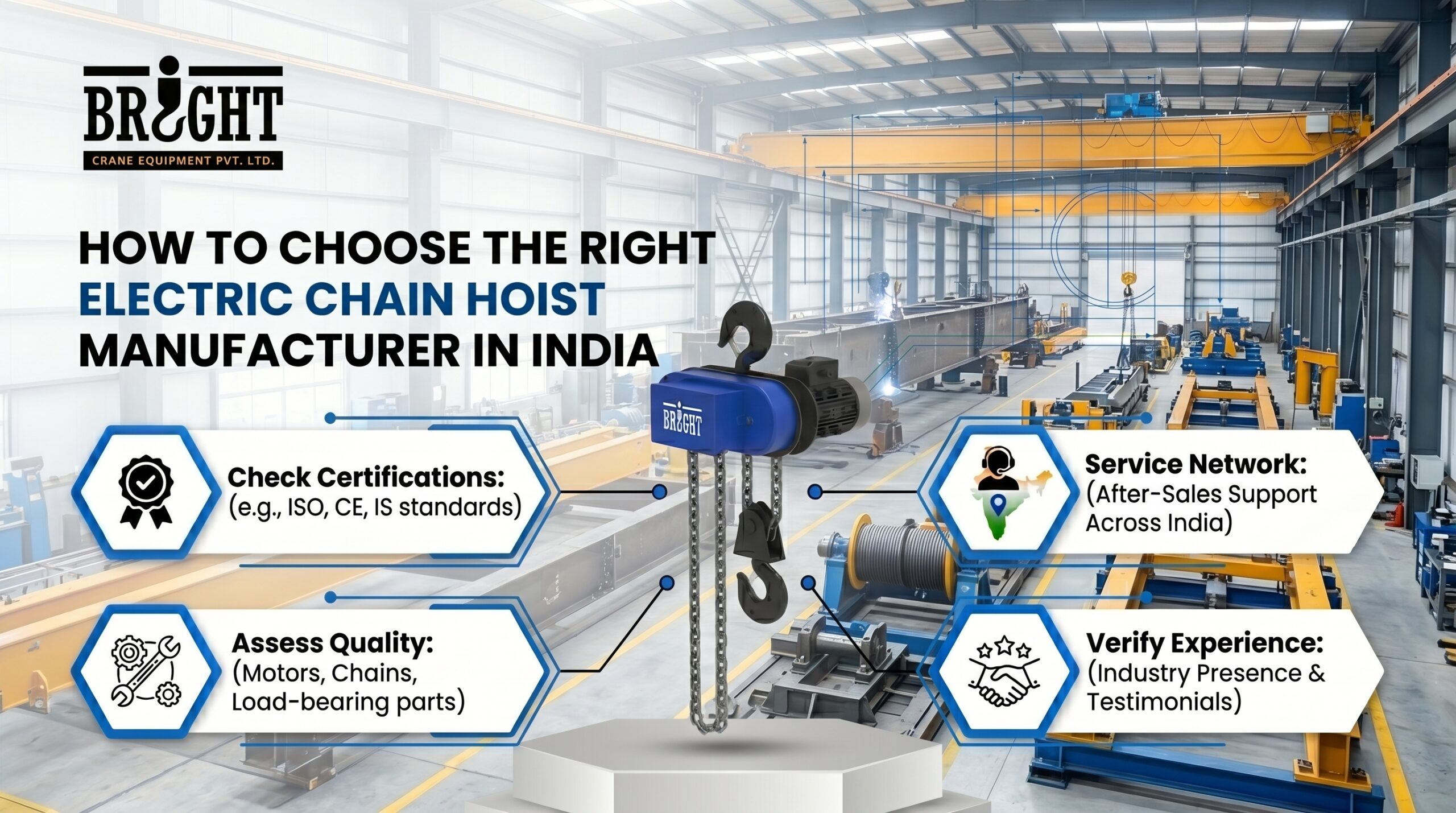
Industrial lifting operations involve a lot more than simply having the right heavy equipment on site. The safety of your workers, the durability of your machinery, how much load it can handle, and whether it will hold up years down the line, all of it comes back to one fundamental decision: picking the right hoist system. That is exactly why selecting the right electric chain hoist manufacturer in India carries so much weight for factories, warehouses, workshops, and construction units.
A lot of businesses fall into the same trap, they look at the price tag and stop there. And honestly, that thinking makes sense on the surface. But a hoist that costs less upfront can quietly drain resources through poor performance, unexpected breakdowns, and maintenance bills that keep piling up. Taking a little extra time to evaluate manufacturers on quality, support, and technical capability is almost always the smarter path.
This guide covers the factors that actually matter when industries are looking to select an industrial hoist manufacturer for safe and efficient material handling operations.
Understand the Application and Operational Requirements
The first step is not browsing catalogues or comparing prices. It is sitting down and honestly evaluating what the lifting application actually demands and what the day-to-day operational requirements look like. Different industries work under very different conditions; load weights, production cycles, floor layouts, and operational intensity can vary dramatically from one facility to the next.
Evaluate Load Capacity and Duty Cycle
Here is something that catches many businesses off guard: they select lifting equipment based on what they need today, without thinking about where operations might be in two or three years. Production tends to grow. Loads tend to get heavier. Shifts tend to get longer.
Before finalising anything, businesses should think through the following:
- Maximum lifting load
- Daily operating hours
- Frequency of lifting cycles
- Future expansion requirements
- Type of material handling operations
Getting the lifting capacity right from the beginning improves operational efficiency and keeps industrial load handling genuinely safer over time.
And the duty cycle is not something to overlook, either. A light-duty hoist might hold up fine when it is used occasionally, but throw it into a continuous heavy-duty environment and the cracks start to show quickly, whether that is in motor performance, braking reliability, or how well the system handles heat buildup.
Consider Working Conditions Before Finalising Equipment
The environment a hoist operates in has a direct say in how long it lasts and how well it performs. A hoist running in a clean, temperature-controlled warehouse faces completely different challenges than one exposed to dust, high heat, or outdoor humidity day after day.
A reliable Electric Chain Hoist Manufacturer in India should not just hand over a brochure; they should genuinely understand the conditions the equipment will face, including:
- Indoor and outdoor operating conditions
- Heat exposure levels
- Dust-prone environments
- Continuous production requirements
- Lifting safety expectations
When a manufacturer truly understands the environment, the recommendations they make around motor capacity, chain quality, and protection systems are grounded in reality rather than default settings.
For operations that also require overhead runway systems, exploring integrated solutions like EOT Cranes alongside chain hoists ensures your entire lifting setup is matched to the application — not just individual components.
Check Manufacturing Quality and Component Reliability
An electric chain hoist does not have an easy life. It works under constant mechanical stress, often for long hours, day after day. When the manufacturing quality is not up to the mark, the problems tend to surface in ways that are both dangerous and expensive – chain elongation, brake failure, motor overheating, and hoist maintenance costs that climb faster than anyone budgeted for.
Importance of High-Quality Components
A well-built heavy-duty electric chain hoist from a professional manufacturer will typically be put together with the following:
- Alloy steel load chains
- Heavy-duty motor systems
- Durable gearbox assemblies
- Electromagnetic braking systems
- Thermal overload protection
Opting for cheaper components to shave off some initial cost is a gamble that rarely pays off. The savings upfront tend to disappear quickly once real-world operational stress starts revealing the weaknesses.
A practical example, chains made from substandard material will start stretching during continuous lifting cycles. And a braking system that has not been built to handle sudden power interruptions is a genuine safety concern, not just an inconvenience.
Verify Testing and Safety Standards
Reputable material handling equipment manufacturers do not simply build the equipment and ship it out. There is a proper inspection and testing process that should happen before anything leaves the facility, and buyers should not hesitate to ask about it.
Key checks that should be standard practice include:
- Load testing
- Brake performance testing
- Motor efficiency inspection
- Chain durability testing
- Safety limit verification
These are not formalities. They are what stand between a piece of equipment that performs reliably for years and one that creates problems from day one.
The Directorate General of Factory Advice Service & Labour Institutes (DGFASLI), under India’s Ministry of Labour and Employment, outlines factory safety requirements that directly govern how industrial lifting equipment must be tested and maintained – a benchmark every serious manufacturer should meet.
Looking for reliable lifting solutions for industrial operations?
Choose Bright Crane Equipment for engineering-focused lifting solutions designed to support operational safety, efficient material handling operations, and dependable long-term industrial performance.
Evaluate Technical Expertise and Industry Experience
Not all lifting applications are the same, and not all manufacturers understand that. A hoist working in a steel fabrication plant needs to be configured very differently from one being used in a warehouse or on an assembly line. The loads, the operating patterns, the environmental conditions, everything differs.
Why Technical Consultation Matters
Manufacturers who have spent years working across different industrial environments bring something that newer or more generic suppliers simply cannot, a real-world understanding of:
- Continuous-duty operations
- Load handling challenges
- Installation limitations
- Production workflow requirements
- Industrial lifting equipment performance standards
Without that kind of informed consultation, it is easy to walk away with a lifting system that technically works but does not actually fit how the business operates.
Review Previous Industrial Projects
Past experience is one of the most honest indicators of what a manufacturer is actually capable of. Before making a final decision, it is worth digging into the kinds of projects they have worked on and the industries they have served.
Manufacturers with hands-on experience across sectors like:
- Engineering plants
- Steel fabrication industries
- Warehousing facilities
- Manufacturing units
- Heavy material handling sectors
bring a depth of practical knowledge that makes a real difference, not just in the product they deliver, but in how well they understand what you actually need.
Evaluate After-Sales Support and Spare Part Availability
Even the best-built equipment needs attention over time. Inspections, wear-and-tear replacements, and occasional technical support, these are just part of keeping industrial lifting equipment running the way it should. After-sales support is not a bonus feature; it is a core part of the value a manufacturer provides.
Importance of Service Support
Many industries have learned this the hard way. Operations grind to a halt not because the hoist completely failed but because:
- A spare part was not available
- Technical support took too long to respond
- Maintenance visits were delayed
- Nobody was available to help with installation issues
Each of these situations costs time, money, and, in some cases, safety.
Important Points to Verify
Before signing anything, it is worth confirming:
- Spare part availability
- Installation assistance
- Technical support response time
- Warranty coverage
- Hoist maintenance support
A manufacturer that stands behind their product with solid after-sales service is not just selling equipment; they are offering peace of mind for the long haul.
Important Factors to Evaluate Before Finalising a Manufacturer
Before committing to a supplier, it helps to run through a clear checklist – both technically and operationally.
Key Evaluation Points
Some practical questions worth asking:
- Do they conduct proper load testing before delivery?
- Are industrial-grade components standard or an upsell?
- Is technical consultation part of the process or an afterthought?
- Do they explain duty classifications in plain terms?
- Will they support installation and ongoing maintenance?
- Is their manufacturing quality consistent, not just impressive in demos?
- What does their long-term service support actually look like?
These questions cut through the marketing and get to what really matters when you are making a decision this important.
Focus on Long-Term Operational Value
The initial price of a hoist is easy to see. The real cost of owning one, when you factor in maintenance, downtime, and how long it actually lasts, takes longer to show up but ultimately matters much more.
A reliable industrial electric chain hoist that is built properly and supported well helps businesses run.
- Better operational efficiency
- Improved workplace safety
- Reduced maintenance costs
- Lower downtime
- Longer equipment service life
Businesses that make decisions based on long-term value consistently come out ahead of those chasing the lowest upfront number.
Conclusion
Finding the right electric chain hoist manufacturer in India is not a decision to take lightly or rush through. Manufacturing quality, technical know-how, operational reliability, safety standards, and after-sales support all deserve serious consideration. A lifting system that is well-matched to the application improves workplace safety, keeps industrial load handling running smoothly, and saves a lot of headaches over the years. The goal should be finding a manufacturer who genuinely understands what industrial lifting looks like in practice — not just on paper. Bright Crane Equipment builds lifting solutions with exactly that in mind, designed to support safe, efficient, and reliable material handling operations across a wide range of industrial environments.