

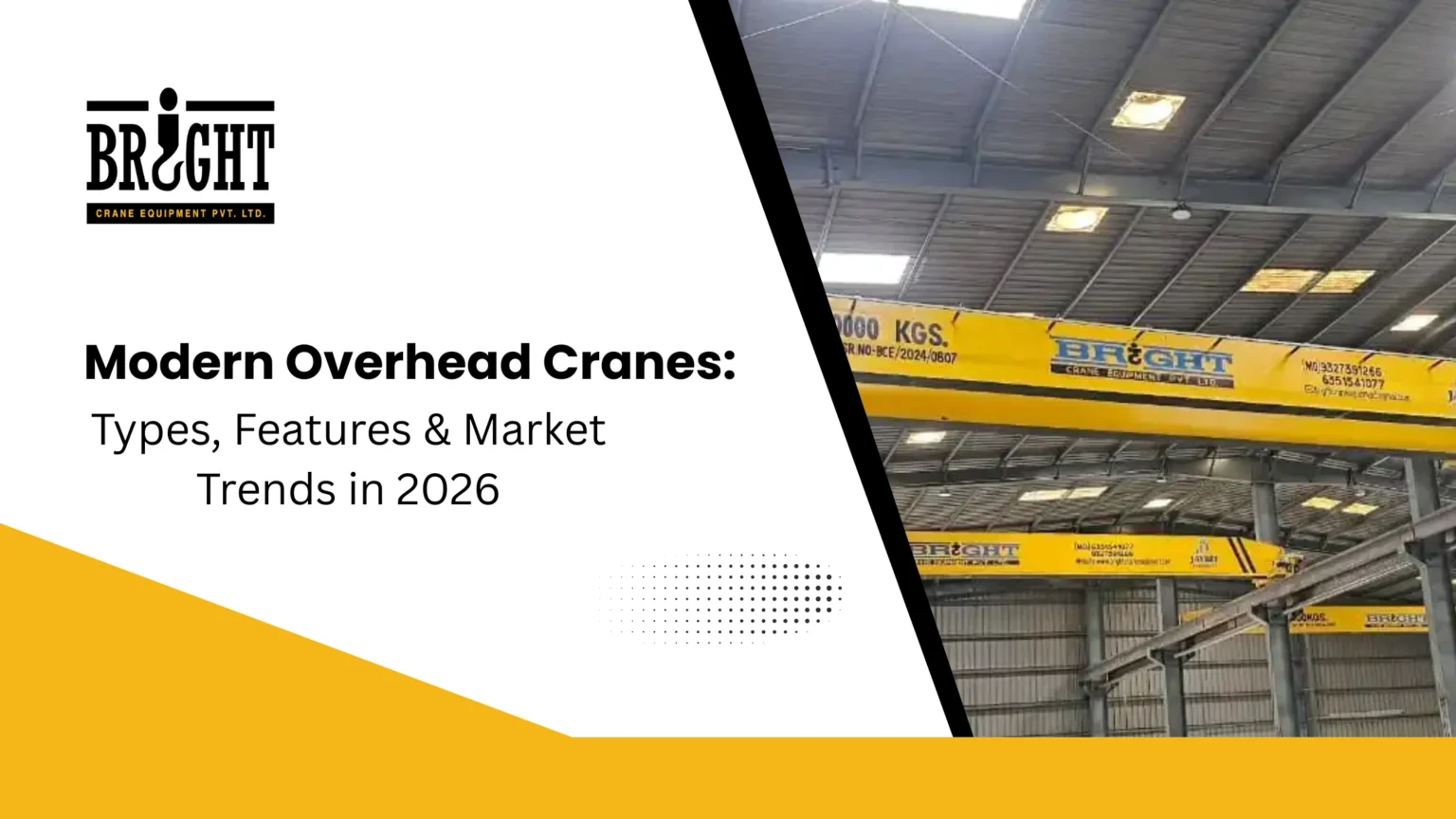
In today’s fast-evolving industrial landscape, overhead cranes have become indispensable for efficient material handling. From manufacturing plants to warehouses and construction sites, modern overhead cranes are designed to improve productivity, enhance safety, and reduce manual labor. With rapid technological advancements, these cranes are no longer just lifting machines – they are smart, efficient systems tailored for diverse industrial needs.
Types of Modern Overhead Cranes
There are several types of overhead cranes available in the market, each designed for specific applications:
- Bridge Cranes
Also known as EOT Cranes, bridge cranes are the most commonly used type in factories and heavy industries. They consist of a bridge that travels along runway beams, allowing movement in multiple directions. They are ideal for lifting heavy loads across large areas. - Gantry Cranes
Gantry cranes are similar to bridge cranes but are supported by legs that move on wheels or tracks. These cranes are widely used in outdoor applications such as shipyards, construction sites, and container handling. - Jib Cranes
Jib cranes are compact and versatile, featuring a rotating arm mounted on a wall or pillar. They are perfect for localized lifting tasks and are commonly used in workshops and small manufacturing units. - Monorail Cranes
Monorail cranes operate on a single rail system and are best suited for repetitive lifting tasks along a fixed path. They are commonly found in assembly lines and production facilities. - Workstation Cranes
Designed for lighter loads, workstation cranes are ergonomic systems that improve efficiency in small work areas. They are often used in warehouses and assembly operations.
Key Features of Modern Overhead Cranes
Modern overhead cranes are equipped with advanced features that enhance performance and safety:
- Automation & Smart Controls: Integration with PLC systems and remote controls allows precise and efficient operation.
- IoT & Predictive Maintenance: Sensors monitor crane performance in real time, helping prevent breakdowns and reduce downtime.
- Enhanced Safety Systems: Features like anti-collision systems, overload protection, and emergency stop functions ensure safer operations.
- Energy Efficiency: Modern cranes use regenerative drives and energy-saving motors to reduce power consumption.
- Customization: Cranes can be tailored to specific industrial requirements, including load capacity, span, and lifting height.
Market Trends Shaping the Industry in 2026
The overhead crane industry in 2026 is witnessing strong growth, driven by automation, infrastructure development, and rising demand for efficient material handling solutions. Backed by data and market insights, several key trends are shaping the future of this industry.
- Strong Market Growth Globally
The global overhead crane market is expected to reach around $5.33 billion in 2026, growing at a CAGR of approximately 6.5%. This steady growth highlights increasing demand across manufacturing, logistics, and construction sectors. - Long-Term Expansion Outlook
Industry projections suggest the market could grow to $6.3–$7+ billion by 2030–2033, with a consistent growth rate of 4.5% to 7% CAGR.
This indicates sustained investment in advanced lifting technologies and smart crane systems. - Rise of Automation & Smart Manufacturing
Automation is one of the biggest drivers, with industries increasingly adopting smart factories. The demand for automated cranes is directly linked to productivity improvements and reduced labor dependency, contributing significantly to market growth. - Asia-Pacific Leading the Market
The Asia-Pacific region holds over 36% of the global market share, driven by rapid industrialization in countries like India and China.
In India alone, the overhead crane market is projected to grow at a CAGR of 10.8%, making it one of the fastest-growing regions globally. - Boom in Logistics & E-commerce
The logistics sector is expanding rapidly, with an estimated 7.5% annual growth rate, increasing the demand for automated warehousing systems and overhead cranes. - Infrastructure & Construction Growth
Global infrastructure investments exceeding $1 trillion in emerging markets are driving crane demand for heavy lifting applications in construction and development projects.
Shift Toward Smart & Energy-Efficient Cranes
Modern cranes now feature IoT integration, predictive maintenance, and energy-efficient drives. These innovations not only improve operational efficiency but also align with global sustainability goals.
Conclusion
Modern overhead cranes are revolutionizing material handling by combining robust engineering with smart technology. With various types available to suit different applications, along with advanced features and evolving market trends, these cranes are becoming more efficient, safe, and adaptable than ever before. As industries continue to embrace automation and digitalization, the demand for innovative overhead crane solutions is set to grow, making them a critical component of the future industrial ecosystem.