
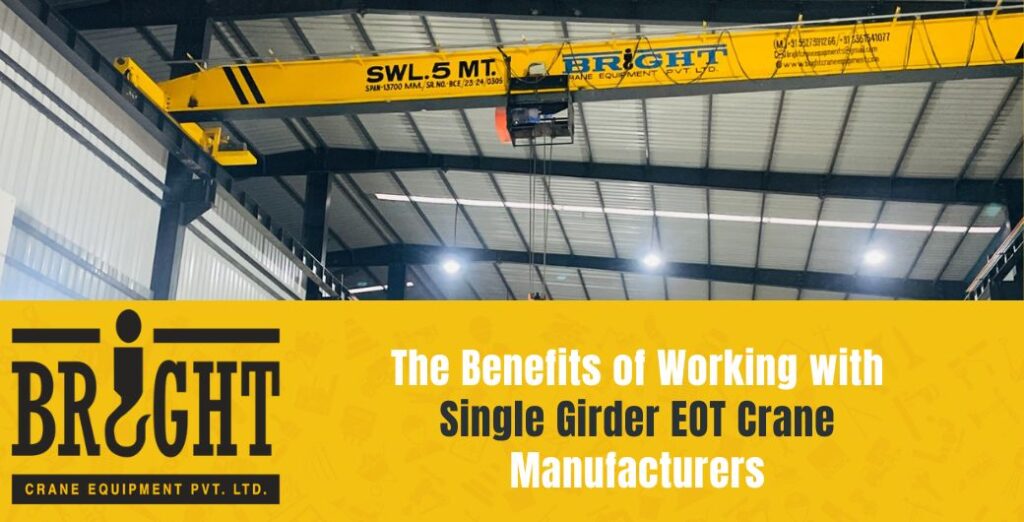
In today’s industrial setting, an efficient material handling system has a visible impact on productivity, safety, and cost management. The single girder overhead bridge crane stands out as one of the most widely employed lifting technologies in this area because of its space-saving and efficient working capabilities. Industries requiring a trusted single girder overhead crane supplier must be aware of the pros and cons of this lifting type.
This blog will explore the working mechanisms of a single girder overhead bridge crane, the type of environment it is best used in, and what needs to be considered before the setup is done.
What is a Single Girder Overhead Bridge Crane?
A single girder overhead bridge crane has one main horizontal beam (girder) with the end trucks supporting the girder with rails for its movement. A hoist travels on the lower flange of the girder to lift and move a load across the workplace.
Key Components:
- Single main girder
- The Electric Wire Rope or Chain Hoist
- carriages with wheels at the end
- Runway rails and control system
Advantages of Single Girder Overhead Bridge Cranes
- Cost-Effective Lifting Solution
One of the biggest benefits of single girder crane is affordability. Single girder cranes require less steel and simpler structures, reducing:
Maintenance overhead
Initial equipment cost
Installation expenses
- Lightweight and Space-Saving Design
Because of their space saving design, these cranes are the best choice for facilities with limited headroom.
Efficient use of vertical space
Lower building load requirements
Smaller runway beam size
- Easy Installation and Maintenance
Single girder cranes are quicker to install and easier to service.
Lower spare parts cost
Fewer components to inspect
Reduced downtime during maintenance
Power Efficiency
With lighter self-weight and smaller hoists, these cranes consume less power, making them suitable for energy-conscious operations.
Common Applications in the Crane Industry
Single girder overhead bridge cranes are generally employed in the following applications:
- Manufacturing units
- Warehouses & Logistic Centers
- Assembly lines
- Workshops, Fabrication Shops
- Light engineering industries
They are most useful for repeated lifting of moderately heavy weights.
Limitations of Single Girder Overhead Bridge Cranes
Limited Load Capacity
Single girder cranes typically handle lighter loads compared to double girder cranes.
- Not suitable for extremely heavy-duty lifting
- Capacity usually limited to medium ranges
Reduced Hook Height
Since the hoist runs under the girder, maximum lifting height can be slightly lower than double girder systems.
Not Ideal for Continuous Heavy-Duty Use
For industries with:
- Very high lifting frequency
- Large spans
- Harsh operating conditions
Features of Single Girder Crane
- Load Capacity: Light to medium
- Cost: Lower
- Installation: Faster and simpler
- Maintenance: Easy
- Hook Height: Slightly lower
- Best For: Small to mid-size facilities
Factors to Consider Before Choosing a Single Girder Crane
Load Requirements
The weights of the maximum and average loads need to be examined.
Reach and Lifting Height
Verify whether building dimensions, available height, and runway length are adequate.
Operating Frequency
Occasional or moderate lifts are considered optimal for this kind of crane.
Future Expansion
Evaluate whether future output growth might necessitate increased capacity or automation.
Why Choosing the Right Crane Supplier Matters
Choosing an experienced Single girder overhead crane supplier that provides safety and reliability:
- Safety standards compliance
- Custom design of cranes
- Dependable after-sales support
- Long-term efficiency of operation
A reliable supplier will have to bridge the gap in crane specification to suit your real working conditions and not a hypothetical complete approach.
Conclusion
Single-girder overhead bridge cranes provide a very good balance between cost-effective, efficient, and user-friendly means of handling light and medium-duty materials. Certainly not appropriate for all heavy industry applications, they continue to be an intelligent choice for a great number of manufacturing and warehouse environments. With solid support from a qualified supplier and thorough consideration of operational needs, clients can ensure top performance and return on investment from the solutions provided by the Bright Crane Equipment Company.