
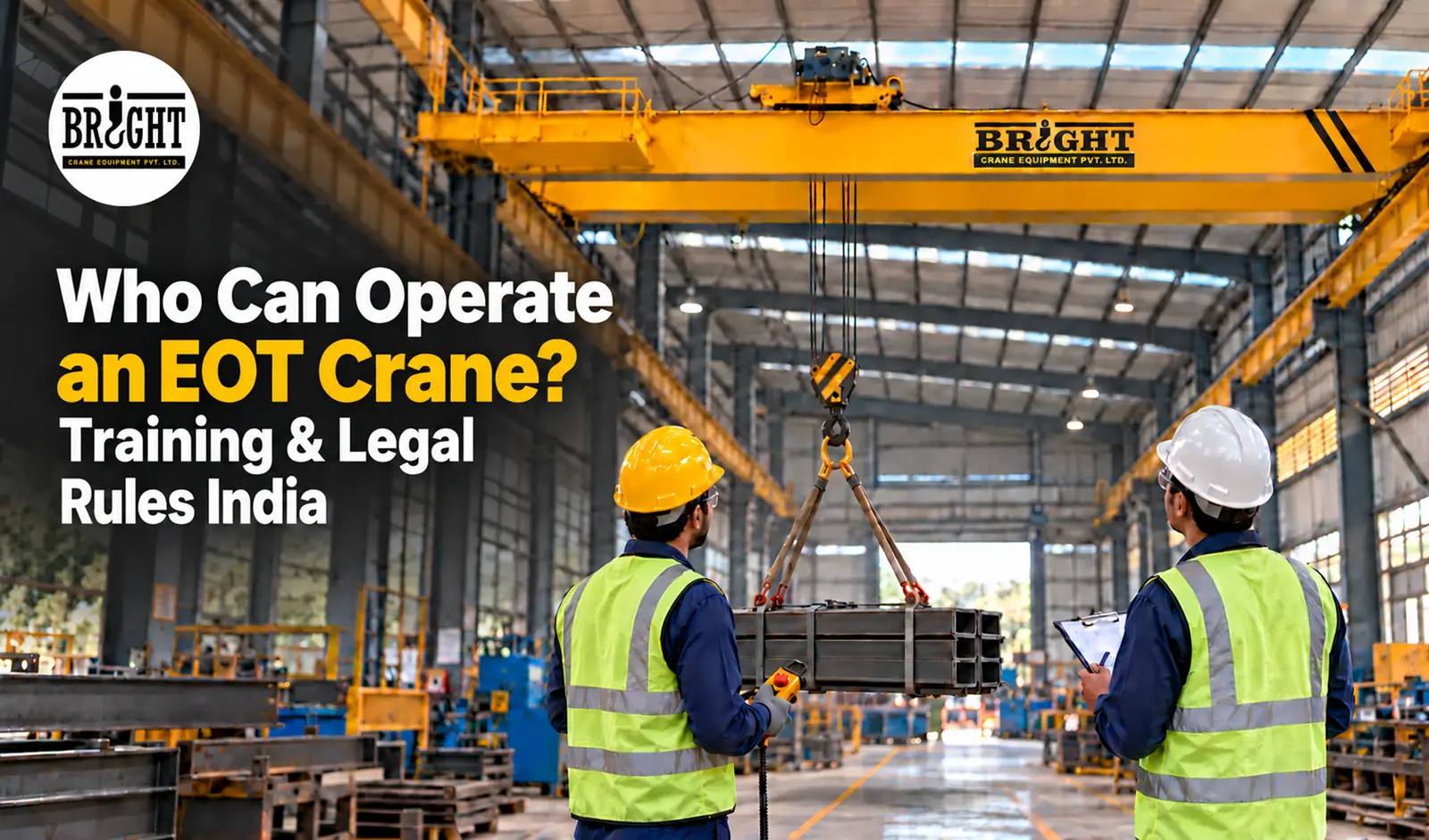
In India, an EOT crane should be run only by a person who is over 18, medically fit, trained on that type of crane and authorised in writing by the employer. There is no government licence for EOT crane operators. The factory is responsible for training, authorisation and keeping the records.
On many shop floors, the pendant hangs within reach of anyone who walks past. A helper needs to shift a die, nobody else is free, so he picks up the pendant. Most days nothing goes wrong. But if a load drops or a crane hits a column, the first question in any inquiry is simple: was this person trained and authorised to operate the crane?
This guide answers that question for factory owners, plant heads and safety officers. It covers who is eligible to work as an EOT crane operator, what the Indian code of practice recommends, what changed when the OSH Code replaced the Factories Act in November 2025, and which records you should keep. It is written by the team at Bright Crane Equipment, an Ahmedabad manufacturer of EOT cranes, hoists, jib cranes and goliath cranes.
In this guide:
- Is there a licence to operate an EOT crane in India?
- Who is eligible to become an EOT crane operator?
- Which Indian laws and standards apply?
- What training should an operator get?
- What should an operator check every shift?
- What are the employer's legal responsibilities?
- Common mistakes factories make
Is There a Licence to Operate an EOT Crane in India?
No. India has no RTO-style licence or national certificate for EOT (overhead) crane operators. A person becomes eligible when the employer trains them, checks their fitness and authorises them in writing to run a specific crane. The legal duty to make sure this happens sits with the employer, not the operator.
This confuses people because mobile cranes work differently. A hydra or a truck-mounted crane drives on public roads, so its driver also needs a valid driving licence for that class of vehicle, on top of crane training. An EOT crane never leaves its runway, so road licensing does not apply to it.
In place of a licence, Indian practice relies on three separate roles. Management names an appointed person to manage lifting work. The appointed person authorises trained operators. A separately recognised competent person examines the crane itself. Mixing up these three roles is a common compliance gap, so it helps to see them side by side.
| Role | Who it is | What they do |
|---|---|---|
| Crane operator (driver) | A trained worker authorised for a specific crane | Runs the crane as per the manufacturer's manual and the lift plan |
| Appointed person | A competent person named by management (IS 13367, clause 4.2) | Plans lifts, selects the crane and authorises operators |
| Competent person (examiner) | An engineer recognised by the state factory inspectorate | Tests and thoroughly examines cranes and lifting tackle, and signs the certificates |
Who Is Eligible to Become an EOT Crane Operator?
Under IS 13367 (Part 1), a crane driver should be more than 18 years old, medically fit (especially in eyesight, hearing and reflexes), trained on the type of crane being driven, familiar with the standard hand signals, and formally authorised by the appointed person. A trainee under 18 may operate only under the direct supervision of a competent person.
IS 13367 (Part 1):1992 is the Indian code of practice for the safe use of cranes. It is a code of practice rather than a law. Even so, it is the clearest Indian document on who should run a crane, and it is the benchmark an audit or accident inquiry is likely to compare your practice against.
The standard also expects the authorisation to be a real decision, not a formality. The appointed person should consider the operator's competence, training, recent experience and fitness before giving it, and keep a record of the operator's training and experience.
| Requirement | What IS 13367 (Part 1) recommends | How you show it |
|---|---|---|
| Age | More than 18 years; under 18 only as a supervised trainee | Age proof in the personnel file |
| Medical fitness | Fit in eyesight, hearing and reflexes; able to judge distances, heights and clearances | Medical certificate, renewed at intervals of not more than 5 years |
| Training | Trained on the type of crane being driven, including its safety devices | Training record showing the crane type, trainer and date |
| Signals | Understands the slinger's and signaller's duties and the standard signal code | Practical check during training |
| Fire safety | Familiar with the fire appliances on the crane | Training record |
| Authorisation | Authorised by the appointed person | Signed authorisation letter |
Note the words "type of crane". An operator trained on a pendant-controlled single girder crane is not automatically ready for a cabin-operated double girder crane or an outdoor goliath. If your plant runs different types of EOT crane, train and authorise operators for each type separately.
Which Indian Laws and Standards Apply to EOT Crane Operation?
Since 21 November 2025, the main law is the Occupational Safety, Health and Working Conditions Code, 2020 (OSH Code), which replaced the Factories Act, 1948. Detailed rules come from each state; in Gujarat, these are the Gujarat OSH Rules, 2025. Indian Standards such as IS 13367 and IS 3177 set the technical benchmarks.
For decades, crane safety in factories came under Section 29 of the Factories Act. It required lifting machines to be thoroughly examined by a competent person at least once in every 12 months, with the results kept in a register. The OSH Code merged the Factories Act and 12 other labour laws into one code. Many training slides and blogs still quote only the Factories Act, so it is worth updating your safety SOPs.
In Gujarat, the Gujarat OSH Rules, 2025 were published in the Government Gazette on 12 June 2025. They replaced the Gujarat Factories Rules, 1963 and came into force along with the Code. Confirm the current examination interval and register format with your recognised competent person or the local Inspector-cum-Facilitator. Do not rely on an old checklist.
| Law or standard | What it covers | Status |
|---|---|---|
| OSH Code, 2020 | Employer duties, workplace safety, accident reporting | In force from 21 November 2025 |
| Gujarat OSH Rules, 2025 | State rules on registers, competent persons and accident notices | Gazette dated 12 June 2025; replaced the Gujarat Factories Rules, 1963 |
| IS 13367 (Part 1):1992 | Safe use of cranes: roles, operator attributes, signals | Code of practice |
| IS 13583 (Part 1) / ISO 9926-1 | Training of crane drivers | Training standard |
| IS 16856:2018 / ISO 23813 | Training of appointed persons | Training standard |
| IS 3177 | Design of EOT cranes, including duty class | Design standard |
The design standard matters to operators too. A crane's duty class tells you how hard and how often it is meant to work. An operator who understands it will not treat a light-duty crane like a production crane.
Construction sites are different. On building and construction work, cranes also come under construction-specific rules, which have their own requirements for operators and lifting appliances. This guide covers EOT cranes inside factories and workshops.
What Training Should an EOT Crane Operator Get?
Good EOT crane training has three parts: classroom basics (safe working load, duty class, signals), supervised practical lifts on the actual crane, and refresher training whenever the crane, the job or the operator's fitness changes. Record every session with the crane type, the trainer's name and the date.
Classroom training
The operator should learn to read the safe working load (SWL) plate and understand why a crane must never be overloaded, even "just once". They should learn the standard hand signals, the basics of slinging so they can spot bad rigging before lifting, and what to do if the power fails or a brake slips. IS 13583 (Part 1), the Indian adoption of ISO 9926-1, sets out a framework for training crane drivers that employers can follow.
Practical training on the actual crane
The practical part should happen on the crane the person will run, under the eye of a competent person. It covers long travel and cross travel, smooth starts and stops so the load does not swing, inching for exact positioning, testing the limit switches, and using the emergency stop. Operators who will use a radio remote also need to learn where to stand so they can always see the load and keep clear of its path. Our guide on operating a single girder crane safely covers these habits in more detail.
Refresher training
Training is not a one-time event. Plan a refresher when a new crane or control type arrives (for example, a switch from pendant to radio remote), after any incident or near miss, after a long break from crane work, and whenever a medical check raises a concern.
Training is usually available from three sources: the crane manufacturer at the time of commissioning, private industrial safety trainers, and government safety institutes. For example, DGFASLI runs programmes for competent persons who examine lifting machines.
What Should an EOT Crane Operator Check Every Shift?
Before the first lift of each shift, the operator should test the brakes and the upper and lower limit switches, check the hook and its safety latch, test every pendant or remote button including the emergency stop, and look over the wire rope or chain. If anything is faulty, the crane is tagged out and reported, not used.
IS 13367 also sets one important rule for running the crane: the operator should respond to signals from only one clearly identified slinger or signaller at a time. Two people shouting directions at once is how loads end up in the wrong place.
- Never lift more than the SWL marked on the crane and the hook block.
- Never move a load over people, and never let anyone stand under a suspended load.
- Never side-pull or drag a load; lift it straight up.
- Never leave a load hanging when you step away from the controls.
- At the end of the shift, raise the empty hook, park the crane in its parking position and switch off the main isolator.
These checks are only the daily layer. Weekly, monthly and annual work belongs to the maintenance team, as set out in our EOT crane maintenance checklist.
What Are the Employer's Legal Responsibilities?
The employer must make sure that only trained, fit and authorised people operate the crane, that a recognised competent person examines it, that its safe working load is clearly marked, that records are kept, and that any crane collapse or failure is reported to the Inspector-cum-Facilitator straight away.
Accident reporting has clear rules in Gujarat. Under Rule 11 of the Gujarat OSH Rules, 2025, the collapse or failure of a crane, hoist or any part of it, or the overturning of a crane, is a "dangerous occurrence". It must be reported even if nobody is hurt. The occupier or manager must notify the Inspector-cum-Facilitator immediately by telephone or messenger, then send a written report within 12 hours: Form 6 if someone is injured or killed, and Form 6-A if no one is injured.
Good records protect both your workers and your business. If something goes wrong, they are the only proof that you did what the law and the standards expect. Keep one file per crane with the following documents.
| Record | Why it matters |
|---|---|
| Operator authorisation letter for each crane | Shows exactly who is allowed to run which crane |
| Training record | Proves the operator was trained on that type of crane |
| Medical fitness certificate | Confirms eyesight, hearing and reflexes; renew at least every 5 years |
| Examination certificates from the competent person | Proves the crane and its lifting tackle were examined |
| Daily check log and defect reports | Shows that checks were done and defects were fixed |
| Accident and dangerous-occurrence reports | Required under the state OSH rules |
Common Mistakes Factories Make With Crane Operators
Most crane incidents in factories come from everyday shortcuts, not unusual events. These are the gaps that appear most often.
- An unlocked pendant or remote. If anyone can pick it up, anyone will. Use a key-operated switch or keep the remote in the control of authorised operators.
- One trained operator, five actual users. Training only the senior operator does not cover the helpers who run the crane on night shift.
- Treating the commissioning test as permanent. A new crane still needs periodic examination by a competent person.
- No paperwork. Training that is not recorded cannot be proven after an accident.
- Running with a known fault. A limit switch that "sometimes works" is one of the common EOT crane failures that turns into an accident.
Want a crane that is handed over safely, not just installed?
Bright Crane Equipment has been building cranes in Ahmedabad since 2007. When we commission a crane, our team takes your nominated operators through the controls, limit switches and emergency stop, and hands over the operating manual. If you are looking for an EOT crane manufacturer in Ahmedabad, talk to our team about a crane built for your load, span and duty.
FAQs
Can a contractor's worker operate our factory's EOT crane?
Yes, if the person meets the same age, fitness and training criteria and is authorised by your appointed person for that crane. The contractor's own certificate does not replace your authorisation, because the organisation that needs the lift remains responsible for lifting work on its premises.
Does an EOT crane operator need an ITI or other formal qualification?
No formal educational qualification is prescribed for EOT crane operators. What counts is competence, training on the crane type, medical fitness and authorisation. Many plants still prefer people with an ITI electrician or fitter background, because they understand the controls and can spot faults early.
How long does EOT crane operator training take?
No fixed duration is set in Indian law. It depends on the crane type, the control method and the person's experience. The practical part should continue under supervision until the appointed person is satisfied that the operator can run the crane safely, and that sign-off should be recorded.
Is the operator or the employer liable if a crane accident happens?
In most cases, both are examined. The employer is responsible for providing a safe crane, trained operators and a safe system of work. An operator who ignores training or safety rules can also face action. Clear training and authorisation records are what protect a well-run factory.