
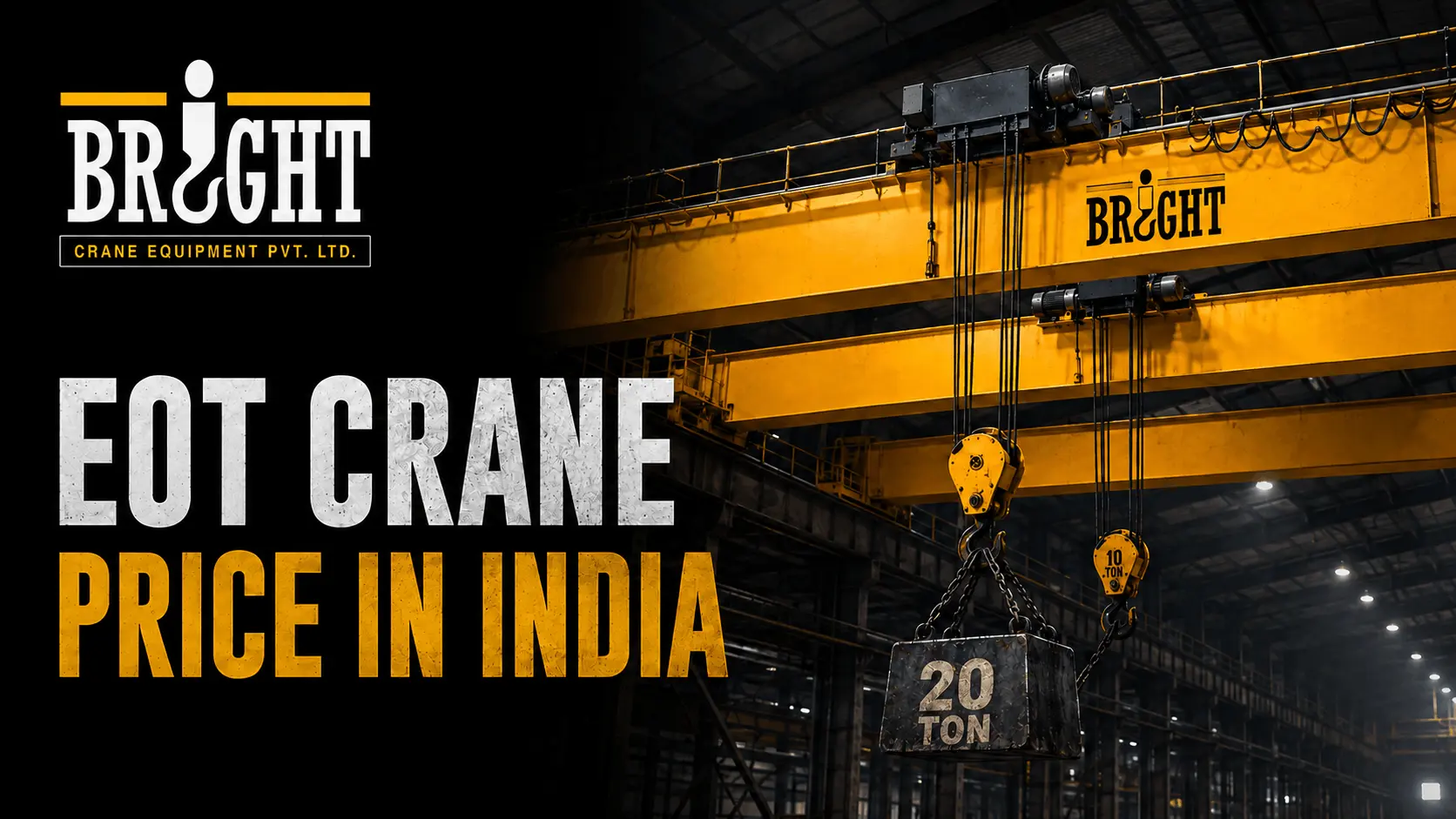
An EOT crane in India is priced on specifications, not a fixed list. The final cost depends on capacity, span, lift height, girder type (single or double), duty class, hoist type, control system, and installation scope. Always compare the total installed project cost - not just the crane body price.
If you are searching for the price of an EOT crane in India, you have probably noticed there is no single fixed rate. And there is a good reason for that.
An EOT (Electric Overhead Travelling) crane is not an off-the-shelf product like a motor or a pump. It is an engineered lifting system built around your factory, your load and your usage pattern. The price changes with lifting capacity, span, lift height, girder type, duty class, hoist selection and the level of customization you need.
This guide explains exactly what drives EOT crane pricing in India - and, more importantly, how to compare quotations correctly so you understand the complete installed project cost, not just the machine price. Get this right, and you avoid the most common (and most expensive) mistake buyers make.
EOT Crane Price in India: Indicative Cost Positioning
Because every EOT crane is quoted to specification, no manufacturer can honestly publish an exact price without knowing your requirements. What we can share is how different crane categories are positioned relative to each other.
| Crane Category | Typical Application | Cost Positioning |
|---|---|---|
| Single girder EOT crane | Light to medium-duty lifting in workshops and warehouses | Generally lower initial cost |
| Double girder EOT crane | Heavy loads, longer spans, higher duty cycles | Higher structural and hoist cost |
| Customized EOT crane | Special height, span, controls or environment | Site-specific quotation |
In publicly available industry examples, basic single-girder cranes sit in the lower price segment, while customized double-girder cranes sit significantly higher. Exact rates should never be published without knowing the specifications and scope of supply - any price quoted without those details is only a rough guess.
What Factors Affect EOT Crane Price in India?
Seven core factors decide the price of an EOT crane. Understanding each one helps you read a quotation properly and know why two cranes of the same tonnage can cost very differently.
1. Lifting Capacity
Capacity is the single biggest price driver. A 1-ton crane, a 5-ton crane, a 10-ton crane, a 20-ton crane and a 50-ton crane are structurally very different machines. Higher capacity demands a stronger girder, a larger hoist and more powerful motors - all of which add cost.
Important distinction: Safe Working Load (SWL) is the maximum load the crane is rated to lift. Your actual operating load should always stay within the SWL, with a safety margin. Never size a crane to lift exactly at its limit.
2. Crane Span
Span is the distance between the two runway rails the crane travels on - effectively the width the crane bridges. A longer span needs a heavier, stronger girder and more structural steel, which increases cost. Your existing factory bay dimensions directly influence the span, and therefore the price.
3. Lifting Height
Lift height is how high the hook can raise the load. Standard heights are more economical; higher or customized lift heights require a larger rope drum, a specific hoist arrangement and adequate headroom - all of which add to the cost.
4. Single Girder vs Double Girder Design
A single girder crane uses one main beam and suits light to medium-duty applications. A double girder crane uses two beams and handles heavy loads, longer spans and higher lift heights. Double girder cranes cost more upfront - but for heavy, continuous work they deliver better lifecycle value. Compare total value, not just the purchase price.
5. Duty Classification
Duty class defines how hard the crane will work - its operating hours, load spectrum and number of starts per hour. Common classes are M3, M4, M5 and M6. A crane used a few hours a day (M3) is built lighter than one running continuous heavy shifts (M6).
This is why two cranes of the same tonnage can be priced very differently. A 10-ton M3 crane and a 10-ton M6 crane are not the same machine - the higher duty class needs heavier-duty components, and costs more.
6. Hoist Type and Brand
The hoist does the actual lifting, and its selection affects both price and performance. A wire rope hoist is standard for higher capacities and lift heights; a chain hoist suits lighter loads. Indian and imported components are priced differently, and factors like hoist speed, lifting mechanism and spare-parts availability all influence the final cost.
7. Control System
How the operator controls the crane changes the price. Options range from a basic pendant control, to a wireless radio remote, to a full operator cabin. Advanced setups with PLC and VFD-based operation, automation or remote monitoring add cost but improve precision, safety and smoothness of operation.
Material and Component Quality
Beyond the headline specifications, the quality of the underlying components matters - structural steel, motors, gearboxes, brakes, wheels, end carriages, and the electrical panel with its safety devices. Components built to the relevant IS standards for EOT cranes offer proven reliability, whereas cheaper, non-compliant components lower the quote but often raise long-term maintenance and downtime costs.
Customization and Special Features
Special requirements add to the price but are essential for certain applications. These include an anti-sway system, overload limiter, load display, dual hoist, heat-resistant design, explosion-proof components, corrosion-resistant coating and automatic lubrication.
Additional Costs Beyond the Crane Price
This is where most buyers get caught out. The crane body is only part of the total project cost. When you receive a quotation, check whether these are included or excluded - because they can add up to a large portion of your final bill:
- Crane transportation to your site
- Erection and installation
- Runway beam and rail system
- Gantry columns
- Electrical cabling and festoon system
- Commissioning
- Load testing and inspection
- GST and other applicable taxes
- Civil or structural modification
- Operator cabin (if required)
- Annual Maintenance Contract (AMC) and maintenance
- Spare parts and warranty extension
A low crane-body price with runway work, installation and electrical connection excluded can end up costing more than a slightly higher quote that includes everything. Always compare the complete installed cost.
Single Girder vs Double Girder EOT Crane Cost
Single and double girder are the two most common configurations, but they are not the only options - portal, semi-portal and gantry variants each suit different site conditions and budgets. If you are still weighing which design fits your application, our complete guide to the types of EOT crane breaks down each one, so you can match the right configuration to your load and cost expectations before finalizing your quote.
| Factor | Single Girder | Double Girder |
|---|---|---|
| Best suited for | Light to medium loads | Heavy-duty lifting |
| Structural design | Comparatively lighter | Heavier and stronger |
| Initial investment | Usually lower | Usually higher |
| Long-span suitability | Limited, depends on design | Better suited |
| Common applications | Workshops, warehouses | Steel, engineering, heavy industry |
How to Calculate the Total EOT Crane Project Cost
Instead of looking only at the crane price, calculate the complete project cost using this simple structure:
Here is why this matters in practice:
If a quotation includes the crane equipment but excludes the runway beam, installation and electrical work, your final project cost can be significantly higher than the basic machine price you first saw. The cheapest-looking quote is not always the cheapest project.
What Should Be Included in an EOT Crane Quotation?
Use this as a checklist when you receive any EOT crane quotation. A complete, transparent quote will clearly state each of these:
- Capacity and duty class
- Span and lift height
- Girder type (single or double)
- Hoist make and capacity
- Motor and gearbox details
- Control method (pendant / remote / cabin)
- Safety features
- Runway scope (included or excluded)
- Installation and commissioning
- Load testing
- Delivery timeline
- Warranty and AMC
- GST and clearly listed exclusions
How to Choose the Right EOT Crane for Your Budget
Smart buying is about matching the crane to your real needs - not just picking the lowest quote. Keep these principles in mind:
- Assess future load requirements, not just your current load
- Select duty class based on how frequently the crane will operate
- Avoid unnecessary customization that inflates cost
- Never remove critical safety features to save money
- Compare at least 2-3 detailed quotations
- Verify the supplier's installation and after-sales support
How to Get an Accurate EOT Crane Price Quote
The more detail you provide, the more accurate your quotation will be. Share these details when requesting a quote:
- Required lifting capacity
- Crane span
- Lifting height
- Runway length
- Indoor or outdoor application
- Operating hours per day
- Material being handled
- Required control system
- Installation location
- Expected delivery date
The more precise your inputs, the closer the quotation will be to the final price - and the fewer surprises later. A vague enquiry gets a vague estimate.
Final Word
There is no fixed price list for EOT cranes in India - and any supplier who quotes a firm number without asking about your capacity, span, duty class and site is guessing. The real cost depends on your specifications and, crucially, on the complete installed scope.
When you evaluate quotations, look past the headline crane price. Check what is included: runway, electrification, installation, testing, taxes and after-sales support. Compare the total project cost across two or three detailed quotes, and choose the supplier who is transparent about exactly what you are paying for.
Do that, and you will not just get a fair price - you will get a crane that performs reliably for the next 15 to 20 years.
Frequently Asked Questions (FAQ)
1. What is the starting price of an EOT crane in India?
There is no fixed starting price, because EOT cranes are priced to specification. Basic single-girder cranes for light-duty use sit in the lower price segment, while heavy-duty and customized double-girder cranes cost significantly more. An accurate figure requires your capacity, span, lift height and duty class.
2. What is the price of a 5-ton EOT crane?
The price of a 5-ton EOT crane depends on its span, lift height, girder type, duty class and control system. Two 5-ton cranes can be priced very differently - for example, a light-duty M3 crane costs less than a heavy-duty M6 crane of the same tonnage. Share your specifications to get an accurate quote.
3. How much does a 10-ton EOT crane cost?
A 10-ton EOT crane's cost is driven by span, lift height, duty class, hoist selection and whether installation and runway work are included. Higher duty cycles and longer spans increase the price. Always ask for a complete installed-cost quotation, not just the machine price.
4. Which is cheaper: single girder or double girder EOT crane?
A single girder EOT crane is usually cheaper as an initial investment and suits light to medium-duty applications. A double girder crane costs more but is better suited to heavy loads, longer spans and higher lift heights. For heavy continuous work, the double girder often offers better long-term value.
5. Is EOT crane installation included in the price?
Not always. Installation, runway beam work and electrical connection are often quoted separately by suppliers. This is why you should always confirm whether installation and commissioning are included, and compare the total installed project cost.
6. Does GST come separately in the quotation?
In many quotations GST and other applicable taxes are listed separately from the equipment price. Always check whether the quoted figure is inclusive or exclusive of GST so you can compare quotes accurately.