
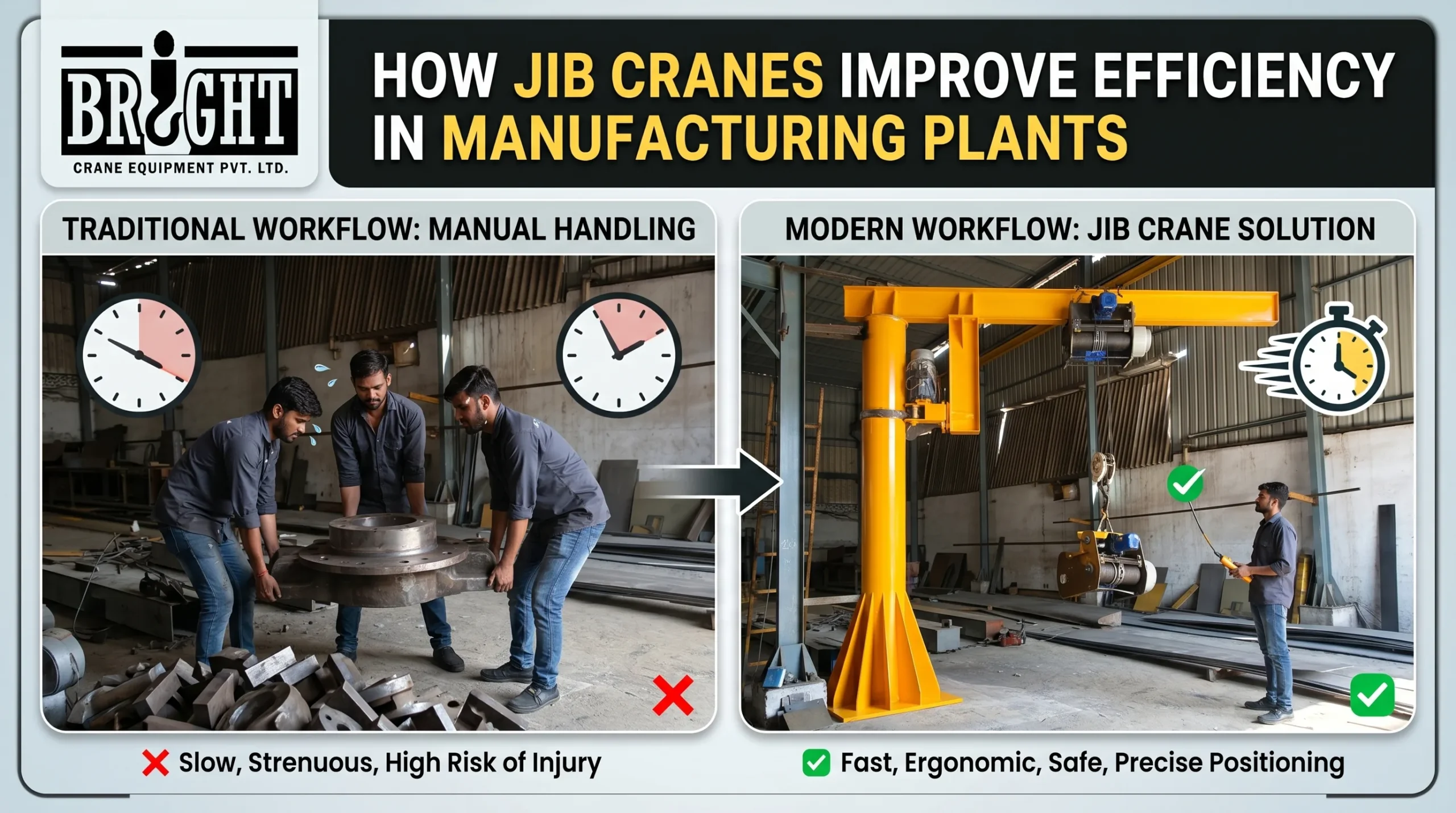
How Does a Jib Crane Improve Efficiency?
A jib crane improves efficiency in a manufacturing plant by giving one workstation its own lifting point. Operators no longer wait for the main overhead crane, or lift parts by hand, to load a machine, position a weldment or move a component onto a fixture. The result is shorter waits between operations, safer handling and better use of the main crane for heavier, bay-wide lifts.
A jib crane works best where the same kind of lift happens again and again within a fixed circle around one point. It is not a replacement for an EOT crane that covers a whole bay. It complements one.
This guide explains the types of jib cranes, their benefits and applications, how to choose and install one, and how to keep it safe and productive. It's written for plant heads, production engineers, maintenance managers and purchase teams in Indian manufacturing.
What Is a Jib Crane?
A jib crane is a lifting device with a horizontal arm, called the jib or boom, fixed to a wall, a building column or a free-standing pillar. A hoist hangs from the arm, usually on a trolley that runs along it. The arm swings (slews) around its pivot, so the hook can reach any point within a circle or an arc.
The main parts of an industrial jib crane are:
- Support structure: a pillar on a foundation, a wall bracket, or a mast.
- Boom (jib arm): the horizontal beam that carries the trolley and hoist.
- Slewing mechanism: bearings that let the boom rotate, either by hand or with a motor.
- Hoist: an electric chain hoist or wire rope hoist for lifting. Manual chain pulley blocks are used for light, occasional lifts.
- Trolley: moves the hoist in and out along the boom, by push or by motor.
- Controls: a pendant or radio remote, with limit switches and an emergency stop.
Types of Jib Cranes
The main types of jib cranes differ in how they're supported and how far they rotate.
| Type | How it's supported | Typical rotation | Best for |
|---|---|---|---|
| Pillar-mounted (free-standing) jib crane | A vertical pillar bolted to a designed foundation | Up to 360° | Open floor areas, machine cells, loading points |
| Wall-mounted jib crane | Brackets fixed to a building wall or column | Limited arc, often around 180° | Workstations along walls or columns, where floor space is tight |
| Mast-type (floor-to-ceiling) jib crane | A mast supported at the floor and at an overhead structure | Close to full rotation, depending on design | Where a foundation is difficult but there is overhead support |
| Articulating jib crane | A boom with a second, hinged arm | Can reach around columns and into machines | Reaching into machines, around obstacles and into tight corners |
Rotation and reach vary by design and site, so the figures above are general guidance. The column or wall must also be checked by a structural engineer before a wall-mounted crane is fitted to it.
Bright Crane Equipment's jib crane range covers wall-mounted, pillar-mounted and free-standing jib cranes, with capacities from 0.25 to 10 tons and rotation of up to 360° on free-standing units. Each is engineered after a review of the application.
Manual vs motorised jib cranes
- Manual slewing and trolley travel: lower cost and simpler. Suited to lighter loads and shorter booms, where an operator can push the load comfortably.
- Motorised slewing and travel: better for heavier loads, longer booms, frequent cycles and precise positioning, where pushing by hand would be slow or tiring.
How Jib Cranes Improve Efficiency in Manufacturing Plants
1. Lifting is available exactly where the work happens
In many plants, one EOT crane serves an entire bay. When a machinist needs to load a 300 kg casting, they often wait for the crane to finish another job. A jib crane at the machine removes that wait. Each workstation lifts on its own schedule.
2. The main crane is freed for heavy lifts
Using the EOT crane for small, frequent lifts ties up the largest lifting asset in the bay. Moving those lifts to jib cranes keeps the overhead crane available for heavy material, assembly and dispatch. If you're planning both, see how jib cranes work alongside single girder EOT cranes in the same bay.
3. Less manual handling and fewer strain injuries
Repeatedly lifting heavy parts by hand, or with two people, is slow and is a known cause of back and shoulder injuries. A jib crane takes the weight. The operator only guides the load. That helps safety, consistency and staff retention, particularly on long shifts.
4. More precise positioning
With a hoist that has two speeds or variable speed, operators can lower a part onto a chuck, fixture or jig in small, controlled movements. Precise placement reduces damage to parts and tooling, and cuts the time spent adjusting.
5. Better use of floor space
A wall-mounted jib crane uses no floor space. A pillar-mounted one uses only its base. Neither needs aisles kept clear for a forklift to reach the workstation, which helps in compact Indian MSME workshops where space is at a premium.
6. Flexible layouts
Jib cranes can be added cell by cell as production grows. A new machine can get its own lifting point without changing the bay's overhead crane system.
Jib Crane Benefits at a Glance
| Benefit | Why it matters | What to check when buying |
|---|---|---|
| Shorter waiting time | Workstations don't queue for the main crane | Cycle time with and without the crane |
| Safer handling | Less manual lifting of heavy parts | Hoist speed, controls, limit switches |
| Precise placement | Less damage to parts and fixtures | Two-speed or variable-speed hoist |
| Space efficiency | Little or no floor footprint | Wall strength, or foundation space for a pillar |
| Lower load on the EOT crane | The main crane is free for heavy lifts | Which lifts move to the jib |
| Scalability | Add cranes as the plant grows | Standard designs and spares |
Jib Crane Applications in Manufacturing
Jib crane applications are widest where loads are repetitive, moderate in weight and handled in one area.
- Machine tending: loading and unloading CNC machines, lathes, VMCs, drilling and boring machines.
- Welding and fabrication: turning, holding and positioning weldments, and moving parts between fit-up and welding.
- Assembly lines: lifting engines, gearboxes, motors, pumps and sub-assemblies onto fixtures or conveyors.
- Loading and dispatch: moving goods between the dock, the truck bed and packing areas.
- Die and mould handling: changing dies on presses and moulds on injection-moulding machines, where a dedicated crane is suitable.
- Maintenance bays: lifting motors, gearboxes and spares during repairs.
- Foundry and finishing: moving castings between fettling, grinding and inspection.
Industries that commonly use a jib crane for manufacturing plants include automotive components, engineering and fabrication, pumps and valves, electrical equipment, plastics, and steel processing.
Jib Crane vs Other Material Handling Options
| Option | Coverage | Best for | Limitations |
|---|---|---|---|
| Jib crane | A circle or arc around one point | Repetitive workstation lifts | Limited to its radius |
| EOT crane | The full bay | Heavy, bay-wide lifts | Shared by many users; needs a gantry structure |
| Forklift | Anywhere the floor allows | Pallets and horizontal transport | Needs aisles; less precise for lowering into machines |
| Manual lifting | Anywhere | Very light items | Slow, inconsistent and a strain-injury risk |
The best plants usually combine them: an EOT crane for the bay, jib cranes at key workstations, and forklifts for movement between areas. A jib crane for material handling fills the gap between manual lifting and the overhead crane.
When a Jib Crane Is Not the Right Choice
A jib crane is not the answer for every lift. If loads must travel the length of a bay, an EOT or goliath crane is the better fit. If parts are very light and lifts are rare, a simple manual aid may be enough. And if the load exceeds what a practical boom and foundation can carry, a different crane type will be safer and cheaper. A good supplier will tell you when a jib crane isn't the right tool.
How to Choose an Industrial Jib Crane
Load capacity
Base capacity on the heaviest load plus everything below the hook: slings, lifting beams, magnets or grabs. Allow for future heavier parts if they're likely. Don't add a personal "safety margin" by overloading a crane rated lower. Choose a crane whose rated capacity covers the full load. The manufacturer's design already includes the factors required by the applicable standards.
Reach (boom length)
Measure from the pivot centre to the farthest point the hook must reach, then check the closest point it must reach as well. A common mistake is sizing the boom to the machine while forgetting the pallet or bin where parts are picked up.
Height under the boom and lift height
Note the floor-to-underside-of-boom height you need, and the hook's lowest and highest positions. Check clearances to roof members, lights and overhead cranes running above.
Slewing angle
Map what lies around the pivot. A wall crane can only cover an arc. A pillar crane can cover a full circle if nothing blocks the boom.
Mounting and foundation
A pillar jib crane needs a foundation designed for the overturning moment. Existing floors are often not suitable without a new foundation. A wall-mounted crane needs a wall or column checked for the added loads. Ask for the foundation drawing and load data.
Hoist type, speed and duty
Electric chain hoists suit most lighter loads, while wire rope hoists suit heavier or more frequent duty. Choose lifting speed (single, dual or variable) for the precision you need, and share how many lifts per hour and per shift you expect.
Power, controls and environment
Confirm the supply voltage, pendant or remote control, and any dust, heat, humidity or outdoor exposure that affects the hoist and electrics.
Information to send a manufacturer: maximum load, boom length, height under the boom, lift height, rotation needed, mounting type, lifts per shift, power supply, site photos and a sketch of the workstation.
Installation: What to Plan
- Site survey by the supplier, including measurements and obstacles.
- Foundation or wall check by a qualified structural engineer, using the manufacturer's load data.
- Foundation casting and curing to the drawing, before the crane is erected.
- Erection and alignment, with the pillar plumb and the boom level.
- Electrical connection with correct earthing and isolation.
- Load testing and commissioning by competent persons, with records kept.
- Operator training before handover.
Common Mistakes When Planning a Jib Crane
- Sizing for today's part only. If heavier parts are likely within a few years, plan the capacity for them now.
- Ignoring the pick-up point. The hook must reach the pallet, bin or conveyor, not just the machine.
- Assuming the floor will hold. Pillar jib cranes need a designed foundation; a standard shop floor slab is often not enough.
- Choosing manual slewing for heavy loads. Pushing a heavy load on a long boom is slow and tiring, which defeats the purpose.
- Overlooking overhead clearance. Roof members, lights or an EOT crane passing above can limit the height or block the boom.
- Skipping operator training. An untrained operator loses most of the efficiency gain and adds risk.
Jib Crane Safety
- Never exceed the rated capacity, and mark it clearly on the boom.
- Train and authorise operators. Only trained people should use the crane.
- Inspect before use: hook, latch, chain or rope, limit switches, brake and pendant.
- Keep clear of the load path, and never lift over people.
- Lift vertically. Don't drag loads sideways or lift at an angle.
- Use rated slings and attachments, and inspect them regularly.
- Fit end stops, limit switches and an emergency stop.
In India, lifting machines must be examined periodically by a competent person. The Occupational Safety, Health and Working Conditions Code, 2020, which subsumes the Factories Act, 1948, and state rules made under it set out the requirements. Confirm the current examination interval and record-keeping rules for your state with your safety officer. For hoist design, relevant Indian Standards include IS 3938 (electric wire rope hoists), and EN 14985 covers slewing jib cranes in Europe.
Jib Crane Maintenance
A simple maintenance plan keeps a jib crane reliable:
| Frequency | Checks |
|---|---|
| Daily (before use) | Hook and latch, chain or rope condition, brake, limit switches, pendant buttons and emergency stop |
| Monthly | Slewing bearing movement, trolley wheels, end stops, fasteners, cable and festoon condition |
| Periodically, as the manufacturer advises | Lubrication of the hoist gearbox, bearings and chain; electrical panel checks |
| Statutory interval | Thorough examination by a competent person, with records |
Keep a log of every inspection, defect and repair. Rising defects on a crane are often the first sign that it's being overused or overloaded.
How to Measure the Efficiency Gain
Measure the effect in your own plant rather than relying on general claims:
- Before installation, time-study a typical cycle: waiting for the crane, lifting, positioning and the number of manual lifts.
- After installation, repeat the same study on the same parts.
- Compare waiting time, cycle time, manual lifts per shift and near-miss reports.
- Review after a month, once operators are used to the crane.
Choosing Jib Crane Manufacturers in India
When comparing jib crane manufacturers in India, check:
- Engineering support: do they survey the site and give foundation and load data?
- In-house manufacturing of the structure, and the source of the hoists.
- Documentation: general arrangement drawing, test certificates and the manual.
- Installation and commissioning by their own trained team.
- After-sales service, spares availability and response time in your region.
- References: installations you can visit or contact, in your industry.
About Bright Crane Equipment
Bright Crane Equipment is a crane manufacturer based at Swarnim Industrial Park, Bakrol, Ahmedabad, Gujarat. The company makes jib cranes, single and double girder EOT cranes, goliath cranes, electric chain hoists and wire rope hoists, and states over 15 years of engineering experience. Its jib cranes are custom-engineered after a technical review of each application.
To plan a jib crane for your workstation, share your load, reach and layout with the team through the contact page, or download the company brochure.
Conclusion
A well-chosen jib crane gives each workstation its own lifting point. That cuts waiting, reduces manual handling, improves placement and frees the main overhead crane for heavy work. The gains depend on getting the capacity, reach, mounting and hoist right for the job, and on installing and maintaining the crane properly. Start with a clear picture of the lifts at each workstation, and measure the results in your own plant.
Frequently Asked Questions
What is a jib crane used for in a manufacturing plant?
A jib crane is used to lift and position loads at a single workstation, such as loading CNC machines, positioning weldments, lifting parts onto assembly fixtures and handling dies. It gives that workstation its own lifting point, so operators don't wait for the main overhead crane.
What are the main types of jib cranes?
The main types are pillar-mounted (free-standing), wall-mounted, mast-type (floor-to-ceiling) and articulating jib cranes. They differ in how they're supported, how far they rotate and how far they can reach around obstacles.
How much weight can a jib crane lift?
It depends on the design. Bright Crane Equipment's jib cranes range from 0.25 to 10 tons. Capacity must cover the load plus any slings or lifting attachments below the hook.
Is a jib crane better than an EOT crane?
Neither is better in general. They do different jobs. An EOT crane covers a whole bay and handles heavy loads. A jib crane serves one workstation within a fixed radius. Many plants use both, with jib cranes taking frequent, lighter lifts off the overhead crane.
Does a pillar jib crane need a foundation?
Yes. A free-standing pillar jib crane needs a foundation designed for its load and overturning moment. A standard factory floor is often not enough. The manufacturer should supply foundation loads and a drawing for a structural engineer to check.
Can a jib crane be mounted on an existing building column?
Often, yes, but only after a structural engineer confirms the column can take the added loads. Wall- and column-mounted jib cranes save floor space but usually rotate through a limited arc, not a full circle.
What rotation does a jib crane have?
Free-standing pillar jib cranes can rotate up to 360° if nothing blocks the boom. Wall-mounted jib cranes usually cover a limited arc, often around 180°, depending on the wall and the design.
Should I choose a manual or motorised jib crane?
Manual slewing suits lighter loads, shorter booms and occasional lifts. Motorised slewing and trolley travel suit heavier loads, longer booms, frequent cycles and precise positioning, where pushing by hand would be slow or tiring.
How often should a jib crane be inspected?
Operators should check the hook, chain or rope, brake, limit switches and controls before each use. Follow the manufacturer's maintenance schedule, and arrange periodic statutory examinations by a competent person under the OSH Code, 2020 and state rules.
What information do jib crane manufacturers in India need for a quote?
Share the maximum load, boom length, height under the boom, lift height, rotation needed, mounting type (wall or pillar), lifts per shift, power supply, and photos or a sketch of the workstation.
How do I know if a jib crane improved efficiency?
Time-study the same job before and after installation. Compare waiting time for the crane, cycle time, the number of manual lifts per shift and near-miss reports, after operators have had about a month to get used to the crane.
Does Bright Crane Equipment install jib cranes?
Bright Crane Equipment custom-engineers jib cranes after a technical review of each application. Contact the team through the contact page to discuss your load, reach and layout.