
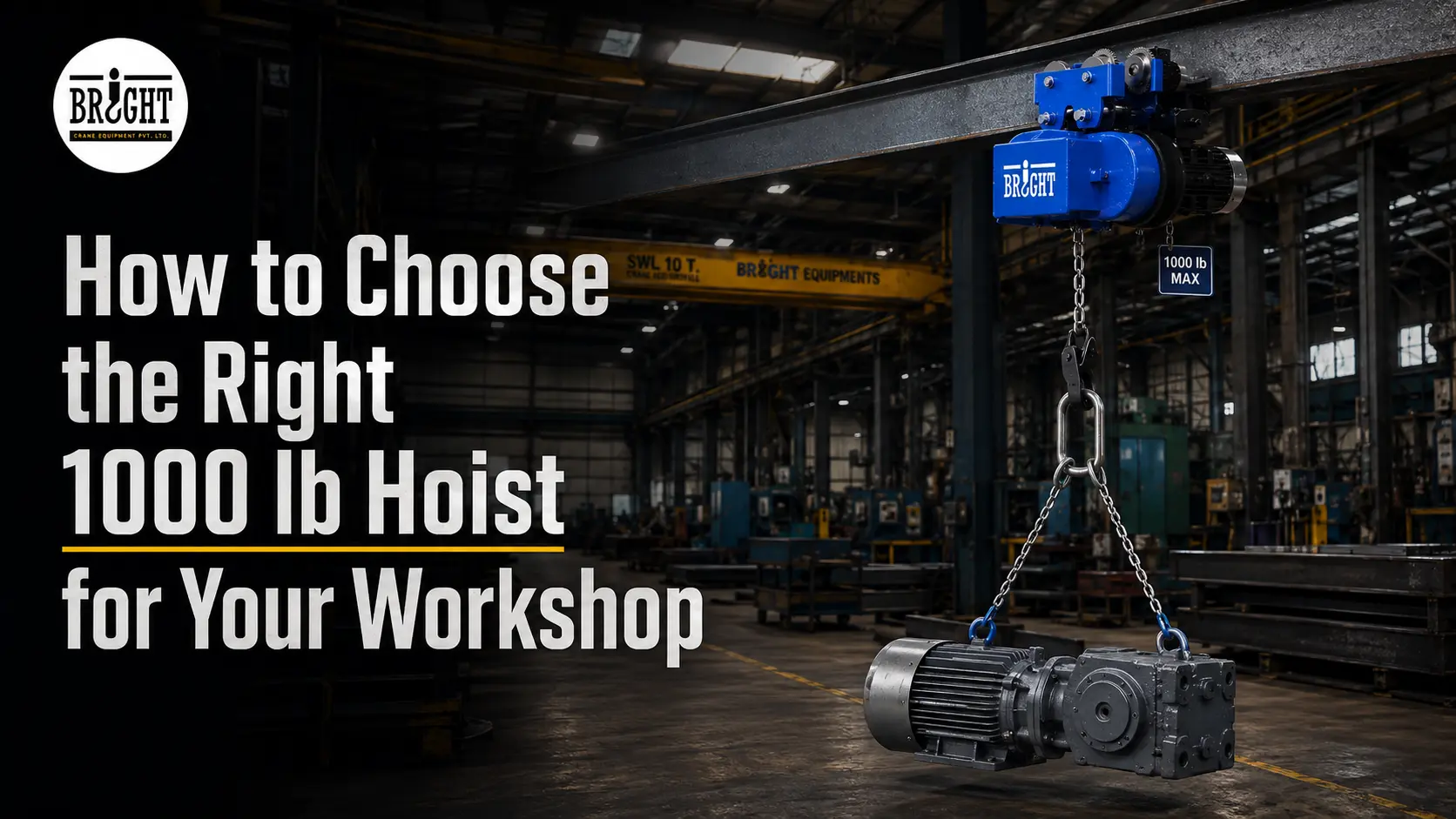
To choose the right 1000 lb hoist for your workshop, first confirm your heaviest load (including rigging) stays safely within 1000 lb after a 25% safety margin. Then match the duty cycle to how often you lift, pick the power source (electric, manual or pneumatic), check headroom and mounting, confirm the power supply, and verify the safety features and after-sales support.
A 1000 lb hoist - that is a ½-ton (500 kg) lifting machine - is one of the most useful pieces of equipment a workshop can own. It is powerful enough to handle engines, gearboxes, fabricated parts and machinery, yet compact enough to fit in a garage, fabrication shop or small industrial bay.
But choosing the right 1000 lb hoist is not just about the tonnage on the label. The correct choice depends on your real load, how often you lift, your ceiling height, your power supply and the safety features you need. This guide gives you a simple, workshop-first decision framework - seven clear steps - so you buy the right hoist the first time.
Why a 1000 lb (½-Ton) Hoist Is Ideal for Most Workshops
A 1000 lb hoist hits the sweet spot for small-to-medium workshops. It covers the majority of everyday lifting tasks - automotive engines, transmissions, small machine components, fabrication assemblies and maintenance work - without the cost, weight and space demands of a larger crane.
For automotive garages, fabrication shops and maintenance bays, a ½-ton electric chain hoist is often all that is needed for frequent, repetitive lifts. It is also easy to mount on a beam, gantry or trolley, making it flexible for changing workshop layouts.
Step 1: Calculate Your Real Maximum Load (Including Rigging)
Before anything else, work out the heaviest load you will ever lift - not the average. A 1000 lb hoist is rated for a working load limit (WLL) of 1000 lb, and you should never operate at that limit.
Add a 25% Safety Margin to Your Heaviest Load
Never size a hoist to lift exactly at its rating. Add a safety margin of at least 25% above your heaviest load. This buffer protects against dynamic forces, uneven loading and future needs, and dramatically extends the hoist's service life.
Don't Forget Hooks, Slings, and Beam Clamps in Weight
The load on the hook includes everything that hangs below it - hooks, slings, chains, lifting beams and beam clamps. Add their weight to your object's weight to get the true gross load before applying the margin.
Usable Load for a 1000 lb Hoist = 1000 lb ÷ 1.25 = 800 lb maximum gross load
In practice: a 1000 lb hoist should handle a real-world load of up to about 800 lb once you allow for a 25% safety margin. If your heaviest load plus rigging exceeds that, size up to a larger hoist.
Step 2: Match Duty Cycle to Your Daily Lifting Frequency
Capacity is only half the decision. The duty cycle - how often and how intensively the hoist works - is just as important. Two 1000 lb hoists can be built very differently depending on their duty class.
Understanding H1-H4 / FEM Duty Classes for Workshops
Hoist duty is classified using systems such as FEM (and equivalent H1-H4 ratings). A lower class suits occasional lifting; a higher class is built for frequent, heavy-cycle use. Light workshop use may need only a low duty class, while a busy production bay needs a higher one.
When to Choose a Higher Duty Class Than You Think You Need
If your hoist will run many lifts per hour, or operate in a busy shop for long shifts, choose a higher duty class than the bare minimum. It costs slightly more upfront but prevents premature wear, overheating and downtime.
Step 3: Electric vs Manual vs Pneumatic - Which Power Source Fits Your Workshop?
The power source shapes how the hoist performs day to day. Match it to your lifting frequency and workshop environment:
| Type | Best For | Key Consideration |
|---|---|---|
| Electric chain hoist | Frequent, repetitive lifts | Fast, low-effort; needs power supply |
| Manual chain hoist | Low-cost, low-frequency lifting | No power needed; slower, manual effort |
| Pneumatic hoist | Hazardous or high-temperature areas | Needs compressed air; spark-free operation |
Electric chain hoist: The best choice for most workshops that lift frequently - smooth, quick and low-effort operation.
Manual chain hoist: A low-cost option for occasional lifting where speed is not critical.
Pneumatic hoist: Ideal for hazardous, dusty or high-temperature areas where spark-free operation matters.
Step 4: Check Headroom, Lift Height, and Mounting Options
A hoist that does not fit your space is no use, however good its specifications. Check the vertical space and how you will mount it.
Hook-Mounted vs Trolley-Mounted Hoists
A hook-mounted hoist hangs from a fixed point - simple and economical for a single lifting position. A trolley-mounted hoist rolls along a beam, letting you move loads horizontally across the workshop. Choose based on whether you need to move loads sideways or just lift in place.
Low Headroom Hoists for Tight Workshop Ceilings
If your workshop has a low ceiling, a low headroom hoist maximizes your usable lifting height by minimizing the space taken up by the hoist itself. Always confirm the required lift height and the available headroom before buying.
Step 5: Power Supply & Control Options
For an electric hoist, the power supply must match what your workshop provides. Confirm these before ordering:
- Single phase vs three phase - small workshops often run single phase; busy shops usually have three phase.
- Voltage compatibility (for example 220V or 415V) with your workshop supply.
- Lifting speed suited to your workflow (measured in m/min or fpm).
- Control type - pendant control for direct use, or a radio remote for flexibility and safety.
Getting the phase and voltage wrong is a common and avoidable mistake. Always confirm your workshop's power supply matches the hoist specification before you order.
Step 6: Safety Features & Compliance You Should Not Ignore
Safety features are not optional extras - they protect your operators and your equipment. Insist on these:
Must-Have Safety Features
- Upper and lower limit switches to stop the hook at safe positions.
- Overload protection to prevent lifting beyond the rated capacity.
- A reliable brake system (mechanical or electromagnetic) to hold the load.
- Thermal overload protection to guard the motor.
- An appropriate IP rating for a dusty or damp workshop environment.
Relevant Standards: ASME, ISO, CE Marking
Look for hoists built to recognized standards such as ASME and ISO, and CE marking where applicable. Ask for a load-testing certificate and keep to a regular inspection checklist once the hoist is in service.
Step 7: Budget, Brand, and After-Sales Support Checklist
The cheapest hoist is rarely the best value. Weigh the total ownership picture:
- Upfront price against build quality and duty class.
- Warranty length and what it covers.
- Spare parts availability - critical for minimizing downtime.
- Local service and support, especially important in dusty or hot climates.
- Installation guidance and a clear maintenance schedule.
Paying 10–15% more for a quality 1000 lb hoist with the right duty class and local support often saves far more over five years through longer life, less downtime and fewer accidents.
Common Mistakes When Buying a 1000 lb Hoist (And How to Avoid Them)
- Sizing for the average load instead of the heaviest load.
- Forgetting to include slings, hooks and beam clamps in the weight.
- Skipping the 25% safety margin to save money.
- Ignoring the duty cycle and choosing on capacity alone.
- Overlooking headroom and buying a hoist that does not fit the ceiling.
- Mismatching the power supply - wrong phase or voltage.
- Choosing on price alone and ignoring spare parts and service.
Final Word
Choosing the right 1000 lb hoist for your workshop comes down to a simple discipline: confirm your real maximum load with a safety margin, match the duty cycle to your usage, pick the right power source, check headroom and mounting, confirm your power supply, and never compromise on safety features or after-sales support.
Work through these seven steps and you will end up with a ½-ton hoist that lifts safely, fits your space and lasts for years. When in doubt, share your load, ceiling height, power supply and lifting frequency with a trusted hoist supplier for a precise recommendation.
Frequently Asked Questions (FAQ)
1. How much can a 1000 lb hoist actually lift safely?
A 1000 lb hoist is rated for a working load limit of 1000 lb, but you should never operate at that limit. After applying a 25% safety margin, the practical maximum gross load is about 800 lb, including the weight of slings, hooks and any rigging.
2. Is a 1000 lb hoist the same as a ½-ton hoist?
Yes. A 1000 lb hoist is a ½-ton hoist, equal to roughly 500 kg. The label may show pounds, tons or kilograms, but they refer to the same rated capacity.
3. Should I choose an electric or manual 1000 lb hoist for my workshop?
Choose an electric chain hoist if you lift frequently - it is fast and low-effort but needs a power supply. Choose a manual chain hoist for occasional, low-frequency lifting where cost matters more than speed. A pneumatic hoist suits hazardous or high-temperature areas.
4. Do I need single phase or three phase for a 1000 lb electric hoist?
It depends on your workshop's power supply. Small workshops often run single phase, while busier shops usually have three phase. Always confirm the hoist's phase and voltage requirement matches your available supply before ordering.
5. What safety features should a 1000 lb workshop hoist have?
Look for upper and lower limit switches, overload protection, a reliable brake system, thermal overload protection and a suitable IP rating. Also confirm the hoist meets standards such as ASME or ISO, with CE marking where applicable and a load-testing certificate.