
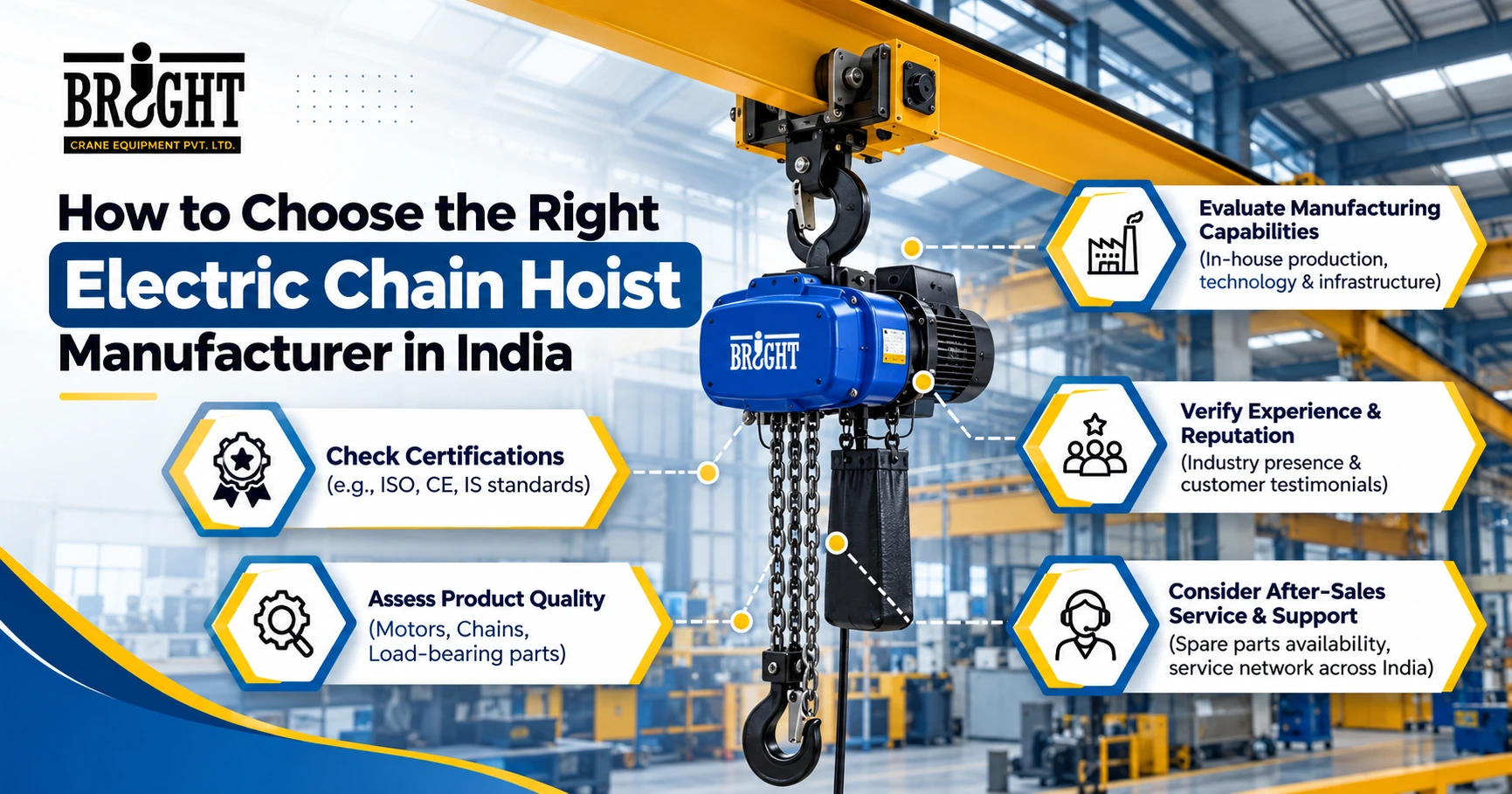
To choose the right electric chain hoist manufacturer in India, check five things: proven experience in your industry, product quality (alloy load chain, brakes, limit switches, overload protection and a duty class matched to your use), testing and certification (load test certificates, ISO-certified manufacturing and compliance with applicable Indian and international standards), after-sales support with spare parts, and transparent pricing and warranty. Compare total cost of ownership, not just the purchase price.
An electric chain hoist is one of the most useful lifting tools in any factory, workshop or warehouse. It lifts loads quickly and precisely, reduces manual handling and fits into tight spaces where larger cranes can't. From assembly lines to maintenance bays, it keeps material moving safely.
But the hoist is only as reliable as the company that makes it. A poorly built hoist can mean chain wear, brake failure, motor burnout and, most seriously, dropped loads. Choosing the right electric chain hoist manufacturer in India protects your people, your productivity and your budget.
This guide explains how electric chain hoists work, the main types, their benefits, how to choose an electric chain hoist manufacturer, the kinds of manufacturers in India and what affects electric chain hoist price in India.
It's written by the team at Bright Crane Equipment, an Ahmedabad-based manufacturer of hoists and cranes with more than 15 years of engineering experience and over 4,500 installations across steel, engineering, power, railway, oil and gas and shipbuilding industries.
Understanding Electric Chain Hoists
What Is an Electric Chain Hoist?
An electric chain hoist is a motorised lifting device that raises and lowers loads using a hardened alloy steel load chain. An electric motor drives a gearbox, which turns a load sprocket (chain wheel). As the sprocket turns, it pulls the chain, lifting or lowering the hook.
How It Works
- The operator presses a button on the pendant or radio remote.
- The motor runs and drives the gearbox.
- The gearbox reduces speed and increases torque to lift heavy loads.
- The load sprocket pulls the chain, raising the hook and load.
- When the button is released, the brake engages automatically and holds the load securely.
- Limit switches stop the hook at its upper and lower limits.
- Overload protection prevents the hoist from lifting more than its rated capacity.
Key Components
|
Component |
Function |
|---|---|
|
Motor |
Provides lifting power |
|
Gearbox |
Reduces speed and increases torque |
|
Load chain |
Alloy steel chain that carries the load |
|
Load sprocket |
Drives the chain |
|
Electromagnetic brake |
Holds the load when the motor stops |
|
Limit switches |
Stop the hook at safe upper and lower positions |
|
Overload protection |
Prevents lifting beyond rated capacity |
|
Hook with safety latch |
Holds slings securely |
|
Chain container |
Stores the slack chain neatly |
|
Pendant or remote control |
Lets the operator control lifting and travel |
Types of Electric Chain Hoists
|
Type |
Description |
Best for |
|---|---|---|
|
Fixed (hook-mounted) hoist |
Hung from a fixed point; lifts vertically only |
Workstations, maintenance bays |
|
Push-pull trolley hoist |
Trolley moved by hand along a beam |
Light loads over short distances |
|
Motorised trolley hoist |
Electric trolley moves the hoist along the beam |
Frequent travel, heavier loads |
|
Single-speed hoist |
One lifting speed |
General lifting |
|
Dual-speed hoist |
Fast speed for travel plus slow speed for precise positioning |
Assembly, machining and delicate loads |
|
Low-headroom hoist |
Compact design for limited height |
Buildings with low ceilings |
|
Flameproof hoist |
Designed for hazardous areas |
Chemical, oil and gas, pharma plants |
|
Heavy duty electric chain hoist |
Higher duty class motors and components for frequent use |
Production lines, steel and engineering plants |
Electric chain hoists are often used with single girder EOT cranes, jib cranes and monorail systems.
Why Choose an Electric Chain Hoist?
Benefits of Electric Chain Hoists
- Faster lifting: Much quicker than manual chain pulley blocks, improving productivity.
- Less physical strain: Reduces operator fatigue and manual handling injuries.
- Precise control: Dual-speed models allow accurate positioning of moulds, dies and assemblies.
- Compact design: Fits in tight spaces and low-headroom buildings.
- Built-in safety: Brakes, limit switches and overload protection reduce risk.
- Low maintenance: Simple, robust design with easy access to key parts.
- Flexible mounting: Fixed, push-pull or motorised trolley options.
- Cost-effective: Usually more economical than wire rope hoists for lighter capacities.
Electric Chain Hoist vs Wire Rope Hoist
|
Feature |
Electric chain hoist |
Wire rope hoist |
|---|---|---|
|
Typical capacity |
Light to medium (commonly up to about 10 tons) |
Medium to very heavy |
|
Lifting speed |
Moderate |
Faster |
|
Lift height |
Short to medium |
Medium to very high |
|
Size |
Compact |
Larger |
|
Initial cost |
Lower |
Higher |
|
Best for |
Workshops, assembly lines, maintenance |
Heavy, high-lift, high-duty applications |
For heavier loads or higher lifts, consider our wire rope hoists.
Industries That Use Industrial Electric Chain Hoists
An industrial electric chain hoist is used in:
- Automotive: Engine, gearbox and component handling on assembly lines
- Fabrication and engineering: Lifting plates, parts and assemblies
- Steel and foundry: Moving moulds, castings and dies
- Warehousing and logistics: Loading and unloading goods
- Power and utilities: Maintenance of pumps, motors and turbines
- Oil and gas, chemical and pharma: Flameproof hoists for hazardous zones
- Food processing: Handling ingredients and equipment
Criteria for Selecting an Electric Chain Hoist Manufacturer
Here's how to choose an electric chain hoist manufacturer that delivers safe, reliable equipment.
1. Expertise and Experience in the Industry
- Years in business and number of installations
- Experience in your industry and with similar loads and duty cycles
- Engineering capability to recommend the right capacity, speed, lift and duty class
- Client references and case studies you can verify
- In-house manufacturing, rather than only trading imported products
2. Quality of Products and Certifications
Look closely at what goes into the hoist:
|
Quality check |
What to ask |
|---|---|
|
Load chain |
Is it hardened alloy steel of a recognised grade? |
|
Motor |
Is it rated for the required duty and protected against overheating? |
|
Brake |
Is there an automatic electromagnetic brake? |
|
Limit switches |
Are upper and lower limits included as standard? |
|
Overload protection |
Is a slipping clutch or electronic overload device fitted? |
|
Duty class |
Is it classified under FEM 9.511 or ISO 4301 to match your usage? |
|
Enclosure |
What is the IP rating for dust and moisture protection? |
|
Testing |
Is every hoist load-tested, with a test certificate? |
Ask for:
- ISO 9001 certification for the manufacturing facility
- Load test certificates for each hoist
- Compliance with applicable Indian Standards (BIS) and international standards such as FEM
- Flameproof certification for hazardous-area hoists
- Operation and maintenance manuals
In India, lifting machines in factories must also be thoroughly examined by a competent person at least once every 12 months under Section 29 of the Factories Act, 1948, so documentation matters throughout the hoist's life.
3. Customer Service and Support
A hoist may run for many years, so support matters as much as the product:
- Pre-sales consultation to select the right hoist
- Installation and commissioning by trained technicians
- Operator training on safe use
- Spare parts availability, especially chains, brakes, limit switches and contactors
- Service response time, including emergency breakdown support
- Maintenance contracts for regular inspection and servicing
4. Pricing and Warranty Considerations
- Compare like for like: Capacity, lift, speed, duty class, trolley type and safety features should match across quotes.
- Check what's included: Trolley, pendant, power supply cable, installation, testing, GST and freight.
- Understand the warranty: Length, what's covered and conditions.
- Consider total cost of ownership: Energy use, maintenance, spare parts and downtime over the hoist's life.
The cheapest quote often leaves out features or uses lower-grade components that cost more in repairs and downtime.
Manufacturer Selection Checklist
- Experience with similar applications and industries
- In-house design and manufacturing
- Alloy load chain, electromagnetic brake, limit switches and overload protection as standard
- Duty class matched to your usage
- ISO-certified manufacturing and load test certificates
- Installation, training and spare parts support
- Clear warranty and itemised quotation
- Verifiable client references
Electric Chain Hoist Manufacturers in India
Overview of the Market
Chain hoist manufacturers in India range from global brands to local workshops. Understanding the main types helps you compare offers fairly:
|
Type of supplier |
Strengths |
Considerations |
|---|---|---|
|
International brands with Indian operations |
Proven designs, global standards, wide product ranges |
Higher prices; spare parts may take longer for some models |
|
Established Indian brands |
Wide distribution, recognised names, standard models |
Customisation may be limited |
|
Crane and hoist manufacturers |
Hoists integrated with cranes, customisation and local service |
Check experience and testing processes |
|
Small fabricators and traders |
Low prices and fast availability |
Quality, testing and support can vary widely |
Many buyers in India choose electric chain hoist manufacturers that also build cranes, because they can supply the hoist, trolley, girder and runway as one engineered system, with a single point of responsibility for safety and service.
Bright Crane Equipment: Electric Chain Hoists
Bright Crane Equipment manufactures electric chain hoists in Ahmedabad, Gujarat, alongside a full range of EOT, goliath and jib cranes. Key features of our electric chain hoists include:
- Capacities from 1 to 10 tons
- Single-speed or dual-speed lifting
- Fixed, push-pull trolley or motorised trolley mounting, for straight or curved monorails
- Alloy steel load chain with a forged hook and safety latch
- Electromagnetic brake, upper and lower limit switches and overload protection
- Pendant control, with an optional radio remote
- Indoor and outdoor versions for different working conditions
- Custom lift heights and specifications
Our clients include Aditya Birla, BHEL, Bharat Electronics, Indian Railways, L&T, Voltas and DP World, and we provide 24/7 service and maintenance support. Learn more about Bright Crane or view our project gallery.
Electric Chain Hoist Price in India
Factors That Influence Price
The electric chain hoist price in India depends on:
- Capacity: Higher capacities need larger motors, chains and gearboxes.
- Lift height: Longer chains add cost.
- Speed: Dual-speed and faster hoists cost more.
- Mounting: Motorised trolleys cost more than fixed or push-pull versions.
- Duty class: Heavy duty electric chain hoists use larger, more durable components.
- Safety features: Overload devices, extra limit switches and radio controls add cost.
- Environment: Flameproof, outdoor or high-temperature versions cost more.
- Brand and origin: Imported and premium brands usually cost more.
- Service and warranty: Installation, training and longer warranties add value and cost.
Indicative Price Ranges
Marketplace listings on IndiaMART and TradeIndia in October 2026 showed electric chain hoists priced from around ₹15,000 to more than ₹2,90,000, depending on capacity, brand and features. Based on those listings, indicative ranges are:
|
Hoist type |
Indicative price range (ex-GST) |
|---|---|
|
Light-duty, basic 1-ton hoists (unbranded or local) |
About ₹15,000 to ₹50,000 |
|
Branded 1–2 ton industrial hoists |
About ₹75,000 to ₹2,00,000 |
|
3–5 ton industrial or heavy duty hoists |
About ₹1,00,000 to ₹3,00,000 or more |
|
Custom, flameproof or high-duty hoists |
Quoted per specification |
These are indicative figures from public marketplace listings, not quotations. Prices vary with specifications, accessories, freight, installation and GST.
What the Price Trend Means for Buyers
- Wide gaps between quotes usually reflect differences in components, duty class and support, not just margins.
- Very low prices for "industrial" hoists often mean lighter-duty components, limited safety features or no load testing.
- Mid-range branded or engineered hoists generally offer the best balance of cost, safety and lifetime value for regular industrial use.
Always ask for an itemised quotation and compare total cost of ownership over at least five years.
Conclusion
Choosing the right electric chain hoist manufacturer in India is a safety decision as much as a purchasing decision. The best manufacturers combine proven experience, quality components, proper testing and certification, responsive after-sales support and transparent pricing.
Start with your application: load, lift height, speed, duty cycle and environment. Then compare manufacturers on the same specification, check certificates and references, and look beyond the purchase price to long-term reliability and support.
Looking for a reliable electric chain hoist? Explore Bright Crane's chain hoists and full range of products, or contact our team for expert advice and a detailed quotation.
Frequently Asked Questions
What are the benefits of electric chain hoists?
Electric chain hoists lift faster than manual hoists, reduce operator strain, offer precise control, fit compact spaces and include safety features such as brakes, limit switches and overload protection.
How do I determine the right hoist capacity?
Find the heaviest load you'll lift, including slings and below-hook attachments, then add a margin for future needs. Also consider how often you'll lift, as frequent use needs a higher duty class, not just a higher capacity.
What certifications should I look for in a manufacturer?
Look for ISO 9001 certified manufacturing, load test certificates for each hoist, compliance with applicable Indian and international standards such as FEM duty classification, and flameproof certification where required.
How can I ensure the quality of the hoists?
Check component specifications (chain grade, motor, brake and safety devices), ask for load test certificates, visit the factory if possible, speak to existing customers and confirm spare parts and service support.
What is the average lifespan of an electric chain hoist?
Lifespan depends on duty class, usage, environment and maintenance. FEM 9.511 duty classes define a theoretical service life at full load, ranging from about 400 hours (class 1Bm) to 3,200 hours (class 3m); hoists working at lighter average loads last much longer. With correct selection and regular maintenance, many industrial hoists give 10 years or more of service.
Is an electric chain hoist better than a wire rope hoist?
For light to medium loads, short to medium lifts and compact spaces, electric chain hoists are usually more economical. Wire rope hoists suit heavier loads, higher lifts and faster speeds.
Can an electric chain hoist be used outdoors?
Yes, with an outdoor version that has weather protection and suitable IP-rated enclosures. Standard hoists are designed for indoor use.
How much does a 1 ton electric chain hoist cost in India?
Marketplace listings in October 2026 showed basic 1-ton hoists from about ₹15,000 to ₹50,000, while branded industrial 1-ton hoists were commonly listed from about ₹75,000 upwards. The final price depends on lift height, speed, trolley type, duty class and support.
What maintenance does an electric chain hoist need?
Operators should check the chain, hook, brake, limit switches and controls before each shift. Lubricate the chain regularly, inspect wear monthly and have a competent person examine the hoist at least once a year, as required under the Factories Act.