
EOT crane lifting capacity is the maximum load a crane can safely lift at the hook, rated in tonnes and available across the full span. To select it, add your heaviest single load to the weight of all below-the-hook attachments, apply a 10–25% safety margin, and round up to the next standard rating - 1, 2, 3, 5, 7.5, 10, 12.5, 15, 20, 25, 30, 40, 50, 63, 80 or 100 tonnes. Single girder cranes suit roughly 1-12.5 tonnes; double girder is standard from 20 tonnes up to 100 tonnes and beyond.
At a glance, capacity maps to configuration and application like this:
- 1–5 tonnes: single girder, workshops, tool rooms and small fabrication units.
- 5–20 tonnes: single girder up to about 12.5 T, double girder above; general manufacturing and machine shops.
- 20–50 tonnes: double girder with a crab unit; steel fabrication, forging, press shops and foundries.
- 50–100 tonnes: double girder with twin hoists or main plus auxiliary hooks; shipyards, large foundries and power projects.
Capacity is the first number anyone quotes on an overhead crane - and the one that quietly decides everything else. It sets whether you end up with a single or double girder bridge, how deep your girders have to be, how much headroom you lose at the roof, what your runway beams and columns must carry, and what the crane finally costs.
This guide walks through the full 1 ton to 100 ton range the way a plant engineer actually works through it: what each capacity band is normally used for in Indian industry, where the girder configuration changes, which technical parameters move with tonnage, and how to arrive at a rated capacity you will not regret in five years.
What Is EOT Crane Lifting Capacity?
The lifting capacity of an Electric Overhead Travelling (EOT) crane is the maximum load the crane is designed and certified to lift in normal service - measured at the hook, in metric tonnes, across the full span and full lifting height.
Two points are easy to miss:
- Capacity is measured at the hook, so everything hanging below it counts against the rating.
- Capacity is valid anywhere on the span, including mid-span where bending stress on the girder is highest.
Understanding Rated Load and Safe Working Load (SWL)
Three terms get used loosely, and it helps to keep them apart:
| Term | What it means |
|---|---|
| Rated capacity | The design capacity the crane is built and tested to - the number stamped on the bridge and shown on the load chart. |
| Safe Working Load (SWL) | The maximum load allowed in actual service. On a healthy, correctly configured crane this equals the rated capacity; a competent person can restrict it below that after inspection. |
| Net usable load | Rated capacity minus the weight of below-the-hook equipment - slings, spreader beam, C-hook, magnet, grab or ladle bail. |
Net usable load is the number your production team actually cares about. A 10 ton crane fitted with a 900 kg spreader beam and shackles gives you roughly 9 tonnes of usable lift, not ten.
A crane is also proof-load tested above its rating during commissioning - typically at 125% of rated capacity as a one-time static test. That test margin is a structural verification, not spare capacity for daily use.
Why Capacity Matters for Safety and Compliance
Under-rating a crane is not a soft error that shows up as slower cycles. It shows up as:
- Hoist motors and brakes running past their thermal and torque limits, so brake linings glaze and gearboxes wear early.
- Girder deflection beyond the permitted limit, leading to loss of camber and fatigue cracking at welded joints.
- Overload limiters tripping mid-shift - and, in badly run plants, getting bypassed, which removes the last protective layer.
- Runway beams, columns and foundations carrying wheel loads they were never designed for.
In India, overhead cranes fall under the Factories Act, 1948 and the relevant State Factories Rules, which require periodic examination of lifting machinery by a competent person along with maintained test and inspection records. Operating a crane above its rated capacity, or without a valid load test certificate, is a compliance failure before it is an engineering one.
EOT Crane Capacity Ranges and Typical Applications
The table below is the quick EOT crane capacity chart most buyers are looking for. Treat spans and configurations as typical, not absolute - every one of these has exceptions.
| Capacity | Usual configuration | Typical span | Common duty | Where you normally see it |
|---|---|---|---|---|
| 1-5 T | Single girder, wire rope or chain hoist | 6-18 m | Light to medium | Workshops, tool rooms, job shops, small fabrication |
| 5-20 T | Single girder up to ~10–12.5 T, double girder above | 10-25 m | Medium to heavy | General manufacturing, machine shops, assembly lines |
| 20-50 T | Double girder with crab unit | 15-30 m | Heavy | Steel fabrication, forging, press shops, foundries |
| 50-100 T | Double girder, often twin hoists or main + auxiliary hook | 20-35 m | Heavy to very heavy | Shipyards, large foundries, power and process projects |
Standard capacity steps in India generally run 1, 2, 3, 5, 7.5, 10, 12.5, 15, 20, 25, 30, 40, 50, 63, 80 and 100 tonnes. Sticking to a standard step keeps hoist units, wheels, gearboxes and spares off the shelf instead of made to order.
1-5 Ton EOT Cranes: Workshops and Small Fabrication Units
This is the highest-volume band in Indian industry and the reason so many enquiries start with a 1 ton EOT crane price question. Typical loads are dies, tool boxes, small castings, motor assemblies, plate stacks and machine components.
At this capacity a single girder EOT crane with an underslung or top-running electric hoist is almost always the right answer. Deadweight is low, so the runway and the building structure stay light, and installation is straightforward even in an existing shed. Spans of 6–15 m are common, duty is usually light to medium, and lifts are intermittent rather than continuous.
Where the lifting is confined to one machine or one corner of a bay, a jib crane sometimes does the job better and cheaper than a full bridge crane - worth checking before you commit to a runway.
5-20 Ton EOT Cranes: Medium Manufacturing Plants
This is the band where the real design decisions start. A 10 ton crane lifting capacity covers a very wide set of jobs - coil handling, medium castings, fabricated frames, gearboxes, transformer tanks, injection moulds.
Up to roughly 10–12.5 tonnes at moderate spans, single girder is still viable and noticeably cheaper. Once you cross that, or once span exceeds about 18–20 m, or the crane runs multiple cycles per hour on a heavy duty class, double girder becomes the sensible configuration. Textile mills, engineering units and general fabrication shops across Ahmedabad, Rajkot and the Vatva–Odhav belt sit largely in this 5–20 T range.
20-50 Ton EOT Cranes: Heavy Engineering and Steel Shops
At 20 tonnes and above, the crane is effectively always a double girder EOT crane with a top-running crab unit rather than a packaged hoist. A 25 ton crane lifting capacity or 30 ton crane lifting capacity is standard in structural fabrication yards, forging units, press shops and pipe manufacturing.
Design characteristics change with the tonnage:
- Box-type welded girders with internal diaphragms replace lighter rolled or plate-web sections.
- The crab carries its own drum, gearbox, brakes and rope reeving, giving better hook approach and easier maintenance access.
- A separate auxiliary hoist - often one-fifth to one-fourth of the main capacity - is common, so light handling does not run the main hoist.
- Anti-sway control, VFD drives on all three motions and radio remote operation stop being optional extras.
50-100 Ton EOT Cranes: Shipyards, Large Foundries and Power Projects
Above 50 tonnes, a crane stops being a catalogue item. A 50 ton crane lifting capacity, 60 ton crane lifting capacity or 100 ton crane lifting capacity machine is engineered around the specific bay: girder depth, wheel arrangement, runway rail size and end carriage configuration all follow from your building.
What typically changes in this band:
- Four-wheel end carriages give way to eight-wheel or bogie arrangements to spread wheel loads onto the runway.
- Two hoisting units working in tandem, or main and auxiliary hooks with separate ratings, become common for turning and orienting long loads.
- Girder depth grows enough that headroom and roof truss position have to be checked before the layout is frozen.
- Ladle, magnet and grab duty pushes the crane into the highest duty classes with dedicated safety features.
Where a supporting building structure does not exist or cannot take the loads, a floor-running goliath crane is often compared against an overhead crane at these capacities, especially in open yards and shipbuilding areas.
Single Girder vs Double Girder EOT Cranes by Capacity
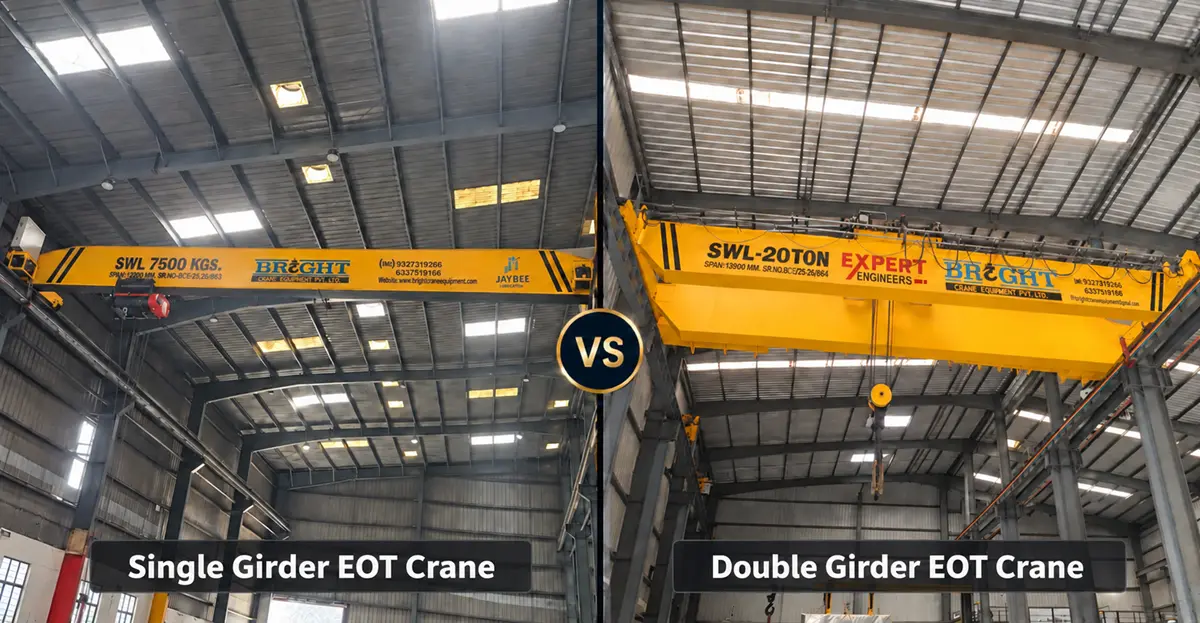
Capacity is the main trigger for this decision, but it is not the only one. Span, duty class and required hook height matter just as much.
When to Choose Single Girder
Single girder makes sense when the numbers stay moderate on all three counts: capacity up to about 10-12.5 tonnes, span up to roughly 18–20 m, and light to medium duty. Some manufacturers do build single girder cranes up to 20 tonnes, but only at short spans and low duty - girder section and deflection limits become the constraint long before the hoist does.
The advantages are real:
- Lower crane deadweight, so lighter runway beams, columns and foundations.
- Lower supply cost, commonly around a third less than a comparable double girder machine.
- Simpler installation and fewer components to maintain.
When to Choose Double Girder
Double girder is the right choice at 20 tonnes and above, and often below that when any of the following is true:
- Span exceeds about 20 m.
- You need maximum hook height under an existing roof.
- Duty class is heavy or the crane runs continuous production cycles.
- You need a walkway, cabin, auxiliary hoist, magnet or grab, or a maintenance platform on the bridge.
- Hook approach has to be close to the runway on both sides.
Because the crab travels on rails on top of the girders, the hook can be raised almost to roof level - which is why double girder frequently wins on lifting height even when capacity alone would not demand it.
Cost, Headroom and Maintenance Differences
| Factor | Single girder | Double girder |
|---|---|---|
| Practical capacity | Up to ~10–12.5 T (20 T in limited cases) | 5 T to 100 T and above |
| Supply cost | Roughly 30–45% lower for the same capacity | Higher structure, crab and electrics cost |
| Hook height | Reduced - hoist hangs below the girder | Maximum - crab sits above the girders |
| Hook approach | Wider dead zone at span ends | Closer approach on both sides |
| Deadweight on runway | Lower | Higher, needs a stronger runway |
| Maintenance access | Ladder or platform access to the hoist | Walkway along the bridge, easier access |
| Attachments and upgrades | Limited | Magnet, grab, auxiliary hoist, cabin all feasible |
Key Technical Parameters Linked to Lifting Capacity
Capacity never travels alone. These four parameters move with it and belong in the same conversation.
Span Length and Its Impact on Structure
Span is the centre-to-centre distance between the runway rails. Bending moment on a bridge girder rises with the square of the span, so a 10 ton crane at 25 m span is a substantially heavier structure than the same 10 ton crane at 12 m. Deflection limits - typically in the range of span/750 to span/1000 for the loaded girder, depending on class - usually govern the design before stress does.
Practical implication: if your bay is wide, expect the girder section and its cost to jump even though the tonnage has not changed. Where a very wide bay is unavoidable, an intermediate column line or a revised bay layout is sometimes cheaper than the extra steel.
Lifting Height and Hook Approach
Lifting height is the vertical travel from the lowest hook position to the highest. Two related numbers decide whether you actually get it:
- Headroom - vertical distance from the top of the rail to the underside of the roof structure. Deeper girders at higher capacities eat into this.
- Hook approach - how close the hook can get to the runway at each end of the span. Poor hook approach means dead zones at both edges of the bay where you cannot pick or place.
At higher capacities, low-headroom designs and close hook approach cost real money, so measure the building first and confirm the roof truss bottom chord level before finalising the crane.
Duty Class (IS Codes and FEM) and Cycle Frequency
Duty class describes how hard the crane works - lifts per hour, average load as a fraction of rated load, and hours of operation per day. Two 20 ton cranes with identical capacity can carry completely different mechanisms if one lifts four times a shift and the other runs continuously.
| Indian class (IS 3177) | Equivalent FEM/ISO group | Service condition | Typical use |
|---|---|---|---|
| Class I | M3 | Light | Powerhouses, maintenance bays, occasional lifts |
| Class II | M5 | Medium | General manufacturing, machine shops |
| Class III | M6 | Heavy | Foundries, fabrication yards, warehouses |
| Class IV | M7–M8 | Very heavy / continuous | Steel plants, ladle handling, magnet and grab duty |
In Indian practice, IS 3177 covers electric overhead travelling cranes and defines these duty classes, while IS 807 is the code of practice for design, erection and testing of crane structures. FEM/ISO M-groups are commonly used in parallel, especially for hoist selection. Specifying capacity without specifying duty class is the single most common gap in an enquiry - and the main reason two quotes for "20 ton" can differ enormously.
Hoist Type: Wire Rope vs Chain vs Crab Unit
Below about 5 tonnes the choice is rarely obvious, and this comparison of an electric chain hoist vs wire rope hoist works through where each one fits.
| Hoist type | Practical capacity range | Best suited to |
|---|---|---|
| Electric chain hoist | Up to about 5 T | Short lifts, light duty, low headroom, low frequency |
| Packaged wire rope hoist | 1–20 T, some units up to 32 T | Most single girder and lighter double girder cranes |
| Open-winch crab unit | 20 T and above | Heavy duty, long lifts, high frequency, custom reeving |
Rope reeving also changes with capacity: 4-fall reeving is typical at medium capacities, while 8-fall and 12-fall arrangements appear at 50 T and above to keep rope diameter and drum size manageable.
How to Select the Right EOT Crane Capacity for Your Plant
Calculating Maximum Load Including Attachments
Work through it in this order:
- Heaviest single load. Take the actual maximum, not the average - including loads you handle only occasionally.
- Add below-the-hook equipment. Slings, shackles, spreader beam, C-hook, magnet, grab, tilting device, ladle bail. This is routinely 5–15% of the load and is sometimes far more.
- Add a safety and growth margin. A 10–25% margin absorbs weighing errors, wet or scaled material, and the load you have not thought of yet.
- Round up to the next standard capacity step. Do not specify 11 T when 12.5 T is a catalogue rating.
Worked example: heaviest casting 8,200 kg + spreader beam and slings 750 kg = 8,950 kg. Add a 15% margin and you are at roughly 10,300 kg. The correct specification is a 12.5 ton crane, not a 10 ton one.
Separately, remember that the structure sees more than the static load. Design codes add a dynamic or impact allowance on the hoisted load, plus horizontal forces from acceleration, braking and skewing. Your crane supplier applies these factors; your building consultant needs the resulting wheel loads.
Future-Proofing for Capacity Expansion
Upgrading capacity later is expensive because it touches the girders, end carriages, wheels, runway and often the building itself. Two low-cost decisions taken now protect you:
- Choose the next standard step up if your forecast load growth is realistic rather than hypothetical.
- Design the runway and columns for a higher capacity even if you buy the smaller crane today - structural steel added at construction stage is far cheaper than retrofitting it.
Think about duty class growth too. A plant moving from single-shift to three-shift operation needs a higher duty class at the same tonnage, and that is not a field upgrade.
Matching Capacity with Building Structure and Runway
Before the capacity is frozen, confirm:
- Runway beam capacity - maximum wheel load, beam section and rail size.
- Column and foundation capacity - vertical wheel loads plus lateral surge and longitudinal braking forces.
- Rail alignment and level tolerances - span tolerance, straightness and level across the runway.
- Headroom - clear height from rail top to the lowest roof member.
- Power supply - incoming supply, DSL or festoon arrangement, and cable sizing for the crane's motor load.
For an existing shed, get the runway checked by a structural engineer before ordering. Retrofitting a heavier crane into a building designed for a lighter one is the most common and most expensive surprise in this process.
EOT Crane Capacity Selection Checklist
Run through this list before you send out an enquiry - it also makes the quotes you get back comparable.
- ☐Heaviest single load, verified by weighing rather than estimated
- ☐Weight of all below-the-hook attachments added
- ☐Safety and growth margin applied (10–25%)
- ☐Rounded up to a standard capacity step
- ☐Span measured centre-to-centre of runway rails
- ☐Required lifting height and lowest hook position confirmed
- ☐Available headroom to the lowest roof member measured
- ☐Hook approach requirement at both ends of the span defined
- ☐Duty class fixed from lifts per hour, average load and operating hours
- ☐Single or double girder decided on capacity, span and duty together
- ☐Auxiliary hoist requirement decided
- ☐Control type chosen: pendant, radio remote or cabin
- ☐VFD or two-speed control specified for each motion
- ☐Runway beam, column and foundation capacity verified
- ☐Power supply and current collection arrangement confirmed
- ☐Safety devices listed: overload limiter, limit switches, anti-collision, rail clamps
- ☐Testing, inspection and certification scope agreed
Common EOT Crane Capacity Mistakes to Avoid
Underestimating Load Weight and Dynamics
Loads get heavier than the drawing says - scale on castings, water in scrap, uncleaned moulds, an extra plate in the stack. Add the dynamic effect of snatch lifting, sudden braking and load swing, and the peak force on the hoist can comfortably exceed the static weight. Weigh your loads instead of estimating, and never plan on the crane "just managing".
Ignoring Duty Class and Service Conditions
Buying the right tonnage at the wrong duty class is a slow-motion failure. The crane lifts fine on day one, then brakes, contactors, gearboxes and rope wear out far ahead of schedule because the mechanism was sized for occasional use and is doing continuous production. Ambient conditions matter as well - foundry heat, cement dust, textile lint, coastal humidity and corrosive fumes all change motor class, enclosure protection and paint specification.
Overlooking Maintenance and Inspection Requirements
Higher capacity means a higher consequence of failure, and inspection scope should scale with it. Regardless of tonnage, plan for daily pre-shift checks by the operator, monthly checks of brakes, rope and limit switches, and periodic thorough examination and load testing by a competent person as required under the applicable Factories Rules. Keep the test certificates and inspection register current - they are the first documents asked for after any incident.
EOT Crane Capacity and Cost: What to Expect
Price Trends from 1 T to 100 T Cranes (Indicative)
The figures below are indicative supply-cost ranges compiled from publicly published Indian crane price guides and verified in September 2026. They assume a standard span of roughly 10–15 m, moderate lift height and medium duty, and they exclude GST, runway beams, civil work and site electricals. Use them for budgeting and for sanity-checking quotes - not as a quotation.
| Capacity | Usual configuration | Indicative supply price range (ex-GST) |
|---|---|---|
| 1–2 T | Single girder | ₹3.5–9 lakh |
| 3–5 T | Single girder | ₹5–18 lakh |
| 5 T | Double girder | ₹10–16 lakh |
| 10 T | Single girder | ₹10–24 lakh |
| 10 T | Double girder | ₹16–35 lakh |
| 15 T | Double girder | ₹22–50 lakh |
| 20 T | Double girder | ₹30–75 lakh |
| 25 T | Double girder | ₹40–95 lakh |
| 30 T | Double girder | ₹50 lakh – ₹1 crore |
| 50 T | Double girder | ₹85 lakh – ₹2.2 crore |
| 100 T | Double girder, project-engineered | Not publicly benchmarked - quoted per project, typically well above the 50 T band |
Two things to note. First, the spread within each row is wide because span, duty class, controls and supplier tier move the price more than tonnage alone. Second, GST at 18% applies on top, and installed cost typically runs several lakh above the supply price once runway rail, erection, load testing and site electricals are added. Capacity-wise ranges are discussed further in this EOT crane price in India breakdown.
Factors That Most Affect EOT Crane Price in India
In roughly descending order of impact:
- Capacity and girder configuration: the base of the price.
- Span: cost rises faster than linearly as span grows.
- Duty class: a Class IV crane can cost far more than a Class I crane of identical tonnage.
- Lift height and reeving: more rope, taller structure, bigger drum.
- Control system: VFD on all motions and radio remote add meaningfully over pendant and two-speed control.
- Attachments: magnet, grab, spreader beam, tilting device, auxiliary hoist.
- Steel prices: plate and structural steel rates move quoted prices quarter to quarter.
- Site scope: runway rail, erection, testing, commissioning and any civil work.
FAQs on EOT Crane Lifting Capacity
1. Does the hook block count against the rated capacity?
No. The hook block, rope and crane structure are part of the crane's own design weight, not your payload. What counts against capacity is everything you attach below the hook - slings, shackles, spreader beam, magnet or grab.
2. Do higher-capacity EOT cranes lift more slowly?
Generally yes. Hoisting speed reduces as capacity increases, because a bigger drum, heavier reeving and higher motor torque are involved. This is normal, and a VFD or dual-speed hoist is used to get a slow "creep" speed for accurate spotting.
3. Can two EOT cranes lift one load together?
Yes, this is called tandem lifting, but you cannot simply add both ratings together. Combined capacity is de-rated to allow for uneven load sharing, and the lift needs supplier approval, a written lift plan and a trained operator on each crane.
4. Does the rated capacity have to be marked on the crane?
Yes. The safe working load must be clearly and permanently marked so it is readable from the floor, and the crane should have its identification number, test certificate and inspection records available. This is a basic requirement under the Factories Act and State Factories Rules.
5. What is the difference between 5 ton and 10 ton EOT crane selection?
Both are usually single girder at moderate spans, so the real difference is downstream: a 10 ton crane has a heavier girder, higher wheel loads and a larger hoist, which means a stronger runway and a higher installed cost. If your genuine maximum load including attachments is around 6–8 tonnes, the 10 ton crane is the safer specification; if it sits comfortably under 4.5 tonnes, 5 ton is adequate and cheaper to install.
6. Which capacity is best for a typical Ahmedabad or Gujarat factory?
It varies by industry. Textile and general engineering units in and around Ahmedabad most often work in the 2–10 ton range. Structural fabrication, forging and pipe manufacturing sit in the 15–30 ton band. Foundries, heavy engineering and larger process plants move into 30–100 tonnes, usually double girder with an auxiliary hoist. Working with a supplier close to your plant helps considerably with erection and after-sales response - this list of crane manufacturing companies in Ahmedabad is a useful starting point.