
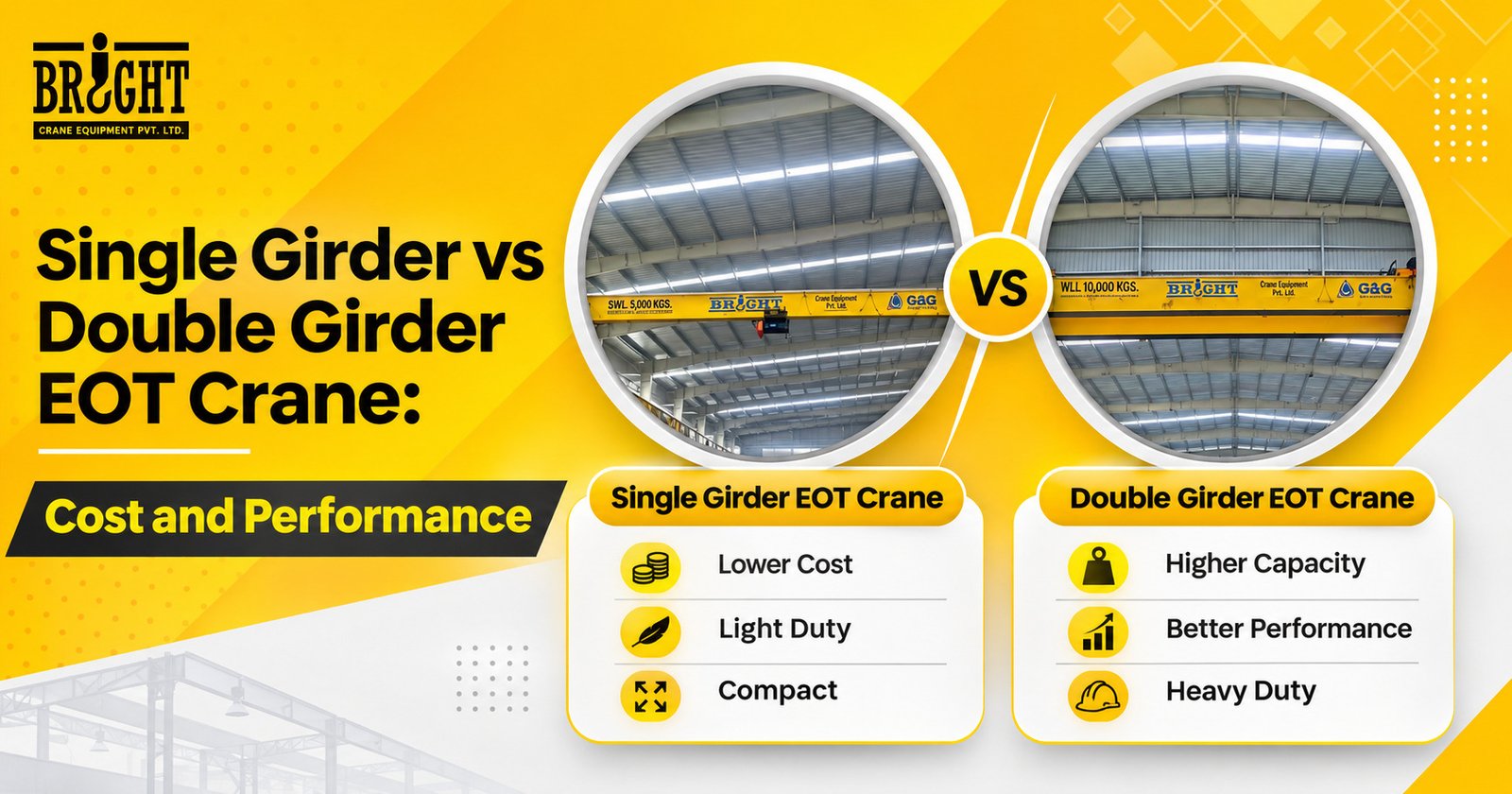
A single girder EOT crane uses one bridge beam with a hoist running underneath; it's lighter, cheaper and ideal for loads up to about 10–15 tonnes on spans up to about 20–25 m with light to moderate use. A double girder EOT crane uses two beams with a trolley running on top; it costs more but offers higher capacity, longer spans, greater hook height and heavier-duty operation. In India, marketplace listings in November 2026 showed single girder cranes from about ₹2–8.5 lakh and double girder cranes from about ₹5 lakh to ₹50 lakh or more, depending on capacity, span and scope.
Electric overhead travelling (EOT) cranes are the backbone of material handling in factories, warehouses, workshops and plants across India. They lift and move raw materials, machines, moulds, coils and finished products safely and efficiently, using space above the floor that would otherwise go unused.
One of the first decisions in any crane project is whether to choose a single girder EOT crane or a double girder EOT crane. The choice affects not only the purchase price but also building design, lifting height, speed, maintenance access and long-term productivity. Choose too small and you limit operations; choose too large and you overspend on steel, building structure and power.
This guide compares single girder vs double girder EOT crane design, performance, costs and applications, with indicative EOT crane prices in India, so you can make an informed decision.
It's written by the team at Bright Crane Equipment, an Ahmedabad-based crane manufacturer with more than 15 years of engineering experience and over 4,500 installations for clients including BHEL, L&T, Indian Railways, Aditya Birla and Voltas.
Single Girder EOT Crane
Definition and Design Features
A single girder EOT crane has one main bridge girder spanning the width of the building, supported by end carriages that travel along runway rails. The hoist, usually an electric wire rope or chain hoist, runs on the bottom flange of the girder.
Key design features:
- One I-beam or fabricated box girder
- Underslung hoist and trolley running on the bottom flange
- Lighter end carriages and wheels
- Lower dead weight, reducing loads on the building
- Usually pendant or radio remote control
- Available as top-running or underslung designs
Learn more about our single girder EOT cranes.
Advantages
- Lower purchase cost: Less steel, simpler trolley and smaller end carriages.
- Lower building cost: Lighter wheel loads mean lighter runway beams and columns.
- Faster installation: Fewer components and simpler assembly.
- Better hook approach at the ends: The hoist can often travel closer to the end carriages.
- Lower power consumption: Lighter structure and smaller motors.
- Simpler maintenance: Fewer parts to inspect.
- Ideal for workshops: Well suited to light and medium-duty work.
Disadvantages
- Limited capacity: Usually best for loads up to about 10–15 tonnes.
- Limited span: Typically economical up to about 20–25 m.
- Lower hook height: The hoist hangs below the girder, using some headroom.
- No walkway in most designs: Maintenance often needs a platform or ladder.
- Lower duty classes: Less suited to continuous, heavy, multi-shift use.
Single Girder EOT Crane Price in India
Marketplace listings checked in November 2026 show the following indicative prices for single girder cranes:
|
Capacity |
Example listed span |
Indicative listed price |
|
2 tonnes |
10 m |
About ₹2 lakh |
|
3.5–5 tonnes |
15–20 m |
About ₹2–4.2 lakh |
|
7.5 tonnes |
14 m |
About ₹4.8 lakh |
|
10 tonnes |
20 m |
About ₹2–8 lakh |
|
15 tonnes |
Not stated |
About ₹8.5 lakh |
Source: IndiaMART and TradeIndia supplier listings, November 2026. Listings rarely state what's included (runway, rails, electrification, installation, GST), so treat these as rough indicators, not quotations.
Double Girder EOT Crane
Definition and Design Features
A double girder EOT crane has two parallel bridge girders, with a crab or trolley running on rails mounted on top of the girders. The hoist mechanism sits on the trolley between the girders.
Key design features:
- Two box or plate girders connected by end carriages
- Top-running crab trolley with its own hoist, gearbox and travel drives
- Walkways and platforms for maintenance access
- Higher-capacity wheels, bearings and drives
- Can carry auxiliary hoists, magnets, grabs and special attachments
- Suitable for cabin, pendant or radio control
Explore our double girder EOT cranes.
Advantages
- High capacity: Suited to heavy loads, from about 10 tonnes to well over 100 tonnes.
- Long spans: Economical for wide bays, often 30 m or more.
- Greater hook height: The hook can rise between the girders, giving more usable lift.
- Heavy-duty operation: Designed for frequent, continuous and multi-shift work.
- Easier maintenance: Walkways give safe access to the trolley and drives.
- More options: Auxiliary hoists, faster speeds, cabin control and special attachments.
- Better stiffness: Lower deflection for precise handling of heavy loads.
Disadvantages
- Higher purchase cost: More steel, a heavier trolley and larger drives.
- Higher building cost: Heavier wheel loads need stronger runway beams and columns.
- More headroom above the rail: The crane's top sits higher, so the building may need to be taller.
- Longer installation time: More components and heavier lifts.
- Higher power demand: Larger motors and heavier structure.
Double Girder EOT Crane Price in India
Marketplace listings checked in November 2026 show these indicative prices:
|
Capacity |
Indicative listed price |
|
3–5 tonnes |
About ₹5–6 lakh |
|
5–10 tonnes |
About ₹5–10 lakh |
|
15 tonnes |
About ₹15 lakh |
|
20 tonnes |
About ₹18 lakh |
|
30–40 tonnes |
From about ₹15 lakh upwards |
|
Large or custom heavy-duty cranes |
₹50 lakh or more |
Source: TradeIndia supplier listings, November 2026. Prices vary widely with span, duty class, speeds and scope, so request detailed quotations.
Key Differences Between Single Girder and Double Girder EOT Cranes
Side-by-Side Comparison
|
Feature |
Single girder EOT crane |
Double girder EOT crane |
|
Number of girders |
One |
Two |
|
Hoist position |
Below the girder |
On a trolley running on top of the girders |
|
Typical capacity |
Light to medium (about 1–15 t) |
Medium to very heavy (about 10 t to 100+ t) |
|
Typical economical span |
Up to about 20–25 m |
30 m and more |
|
Hook height |
Lower for the same rail level |
Higher |
|
Duty class |
Light to moderate |
Moderate to very heavy |
|
Speeds |
Standard |
Higher speeds available |
|
Maintenance access |
Usually needs a platform |
Walkways on the girders |
|
Dead weight and wheel loads |
Lower |
Higher |
|
Building cost impact |
Lower |
Higher |
|
Purchase price |
Lower |
Higher |
|
Best for |
Workshops, assembly, warehouses |
Steel plants, heavy engineering, power, shipbuilding |
Performance Metrics
|
Metric |
Single girder |
Double girder |
|
Lifting capacity |
Limited by girder and hoist size |
Much higher, with auxiliary hoist options |
|
Span capability |
Shorter |
Longer, with less deflection |
|
Hook height |
Reduced by hoist below the girder |
Maximised by trolley on top |
|
Duty cycle |
Intermittent use |
Frequent, continuous and multi-shift use |
|
Hoist and travel speeds |
Moderate |
Higher, often with variable speed drives |
|
Precision |
Good for light loads |
Better stiffness for heavy, precise lifts |
|
Attachments |
Limited |
Grabs, magnets, spreader beams, rotating hooks |
Load Capacity and Operational Efficiency
Load capacity is the clearest dividing line. For loads up to about 10 tonnes on moderate spans, a single girder crane usually does the job at lower cost. Above about 15–20 tonnes, or for spans beyond about 25 m, a double girder crane is normally the practical choice.
Operational efficiency depends on how the crane is used:
- Low to moderate use (a few lifts per hour, single shift): single girder cranes offer the best value.
- High use (frequent lifts, multiple shifts, long travel distances): double girder cranes with higher duty classes and faster speeds keep production moving and last longer.
- Height-critical operations: double girder cranes give more usable hook height in the same building.
Duty class matters as much as capacity. A 5-tonne crane lifting near full load all day in a steel plant needs a much more robust design than a 5-tonne crane used occasionally in a maintenance bay. Indian practice follows IS 3177 and IS 807 for crane classification and design.
Cost Comparison: Single Girder vs Double Girder EOT Crane Prices in India
Breakdown of Costs
The crane's purchase price is only part of the total project cost.
|
Cost element |
Single girder |
Double girder |
|
Crane structure (girder, end carriages) |
Lower |
Higher (two girders, heavier end carriages) |
|
Hoist and trolley |
Standard electric hoist |
Crab trolley with separate drives |
|
Electricals and controls |
Simpler |
More complex, often with VFDs |
|
Runway beams and rails |
Lighter |
Heavier |
|
Building columns and foundations |
Lighter |
Stronger |
|
Building height |
Lower possible |
May need more height above rail |
|
Installation |
Faster and simpler |
Longer, often needs larger lifting equipment |
|
Power consumption |
Lower |
Higher |
|
Maintenance |
Fewer components |
More components, but easier access |
At the same capacity and span, a single girder crane is almost always the lower-cost option. For example, November 2026 listings showed 5-tonne single girder cranes from about ₹4.2 lakh and 5-tonne double girder cranes from about ₹5 lakh, with the gap widening as span and duty increase.
Factors Affecting EOT Crane Pricing
- Capacity: Heavier loads need larger girders, hoists and drives.
- Span: Longer spans need deeper girders and more steel.
- Height of lift: Longer lifts need more rope and larger drums.
- Duty class: Heavy-duty cranes use larger motors, gearboxes and bearings.
- Speeds: Faster hoisting and travel speeds, and variable frequency drives, add cost.
- Controls: Pendant, radio remote or operator cabin.
- Environment: Flameproof, outdoor, high-temperature or corrosive conditions.
- Safety features: Overload protection, anti-collision devices and additional limit switches.
- Runway and electrification: Whether runway beams, rails and power supply are included.
- Steel prices: Structural steel is a large share of crane cost.
- Installation, freight and GST.
When comparing EOT crane prices in India, always compare quotes for the same capacity, span, lift, duty class, speeds and scope.
Look at Total Cost of Ownership
The cheapest crane isn't always the lowest-cost option over 10–20 years. A single girder crane pushed beyond its duty class wears faster, needs more frequent repairs and may cause costly production stoppages. A double girder crane bought for occasional light lifting ties up capital, steel and building height that could be used elsewhere. The best value comes from matching the crane's capacity, span and duty class to real operating needs, with a small margin for future growth, and from a manufacturer that offers reliable service and spare parts.
Choosing the Right Crane for Your Needs
Considerations by Application
|
Application |
Usually the better choice |
Why |
|
Workshops and maintenance bays |
Single girder |
Light loads, occasional use, lower cost |
|
Assembly lines and fabrication |
Single girder |
Moderate loads, good hook approach |
|
Warehouses and logistics |
Single girder |
Cost-effective for regular light lifting |
|
Automotive and engineering plants |
Single or double |
Depends on load and duty |
|
Steel plants and foundries |
Double girder |
Heavy loads, high duty, high temperatures |
|
Power plants and heavy engineering |
Double girder |
Very heavy components, precise handling |
|
Shipbuilding and large fabrication |
Double girder |
Heavy loads over long spans |
|
Paper, coil and plate handling |
Double girder |
Frequent heavy lifts and special attachments |
Considerations by Load Requirements
- Up to about 5 tonnes: Single girder in most cases.
- About 5–15 tonnes: Single girder for moderate use and spans; double girder for heavy use, long spans or extra hook height.
- Above about 15–20 tonnes: Usually double girder.
Considerations by Budget
- If budget is tight and loads, spans and usage are moderate, a single girder crane offers the best value.
- If downtime is costly, usage is heavy or future expansion is likely, a double girder crane is the better long-term investment.
- Always consider building costs alongside crane costs, especially for new buildings.
For help with span and hook coverage, see our guide to EOT crane span and hook coverage calculation.
Conclusion
The single girder vs double girder EOT crane decision depends on load, span, lift height, usage and budget. Single girder cranes are lighter, simpler and more affordable, making them ideal for workshops, assembly lines and warehouses with light to medium loads. Double girder cranes cost more but deliver higher capacity, longer spans, greater hook height and heavy-duty performance for steel plants, heavy engineering and power projects.
Look beyond the crane price to the total project cost, including runway, building structure, installation, power and maintenance, and choose a design and duty class matched to how the crane will actually be used.
Need expert advice? Explore Bright Crane's EOT cranes, wire rope hoists and full range of products, or contact our engineering team for a recommendation and detailed quotation for your project.
Frequently Asked Questions
What is the primary difference between single girder and double girder EOT cranes?
A single girder crane has one bridge beam with the hoist running underneath. A double girder crane has two beams with a trolley running on top, which allows higher capacity, longer spans, more hook height and heavier-duty use.
Which type of crane is more cost-effective?
For light to medium loads, moderate spans and intermittent use, a single girder crane is more cost-effective because it uses less steel and needs a lighter building structure. For heavy loads, long spans or intensive use, a double girder crane gives better long-term value.
What factors influence the price of EOT cranes in India?
Capacity, span, lift height, duty class, speeds, controls, environment, safety features, scope (runway, electrification, installation), steel prices, freight and GST all affect price.
How do I decide which crane is best for my application?
List your maximum load, span, lift height, number of lifts per hour, working shifts and building constraints. Then ask a crane manufacturer to recommend a design and duty class, and compare quotes on the same specification.
What is the price of a single girder EOT crane in India?
November 2026 marketplace listings showed single girder cranes from about ₹2 lakh for 2 tonnes to about ₹8.5 lakh for 15 tonnes, depending on span and scope.
What is the price of a double girder EOT crane in India?
Listings showed double girder cranes from about ₹5 lakh for small capacities to ₹15–18 lakh for 15–20 tonnes, and ₹50 lakh or more for large custom cranes.
Can a single girder crane be upgraded to a double girder crane?
Not directly. A double girder crane is a different design with different wheel loads and building requirements. Plan for future capacity before choosing.
Which crane needs more building height?
A double girder crane usually needs more height above the rail, but gives more hook height. A single girder crane needs less height above the rail, but the hoist hangs below the girder.