
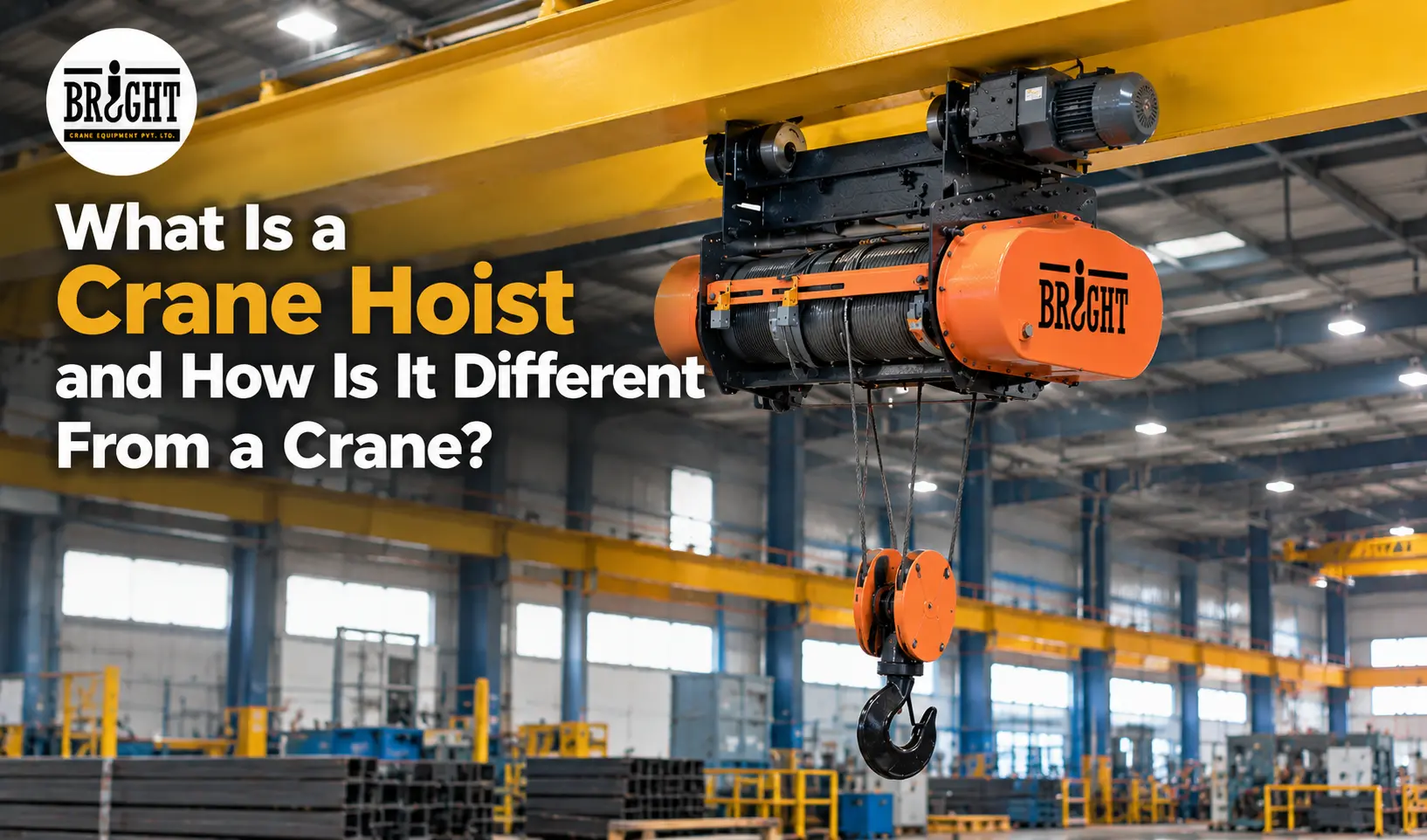
A crane hoist is the lifting mechanism of a crane. It raises, lowers and holds a load using a motor, gearbox, rope drum or chain wheel, wire rope or load chain, hook and a fail-safe brake. The hoist handles only the vertical lift; the crane structure (trolley, bridge girder and runway) moves the hoist horizontally. Wire rope hoists suit heavier loads and higher lifts, while electric chain hoists suit lighter, compact applications.
Whether you are selecting an industrial crane hoist, upgrading an existing lifting system or trying to understand how an overhead crane operates, knowing exactly what the hoist does, and what it does not do, helps you write a clearer specification and compare quotations fairly.
This guide is written by the engineering team at Bright Crane Equipment, a manufacturer of EOT cranes and hoists in Ahmedabad, Gujarat. It covers the definition, working principle, components, types, capacity selection and the most common questions buyers ask before ordering a hoist.
| Crane Hoist at a Glance | |
|---|---|
| What it does | Lifts, lowers and holds a suspended load |
| Lifting medium | Steel wire rope (on a drum) or alloy load chain (on a chain wheel) |
| Power source | Electric, manual, pneumatic or hydraulic |
| Main safety parts | Fail-safe brake, upper and lower limit switches, overload protection, hook safety latch |
| Mounted on | Fixed beam, trolley, monorail, jib arm, EOT or goliath crane girder |
| Key selection factors | Capacity, lifting height, duty class, speed, headroom, environment |
| Indian standards | IS 3938 (electric wire rope hoists), IS 3832 (hand chain pulley blocks), IS 3177 (EOT cranes) |
What Is a Crane Hoist?
A crane hoist is a mechanical lifting device designed to lift and lower loads in a controlled manner. It is the working heart of most industrial cranes, because every lift the crane makes is performed by the hoist.
A hoist uses a lifting medium, either a wire rope or a load chain, to connect the lifting mechanism to a hook. Depending on the design, it is powered by an electric motor, compressed air or manual effort through a hand chain. Electric hoists are by far the most common in Indian factories because they give consistent lifting speed and need only one operator.
The primary function of a crane hoist is vertical load movement. On its own, a hoist fixed to a beam can only lift straight up and down. When it is installed on a trolley, bridge, jib arm or monorail, the hoist can also be positioned horizontally within the working area of that structure.
Crane Hoist Definition
In simple terms, a crane hoist is the lifting mechanism that raises and lowers a load using a hook connected to a wire rope or chain.
A complete crane includes the hoist along with the structural and travel components, such as the bridge girder, end carriages, runway rails and travel drives, that allow the load to be moved across a defined working area.
What Is a Hoist in a Crane?
A hoist in a crane is the component responsible for lifting and lowering the load. While the hoist provides vertical movement, other crane components provide structural support and horizontal travel.
For example, in an EOT crane, the hoist is mounted on a trolley. The hoist lifts or lowers the load, the trolley carries the hoist across the bridge girder (called cross travel), and the bridge travels along the runway rails that run the length of the building (called long travel). These three motions together let the crane reach any point in the bay.
The relationship can be simplified as:
- Hoist = the lifting mechanism
- Crane = the complete lifting and material-handling system
This distinction matters when buying. The terms crane and hoist are not interchangeable: a hoist can be bought and installed on its own, but a crane cannot lift anything without a hoist or a similar lifting mechanism.
What Is the Difference Between a Crane and a Hoist?
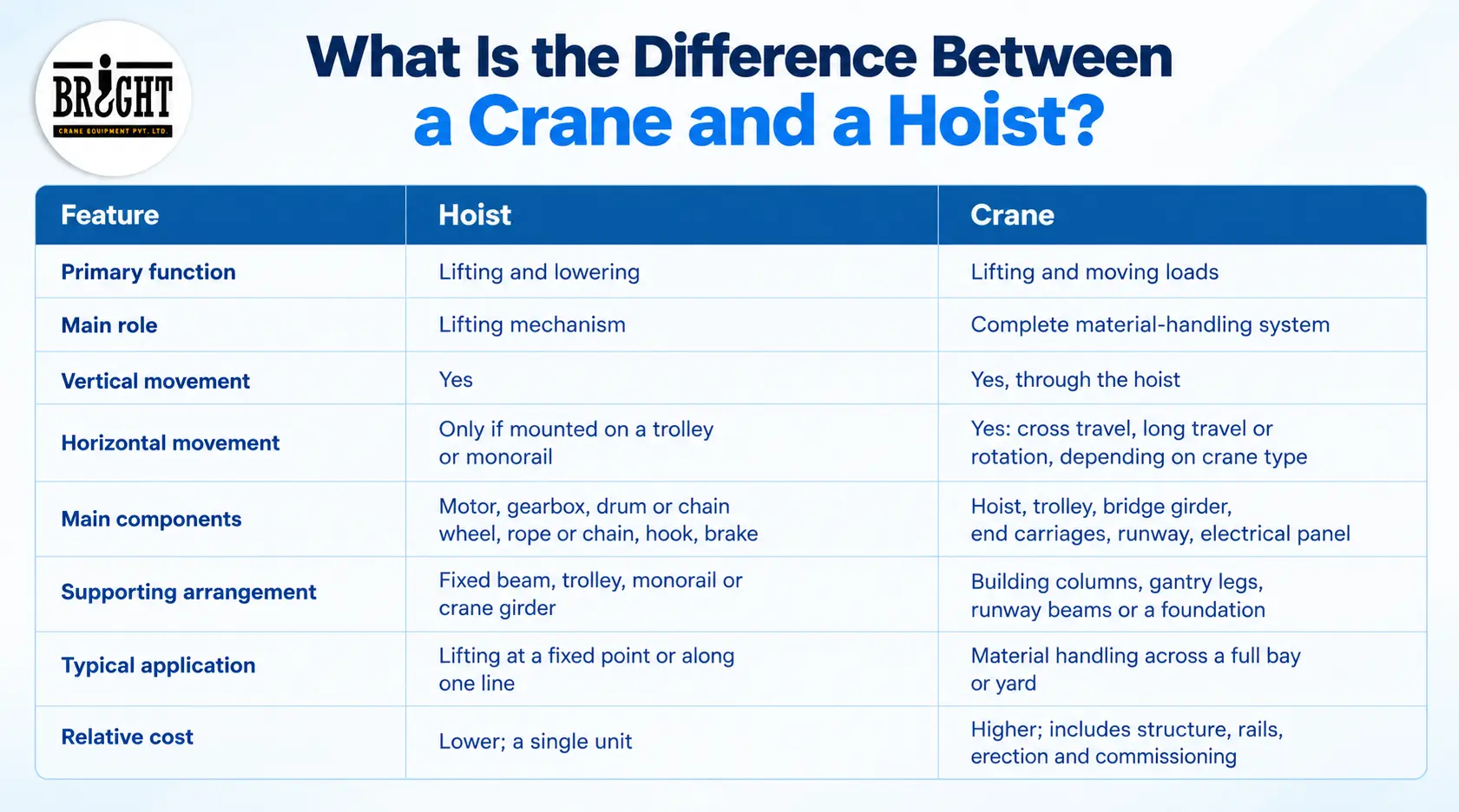
The main difference between a crane and a hoist is their scope. A hoist performs lifting and lowering, while a crane is a complete material-handling system designed to lift and move loads within a defined area.
Crane Hoist vs Crane: In Simple Terms
The easiest way to understand the crane hoist vs crane difference is:
A hoist performs the lifting, while a crane provides the overall system for lifting and moving the load.
For example, an EOT crane uses a wire rope hoist mounted on a trolley. The hoist lifts a 5 tonne steel coil off a trailer, and the trolley and bridge then carry that coil to a slitting machine at the other end of the shed. Without the crane, the same hoist could only lift the coil and set it back down in the same spot.
How Does a Crane Hoist Work?
A crane hoist works by converting electrical or manual power into controlled lifting and lowering movement. In a typical electric hoist, the motor drives a gearbox, the gearbox turns a rope drum or chain wheel, and that motion winds the wire rope or chain connected to the load hook.
The basic working process is:
- The operator gives a lifting command from a pendant push-button station or radio remote.
- The contactor energises the motor, and at the same moment the brake releases.
- The gearbox reduces the motor speed and multiplies its torque, so a compact motor can lift a heavy load.
- A grooved drum winds the wire rope, or a pocketed chain wheel pulls the load chain.
- The hook block rises and lifts the load.
- When the button is released, power to the brake is cut and the spring-applied brake clamps instantly, holding the load in position.
- Upper and lower limit switches cut the motor automatically if the hook reaches its safe travel limit.
During lowering, the motor runs in reverse while the gearbox and brake keep the descent controlled. Because the brake is fail-safe (spring-applied and released electrically), it also holds the load automatically during a power failure. This is the single most important safety feature of any crane hoist.
The exact working principle varies with hoist type, lifting medium, capacity, lifting height and duty class, but this power flow is common to almost every electric crane hoist.
What Are the Main Crane Hoist Components?
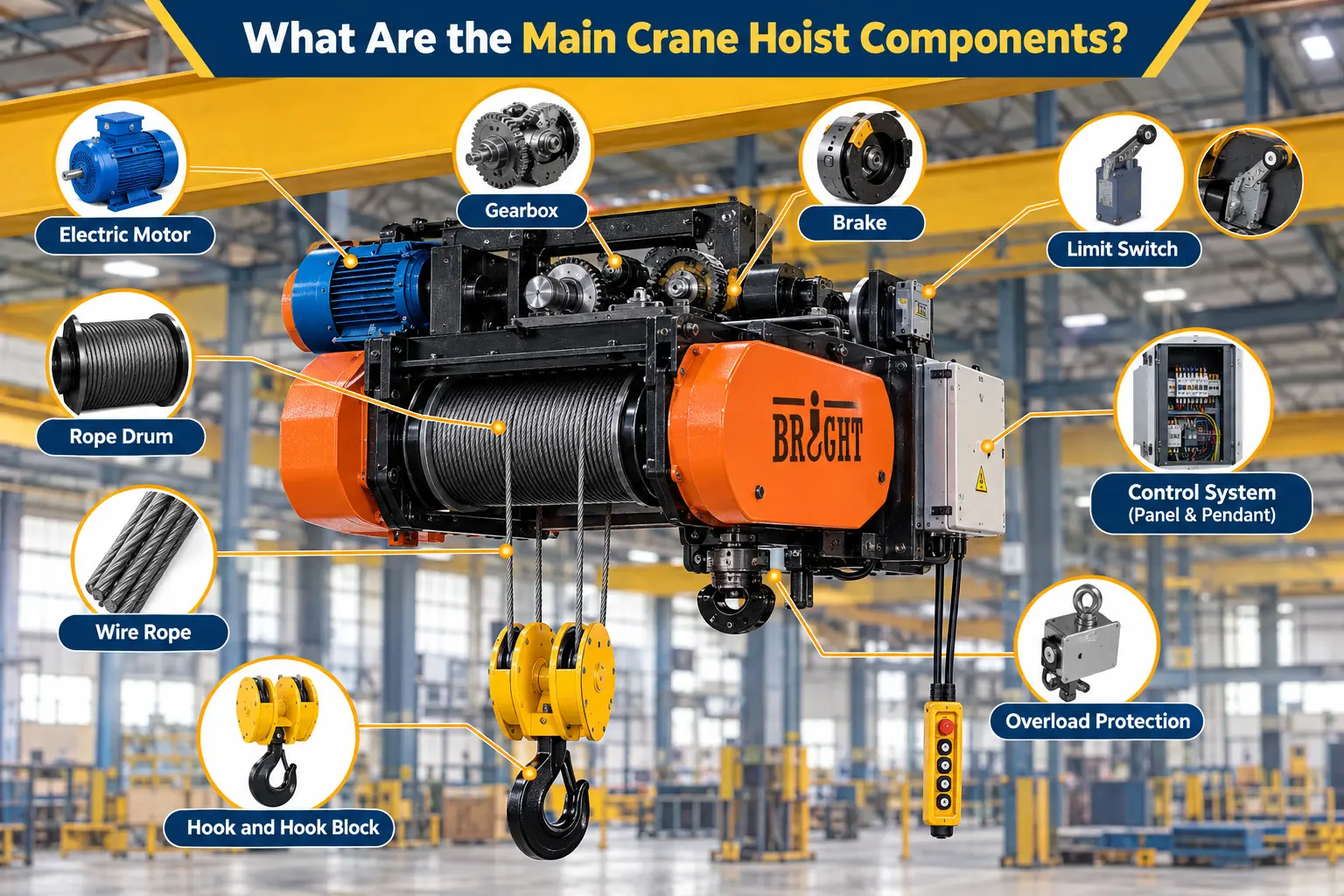
The main crane hoist components work together to provide controlled lifting, lowering and load holding. Knowing them helps you compare quotations: two hoists with the same capacity can differ greatly in motor rating, brake type and protection.
Electric Motor
The motor provides the lifting power. Crane-duty motors are rated for frequent starts and stops, usually with a cyclic duty rating such as 40% ED, and commonly come with Class F insulation and IP55 protection against dust and water.
Gearbox
The gearbox transfers power from the motor to the drum or chain wheel while reducing speed and increasing torque. Hardened, oil-bath helical gears give quieter running and longer life than open gearing.
Wire Rope or Chain
The lifting medium between the mechanism and the hook. Wire rope hoists use high-tensile galvanised or bright steel wire rope. Electric chain hoists commonly use hardened alloy load chain of grade 80 or higher.
Drum or Sprocket
A wire rope hoist uses a grooved drum that winds the rope in a single, even layer. A chain hoist uses a pocketed chain wheel (sprocket) that grips each chain link, with the slack chain collecting in a chain container.
Hook and Hook Block
The hook connects the load to the hoist. It is a forged hook with a safety latch that stops slings from slipping off, and it swivels so the load can be turned. The hook block also carries the sheaves (pulleys) that the rope passes through.
Brake
An electromagnetic, spring-applied brake stops the lifting movement and holds the load whenever the motor is not running, including during power cuts. Brake condition is the first thing to check in any hoist inspection.
Limit Switch
Upper and lower limit switches stop the hook before it hits the hoist body or before the rope unwinds too far from the drum. Some hoists also have travel limit switches on the trolley.
Control System
The operator controls lifting, lowering and travel through a pendant push-button station or a radio remote control. Radio remotes let the operator stand at a safe distance with a clear view of the load.
Overload Protection
An overload limiting device stops the hoist from lifting a load above its rated capacity. It protects the motor, gearbox, rope and crane structure from the most common cause of hoist damage.
What Are the Different Crane Hoist Types?
There are several crane hoist types, each designed for different capacities, lifting heights, duty cycles and working conditions. The capacity ranges below are typical market ranges, not fixed limits.
| Hoist Type | Lifting Medium | Typical Capacity | Best For |
|---|---|---|---|
| Electric wire rope hoist | Wire rope on drum | About 1 to 50 tonnes and above | EOT and goliath cranes, high lifts, frequent use |
| Electric chain hoist | Alloy load chain | About 0.25 to 5 tonnes (higher with multiple falls) | Workshops, assembly lines, jib cranes |
| Manual chain hoist | Load chain, hand chain | About 0.5 to 10 tonnes | Occasional lifts, maintenance, no power supply |
| Pneumatic hoist | Chain or rope, compressed air | Light to medium loads | Flammable or explosive atmospheres |
Electric Crane Hoist
An electric crane hoist uses an electric motor to power the lifting mechanism. It is the standard choice for industrial material handling because it gives consistent lifting speed, needs only one operator and can be fitted with dual-speed or VFD control for precise positioning.
Electric hoists are configured according to capacity, lifting height, speed, duty cycle and the crane arrangement they will be fitted on.
Wire Rope Crane Hoist
A wire rope crane hoist uses a steel wire rope wound around a grooved drum to raise and lower loads. It is the preferred choice for heavier loads, greater lifting heights and higher duty classes, which is why it is used on most EOT cranes and goliath cranes.
Wire rope hoists also lift faster at higher capacities and give a true vertical lift with minimal hook drift. See our wire rope hoist range for configurations.
Chain Hoist for Crane
A chain hoist for crane applications uses a load chain and chain wheel instead of a wire rope. Electric chain hoists are compact, lighter and easier to install, which makes them a good fit for jib cranes, light monorails and workstation cranes.
Their main limit is lifting height and capacity: chain hoists are best for lighter loads and moderate lifts. See our electric chain hoist options and the guide to types of chain hoists.
Manual Hoist
A manual hoist, also called a chain pulley block, uses operator effort through a hand chain rather than a motor. Internal gearing multiplies the operator's pull so one person can lift a heavy load. It suits maintenance work and sites with occasional lifting or no power supply. Our comparison of electric vs manual chain hoists explains when each makes sense.
Pneumatic Hoist
A pneumatic hoist runs on compressed air instead of electricity. Because it produces no electrical sparks, it is used in paint shops, chemical plants and other areas with flammable vapours, as well as in plants that already have a reliable compressed-air supply.
The right hoist type depends on the load, lifting height, duty cycle, operating environment, lifting speed and required movement, not on a general preference for one type.
What Is an Overhead Crane Hoist?
An overhead crane hoist is the lifting mechanism installed on an overhead crane system. It is mounted on a trolley that travels along the crane bridge.
A typical overhead crane arrangement works as follows:
- Hoist: lifts and lowers the load
- Trolley: moves the hoist across the bridge (cross travel)
- Bridge girder: supports the trolley and hoist
- Runway: provides the travel path for the whole crane (long travel)
The hoist arrangement changes with the crane design. On a single girder EOT crane, the wire rope hoist usually hangs under the girder on an underslung trolley. On a double girder EOT crane, the hoist sits on a crab that runs on rails on top of the two girders, which gives more hook height and allows much heavier loads. Our guide on the difference between single and double girder cranes explains this in detail, and you can also read how an overhead crane works.
Overhead crane hoists are used in manufacturing plants, engineering and fabrication units, warehouses, steel plants and any facility where loads must be moved across a covered bay.
What Is an Industrial Crane Hoist?
An industrial crane hoist is a lifting mechanism built for continuous material handling in factories and plants. Compared with a light workshop hoist, it is designed for more lifts per hour, heavier loads and harsher conditions such as dust, heat and humidity.
That usually means a higher duty class, crane-duty motors with thermal protection, a heavier gearbox, sealed electrical enclosures and components that can be serviced and replaced locally.
Industrial crane hoists are used to move machinery, dies, raw material, fabricated structures and finished products. Common industries include:
- Manufacturing and engineering
- Automotive and auto components
- Steel, metal and fabrication
- Warehousing and logistics
- Power generation and heavy engineering
- Foundries and forging units
For industrial use, selection should consider not only load capacity but also duty cycle, lifting height, operating frequency, speed, environment and travel requirements.
What Is the Crane Lifting Mechanism?
The crane lifting mechanism is the part of a crane that raises and lowers the load, and in most industrial cranes this is the hoist.
A typical lifting arrangement can be represented as:
Motor → Gearbox → Drum or Chain Wheel → Wire Rope or Chain → Hook Block → Load
One detail that buyers often miss is reeving, or the number of rope falls. In a 2-fall arrangement, the load hangs on two lines of rope; in a 4-fall arrangement, it hangs on four. More falls means each rope carries a smaller share of the load, so the same hoist can lift more, but the hook moves more slowly and a longer rope is needed for the same lifting height. This is why a heavy-capacity hoist is often slower than a light one.
Different crane designs use different lifting mechanisms depending on capacity, speed, lifting height and duty class. A double girder crane may also carry two hoists: a main hoist for heavy lifts and a faster auxiliary hoist for lighter jobs.
What Is Crane Hoist Capacity?
Crane hoist capacity is the rated load, or Safe Working Load (SWL), that a hoist is designed to lift under specified operating conditions. It is marked on the hoist and on the hook block, and it should never be exceeded.
The rated capacity already includes a safety margin in the design. Hoists and cranes are load-tested above their SWL at the factory and during commissioning (commonly a static overload test and a dynamic test as per the applicable standard), but that margin exists to protect people, not to be used in daily work.
Standard hoist capacities follow fixed steps, such as 1, 2, 3, 5, 7.5, 10, 15 and 20 tonnes. The capacity you choose must cover the heaviest load you lift regularly, plus anything hanging below the hook: slings, shackles, lifting beams and magnets.
Why Is a Hoist Used in an Overhead Crane?
A hoist is used in an overhead crane because it provides the controlled vertical movement needed to raise and lower loads. The bridge and trolley can position the load anywhere in the bay, but without a hoist there is nothing to pick the load up.
Using a separate hoist unit also makes the crane easier to maintain and upgrade. A worn hoist can be serviced or replaced without changing the crane structure, and a higher-capacity hoist can sometimes be fitted if the girder and runway are checked and certified for the new load.
How Do You Choose the Right Crane Hoist Capacity?
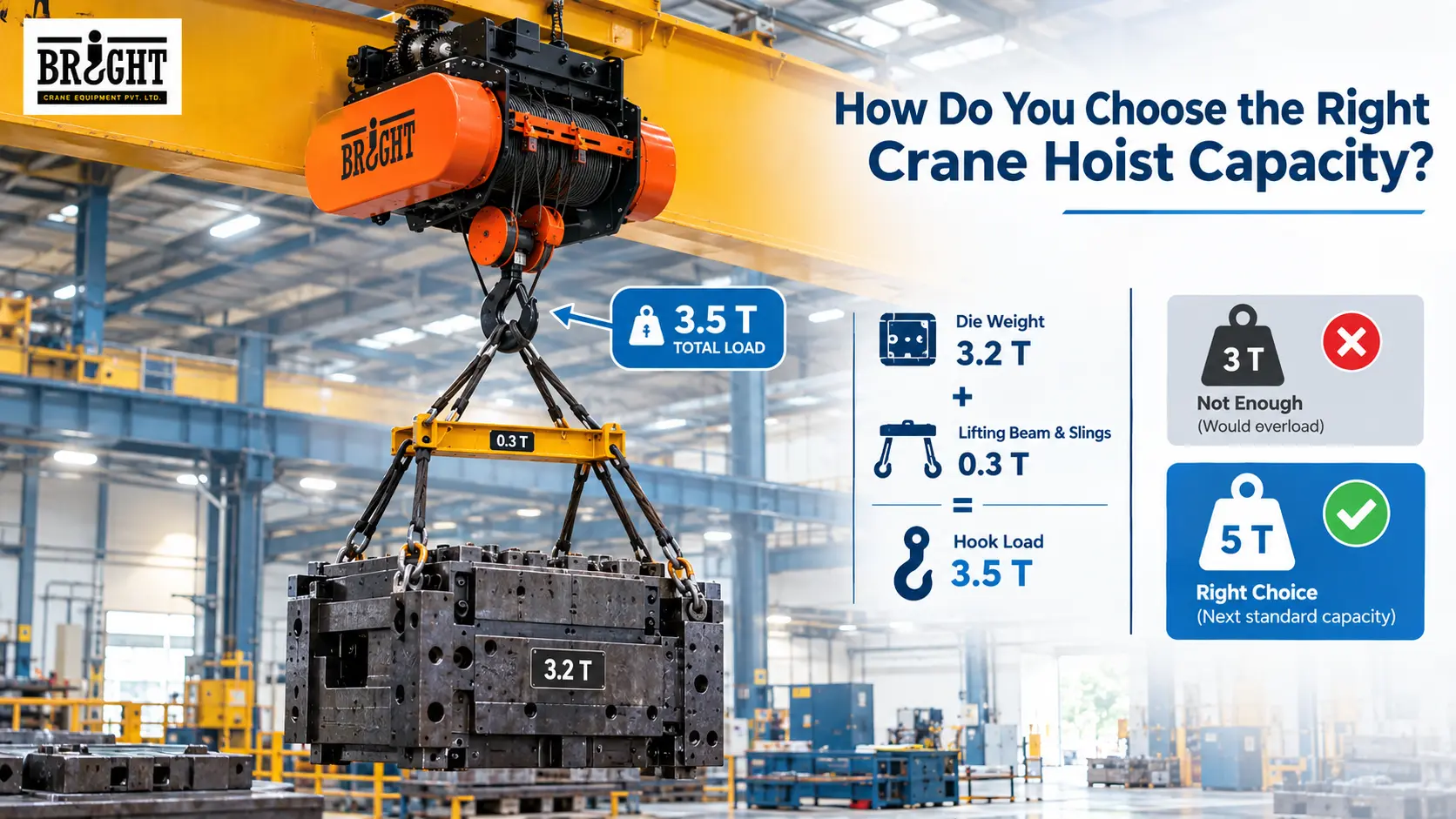
Choosing the right crane hoist capacity starts with the heaviest load you lift during normal operation, not the average load.
Worked example: Your heaviest regular job is a 3.2 tonne die. The lifting beam and slings add 0.3 tonnes, so the hook sees 3.5 tonnes. The next standard capacity above that is 5 tonnes, so a 5 tonne hoist is the correct choice. Choosing a 3 tonne hoist would mean overloading it every time you lift that die.
After capacity, evaluate:
- Required lifting height (floor to the highest hook position needed)
- Number of lifts per hour and hours of use per day
- Duty class, as defined in IS 3177 (see our guide to crane duty classes)
- Lifting speed, and whether a slow creep speed is needed for precise positioning
- Load type: rigid, loose, hot, hazardous or fragile
- Working environment: indoor, outdoor, dusty, humid or hot
- Horizontal travel required
- Power supply available at site
- Crane configuration and available headroom
- Applicable safety requirements and inspection rules
For sizing across a wider range, our EOT crane lifting capacity guide covers 1 ton to 100 ton applications.
Which Is Better for Industrial Lifting: Wire Rope Hoist or Chain Hoist?
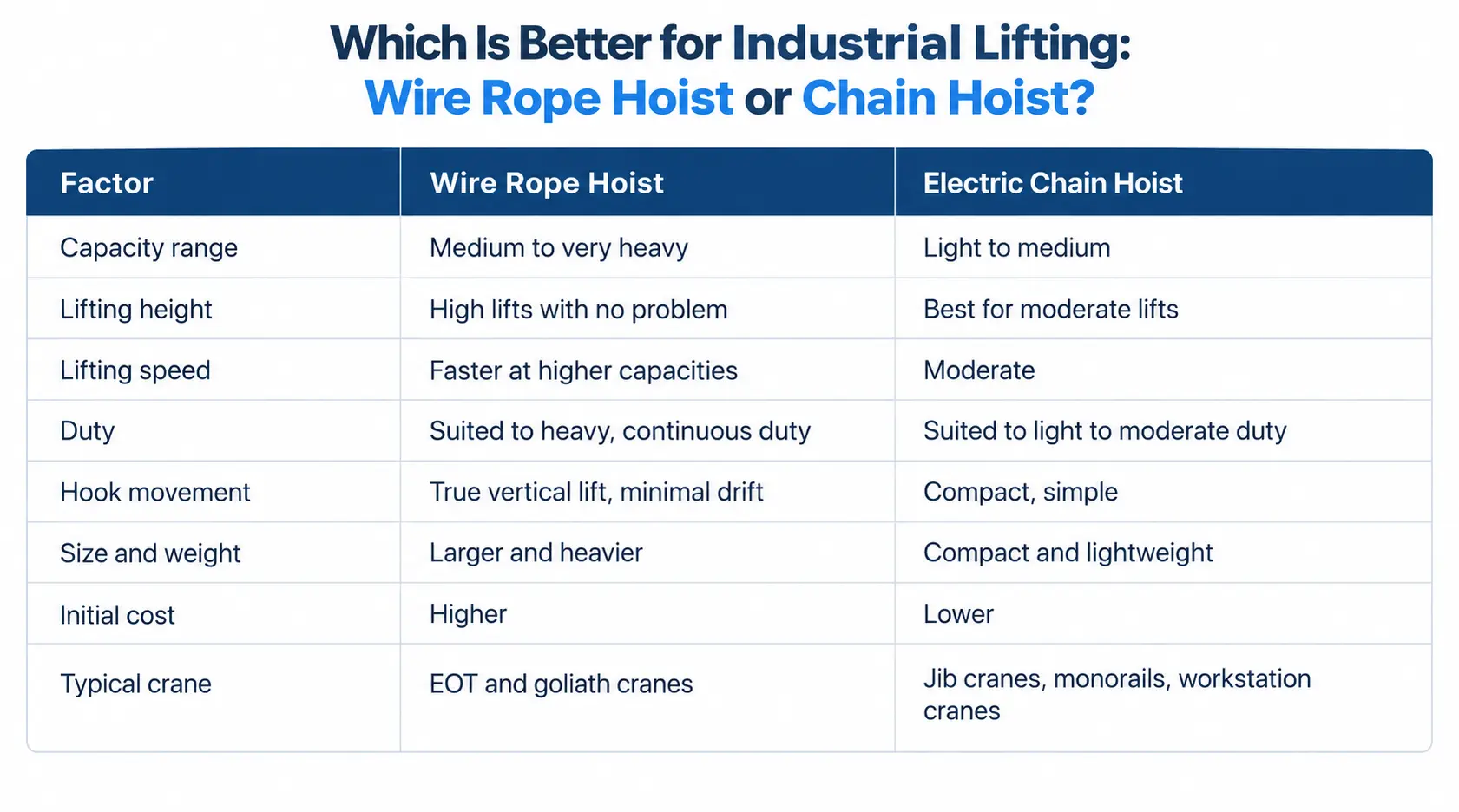
There is no single choice that suits every application. Wire rope hoists and chain hoists have different strengths, and the right choice depends on capacity, lifting height, duty, headroom and budget.
As a rule of thumb, a wire rope hoist is the better choice when loads are heavy, lifts are high or the hoist runs most of the shift. An electric chain hoist is the better choice for lighter loads, occasional use and tight spaces. For a detailed comparison, read electric chain hoist vs wire rope hoist.
Can a Crane Hoist Move Horizontally?
A crane hoist itself only lifts and lowers. It moves horizontally only when it is mounted on a travel system.
The hoist can be mounted in four common ways:
- Fixed (lug or base mounted): bolted to a beam or structure; vertical lift only.
- Hook suspended: hung from a hook or eye; can be moved manually between locations.
- Push trolley: the operator pushes the load along a beam; suits light loads and short travel.
- Geared or motorised trolley: the trolley is driven by a hand chain or a motor; suits heavier loads and longer travel.
In an overhead crane, the trolley gives cross travel and the bridge gives long travel. On a jib crane, the arm also rotates, giving the hoist a circular working area.
Can a Hoist Be Used Without a Crane?
Yes. A hoist can be used without a conventional overhead crane, as long as it is installed on a structure designed for the load.
Common examples include:
- Jib cranes at individual machines or loading bays
- Monorail systems that follow a fixed path, such as a line between two workstations
- Workstation lifting systems on assembly lines
- Fixed beams above a machine, pit or loading point
The supporting beam or structure must be designed by a qualified engineer for the hoist's rated load plus a margin for dynamic forces. Hanging a hoist from an existing roof truss or building beam that was never designed for lifting is one of the most common, and most dangerous, mistakes in small workshops.
When Should You Choose a Wire Rope Crane Hoist?
Choose a wire rope crane hoist when your application involves one or more of the following:
- Loads above the practical range of chain hoists
- Lifting heights of several metres or more
- Frequent lifting through most of the shift (higher duty class)
- Installation on an EOT or goliath crane
- A need for faster lifting speeds at higher capacities
- Precise positioning of heavy loads, where dual-speed or VFD control helps
Crane configuration, available headroom, operating environment and budget also play a part. Low-headroom wire rope hoists are available for buildings where the roof height is limited. Our blog on how much a wire rope hoist costs explains the price factors.
What Factors Affect Crane Hoist Capacity?
The capacity you need is affected by more than the weight of the load itself:
- Below-the-hook attachments: slings, shackles, spreader beams, magnets and vacuum lifters all add weight.
- Load behaviour: loads that swing, shift or are lifted from awkward angles put extra stress on the hoist.
- Duty cycle: a hoist working near its full capacity all day needs a higher duty class than one lifting occasionally.
- Future growth: if heavier products are planned in the next few years, choosing a higher capacity now is cheaper than replacing the hoist later.
- Supporting structure: the girder, runway and building must be rated for the hoist capacity, not only the hoist itself.
- Environment: high ambient temperatures, dust and moisture can reduce component life and call for higher protection ratings.
Capacity should always be decided on the actual lifting application, and confirmed with the hoist manufacturer before ordering.
What Industries Use Crane Hoists?
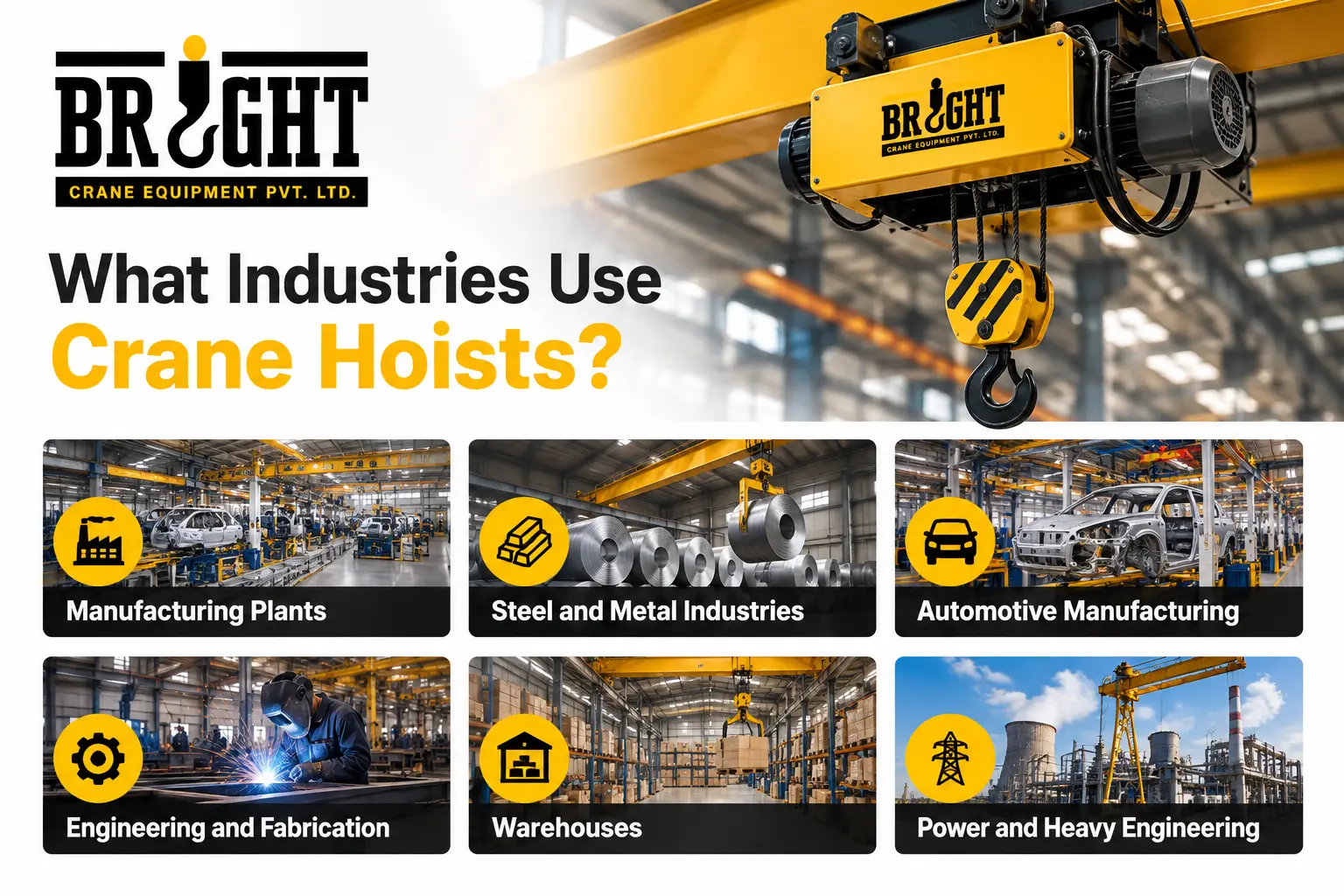
Crane hoists are used across every industry where heavy or awkward loads must be lifted regularly. In Gujarat, they are a daily part of work in industrial clusters such as Changodar, Sanand, Vatva, Naroda and Makarpura.
Manufacturing Plants
For handling machinery, components, raw material and finished products between production stages.
Steel and Metal Industries
For moving plates, coils, sections and fabricated structures, often at higher duty classes and in hot, dusty conditions.
Automotive Manufacturing
For handling press dies, moulds, engines and sub-assemblies on production lines.
Engineering and Fabrication
For positioning heavy jobs on CNC machines and presses, and for turning and assembling fabricated structures.
Warehouses
For loading and unloading trucks and stacking heavy stock where forklifts cannot reach or aisles are narrow.
Power and Heavy Engineering
For installing and servicing turbines, motors, pumps, fans and gearboxes during maintenance shutdowns.
How Is a Crane Hoist Different From Other Lifting Equipment?
A crane hoist is designed for controlled vertical lifting within a crane or a fixed support system. Other lifting equipment serves different purposes.
| Equipment | Main Movement | Best For | Main Limitation |
|---|---|---|---|
| Crane hoist | Vertical (horizontal when trolley-mounted) | Repeated lifting at fixed points or across a bay | Needs a support structure |
| Forklift | Floor-level lifting and transport | Palletised loads, stacking | Needs clear aisles; limited lift height |
| Winch | Mainly horizontal pulling | Dragging, hauling, tensioning | Not designed for overhead lifting unless rated for it |
| Mobile crane | Lifting and slewing with a boom | Outdoor, one-off or site lifts | High hire cost; needs space and setup |
The right equipment depends on load type and weight, lifting height, travel distance, working space and how often the lift happens. For repeated lifting inside a factory, a hoist on a crane is almost always safer and cheaper per lift than a forklift or a hired mobile crane.
How Can You Select the Right Crane Hoist for Your Application?
Start by defining the complete material-handling requirement rather than choosing a hoist on capacity alone. A simple selection sequence is:
Load → Capacity → Lifting height → Speed → Duty class → Environment → Travel → Controls
When you ask for a quotation, share these details so every supplier quotes the same specification:
- Heaviest load and type of load
- Required lifting height
- Span (for a crane) or beam size (for a standalone hoist)
- Number of lifts per hour and working hours per day
- Indoor or outdoor use, and any heat, dust or hazardous areas
- Single speed, dual speed or VFD control
- Pendant or radio remote control
- Power supply available at site
Once these requirements are clear, the right hoist type and crane configuration can be selected, and quotations from different manufacturers can be compared fairly.
Frequently Asked Questions About Crane Hoists
What is the difference between a hoist and a winch?
A hoist is designed to lift loads vertically and has a brake that safely holds a suspended load. A winch is designed mainly to pull loads horizontally, such as hauling material along the ground. A winch should not be used for overhead lifting unless it is specifically designed and rated for it.
Is inspection of a crane hoist mandatory in India?
Yes. Under Section 29 of the Factories Act, 1948, every lifting machine, including cranes and hoists, must be thoroughly examined by a competent person at least once every 12 months, and the results must be recorded. Many state factory rules add their own forms and load-test requirements.
How long does a crane hoist last?
A well-maintained industrial hoist that is correctly matched to its duty class commonly gives many years of service. Wear parts such as the wire rope or chain, brake lining and contactors are replaced periodically, while the gearbox and structure last much longer. Using a light-duty hoist for heavy, continuous work is the most common reason for a short hoist life.
What is the lead time for a new crane hoist?
Standard-capacity hoists are often available within a few weeks, while custom hoists and complete EOT cranes take longer because of design, fabrication, testing and site erection. Sharing complete specifications at the enquiry stage is the easiest way to shorten the lead time.
References and Technical Sources
- IS 3938: Specification for Electric Wire Rope Hoists (Bureau of Indian Standards)
- IS 3832: Specification for Hand-Operated Chain Pulley Blocks (Bureau of Indian Standards)
- IS 3177: Code of Practice for Electric Overhead Travelling Cranes and Gantry Cranes Other Than Steel Works Cranes (Bureau of Indian Standards)
- IS 807: Design, Erection and Testing (Structural Portion) of Cranes and Hoists (Bureau of Indian Standards)
- ASME B30.16: Overhead Underhung and Stationary Hoists (American Society of Mechanical Engineers)
- ASME B30.2: Overhead and Gantry Cranes (American Society of Mechanical Engineers)
- The Factories Act, 1948, Section 29: Lifting Machines, Chains, Ropes and Lifting Tackles
Need Help Choosing a Crane Hoist?
Selecting the right crane hoist means matching the lifting mechanism to your load, lifting height, duty cycle and working environment. Bright Crane Equipment manufactures wire rope hoists, electric chain hoists and complete EOT cranes at our plant in Bakrol Bujrang, Ahmedabad. If you are looking for a crane hoist manufacturer in Ahmedabad, share your requirement and our engineers will recommend the right configuration.
Contact us →