
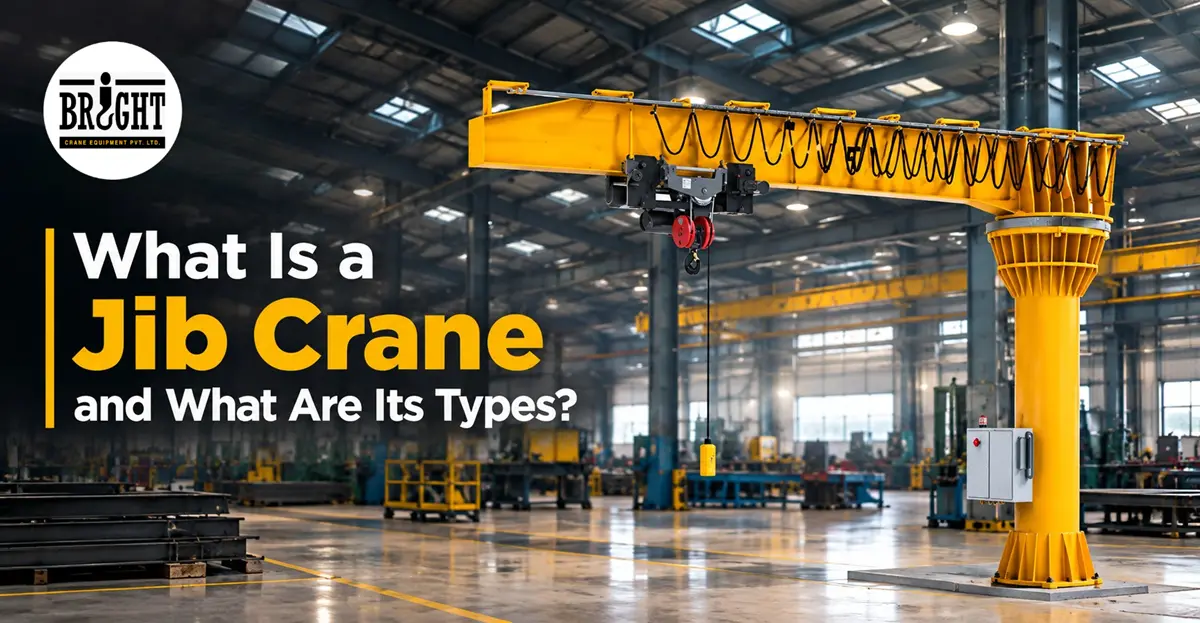
A jib crane is a lifting machine with a horizontal or articulated arm, called a jib, that supports a hoist for lifting, lowering, and moving loads within a defined working area. Jib cranes are commonly used in manufacturing plants, workshops, warehouses, fabrication facilities, and assembly areas for localized material handling.
The main types of jib cranes include freestanding jib cranes, wall-mounted jib cranes, pillar-mounted jib cranes, mast-type jib cranes, articulating jib cranes, and mobile jib cranes. The appropriate type depends on factors such as load capacity, working radius, lifting height, available space, rotation, and installation requirements.
What Is a Jib Crane?
A jib crane is a type of lifting equipment designed to move loads within a specific working area. It consists of a projecting arm or jib that supports a hoist and, depending on the design, a trolley.
The jib can rotate around a fixed point, allowing the operator to position a suspended load at different locations within the crane's working radius.
Unlike an overhead crane that can cover a larger area of a building, a jib crane is generally designed for localized lifting and material handling. This makes it useful for individual workstations, machines, assembly areas, maintenance zones, and production lines.
Main components of a jib crane
A typical jib crane can include:
- Jib arm: Horizontal or articulated arm that provides the crane's reach.
- Column or mounting structure: Supports the jib assembly.
- Hoist: Raises and lowers the load.
- Trolley: Moves the hoist along the jib where the design incorporates one.
- Rotation mechanism: Allows the jib to swing through its designed angle.
- Foundation or mounting arrangement: Transfers the crane loads to the supporting structure.
- Controls: Used to operate lifting, lowering, trolley movement, and rotation.
How Does a Jib Crane Work?
A jib crane works by combining vertical lifting with horizontal positioning and rotation to move a load within a defined operating area.
The basic working process is:
- The load is attached to the crane's hook or lifting attachment.
- The hoist lifts the load to the required height.
- The trolley moves the hoist along the jib where applicable.
- The jib rotates or articulates to position the load.
- The operator lowers the load at the required location.
The exact movement depends on the jib crane design, hoist configuration, mounting arrangement, and rotation mechanism.
What Are the Types of Jib Cranes?
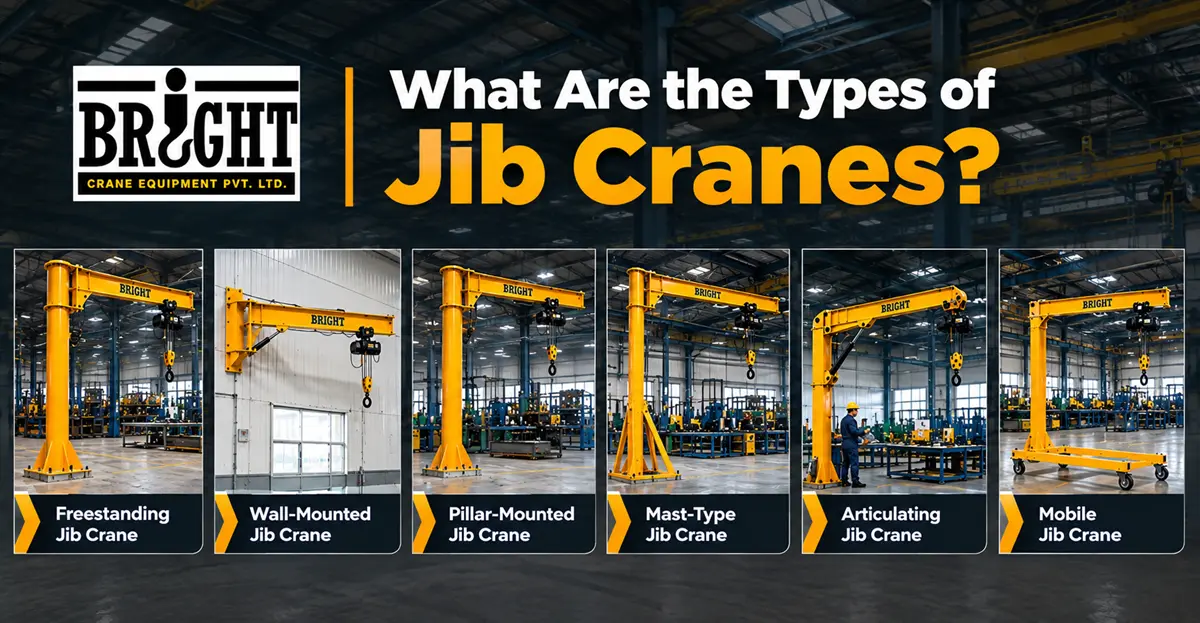
Jib cranes can be classified according to their mounting arrangement, arm configuration, mobility, and application.
The commonly used types include:
| Type of Jib Crane | Mounting | Typical Rotation | Common Applications |
|---|---|---|---|
| Freestanding Jib Crane | Floor/foundation | Up to 360° depending on design | Manufacturing, workshops |
| Wall-Mounted Jib Crane | Wall or column | Limited/defined range | Workstations |
| Pillar-Mounted Jib Crane | Floor/foundation | Often 360° | Industrial lifting |
| Mast-Type Jib Crane | Existing structure/foundation | Varies | Production areas |
| Articulating Jib Crane | Wall/floor/column | Flexible | Restricted spaces |
| Mobile Jib Crane | Mobile base | Depends on design | Flexible lifting |
1. Freestanding Jib Crane
A freestanding jib crane is installed on a dedicated floor foundation rather than being attached directly to an existing building column or wall.
It provides a dedicated lifting station and can be configured for different capacities, arm lengths, lifting heights, and rotation requirements.
Common applications include:
- Manufacturing plants
- Fabrication workshops
- Machine shops
- Assembly areas
- Maintenance stations
- Material handling workstations
A freestanding design can be useful when an independent lifting structure is required without relying on an existing building column.
2. Wall-Mounted Jib Crane
A wall-mounted jib crane is attached to a suitable wall or structural column. Instead of requiring a separate floor-mounted foundation, it uses the supporting structure for mounting.
This type is often used where floor space is limited and lifting is required close to a wall or workstation.
Common applications include:
- Machine loading and unloading
- Maintenance areas
- Workshops
- Assembly stations
- Production lines
The supporting structure must be suitable for the loads and forces generated by the crane.
3. Pillar-Mounted Jib Crane
A pillar-mounted jib crane uses a vertical pillar or column as its primary support. The pillar is generally anchored to a suitable foundation, with the jib assembly mounted around or on the column.
Depending on its design, a pillar-mounted jib crane can provide a large rotational working area.
It is commonly used for:
- Heavy-duty material handling
- Manufacturing plants
- Fabrication facilities
- Machine loading
- Assembly operations
- Industrial workstations
The required foundation and structural design depend on factors such as lifting capacity, jib length, working radius, and duty cycle.
4. Mast-Type Jib Crane
A mast-type jib crane uses a mast or vertical supporting structure to carry the jib assembly. Depending on the design, the mast may work with an existing building structure or dedicated support arrangement.
This configuration can be considered when a facility requires a jib crane but has specific structural or installation constraints.
Its suitability depends on:
- Load capacity
- Jib length
- Available structural support
- Required rotation
- Lifting height
- Working environment
5. Articulating Jib Crane
An articulating jib crane uses an articulated arm arrangement that allows greater flexibility in positioning the load compared with a conventional straight-arm configuration.
Its jointed arm can help the operator reach areas around obstacles or into spaces where a conventional jib may have limited access.
It can be useful for:
- Workstations
- Machine loading
- Maintenance
- Assembly operations
- Areas with restricted access
The actual movement and capacity depend on the crane's specific design.
6. Mobile Jib Crane
A mobile jib crane is mounted on a movable base, allowing the lifting equipment to be relocated when required.
This can provide flexibility where multiple work areas require occasional lifting and a permanently installed crane is not practical.
However, capacity, stability, floor conditions, load movement, and operating procedures must be considered carefully when selecting a mobile design.
What Are Jib Cranes Used For?
Jib cranes are generally used where loads need to be lifted and positioned repeatedly within a localized area.
Common applications include:
Manufacturing
Jib cranes can assist with moving components, tools, dies, and materials between machines and workstations.
Engineering and Fabrication
They can be used for handling fabricated components, assemblies, and heavy parts during production.
Automotive Industry
Jib cranes can support engine, component, tooling, and maintenance operations.
Warehouses
They can be used for localized loading, unloading, and material handling operations.
Machine Shops
Jib cranes can help with machine loading and unloading, especially when heavy components need to be positioned accurately.
Maintenance Areas
They can assist maintenance teams in handling motors, pumps, gearboxes, and other equipment.
Assembly Lines
A jib crane can provide dedicated lifting support at individual assembly stations.
What Are the Advantages of a Jib Crane?
A jib crane can provide several benefits when the lifting requirement is localized.
- Localized lifting: Provides lifting support within a defined working area.
- Efficient material handling: Reduces the need for manual movement of heavy components.
- Flexible positioning: Rotation and trolley movement can help position loads.
- Workstation integration: Can be installed close to individual machines or production stations.
- Space utilization: Certain configurations can work effectively in areas where a full overhead crane system is unnecessary.
- Reduced manual handling: Mechanical lifting can reduce dependence on manual handling for suitable loads.
What Are the Limitations of a Jib Crane?
Jib cranes are not suitable for every lifting application. Their limitations can include:
- Limited working radius compared with large overhead crane systems
- Capacity restrictions depending on design
- Structural and foundation requirements
- Clearance requirements around the operating area
- Limited suitability for moving loads across an entire production hall
- Requirement for appropriate installation, inspection, and maintenance
The crane should therefore be selected according to the actual load, application, environment, and required movement rather than capacity alone.
Jib Crane vs EOT Crane: What Is the Difference?
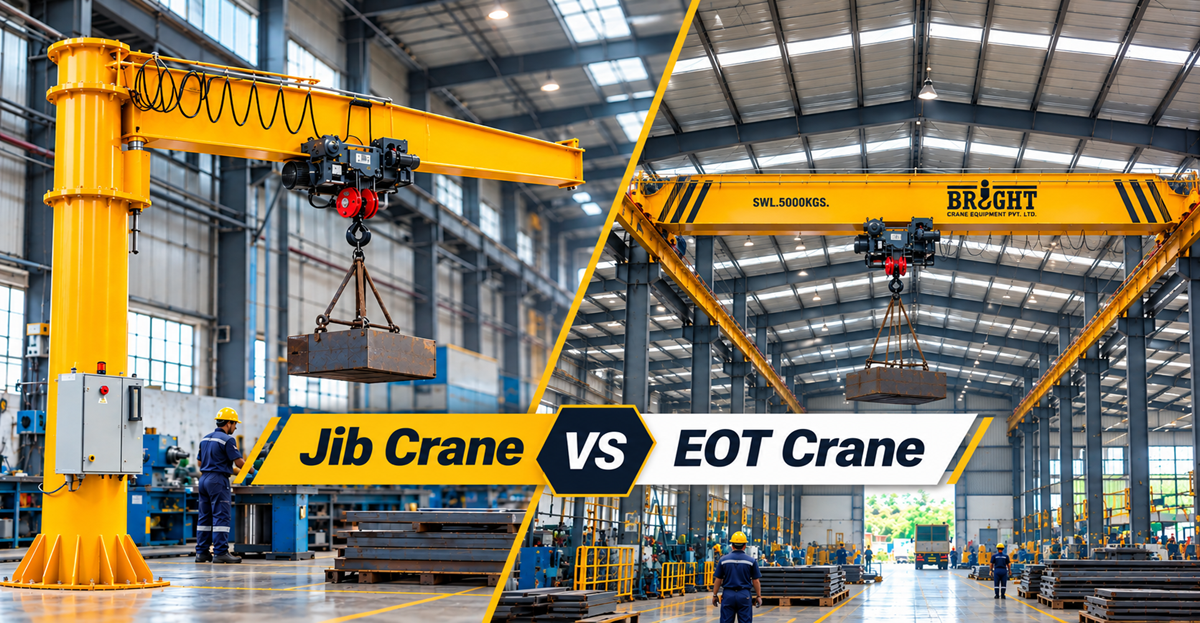
Both jib cranes and EOT cranes are used for material handling, but their operating areas and installation arrangements are different.
| Factor | Jib Crane | EOT Crane |
|---|---|---|
| Working area | Localized | Larger overhead area |
| Installation | Floor, wall, column, or other support | Overhead runway structure |
| Main application | Workstations and localized lifting | Production halls and large work areas |
| Movement | Rotation + hoist/trolley depending on design | Bridge + trolley + hoist |
| Space requirement | Suitable for dedicated lifting zones | Requires runway and building/structural arrangement |
| Typical use | Machine loading, maintenance, assembly | Heavy material handling across a facility |
A jib crane is generally considered when lifting is concentrated around a particular workstation or area, whereas an EOT crane may be considered when loads need to travel across a larger overhead working area.
How to Choose the Right Jib Crane?
Choosing a jib crane requires more than simply selecting a lifting capacity. The crane should be matched to the complete application.
Consider the following factors:
1. Load Capacity
Determine the maximum load that the crane needs to lift, including the weight of any lifting attachment.
2. Working Radius
The required horizontal reach determines the appropriate jib length and working area.
3. Lifting Height
Consider the required hook height, available headroom, and the height of the load being handled.
4. Rotation
Determine whether the application requires a limited rotation or a larger rotational working area.
5. Mounting Arrangement
Choose between options such as:
- Floor-mounted
- Wall-mounted
- Column/pillar-mounted
- Other application-specific arrangements
6. Duty Cycle
Consider how frequently the crane will operate and the type of loads it will handle.
7. Available Space
Check floor space, overhead clearance, surrounding equipment, walls, columns, and potential load paths.
8. Hoist Configuration
The hoist should be selected according to required capacity, lifting height, lifting speed, duty, and operating conditions.
What Jib Crane Specifications Should You Check?
Before selecting or purchasing a jib crane, review the key technical specifications.
These may include:
- Safe Working Load (SWL) / rated capacity
- Jib length
- Working radius
- Lifting height
- Hook height
- Rotation angle
- Hoist type
- Hoisting speed
- Trolley speed
- Duty classification
- Power supply
- Mounting arrangement
- Foundation requirements
- Operating environment
For industrial applications, the manufacturer's technical documentation should clearly define the crane's rated capacity and operating limitations.
Jib Crane Safety and Maintenance
Safe operation depends on correct design, installation, inspection, maintenance, and use within the crane's rated limits.
Important considerations include:
- Do not exceed the crane's rated/SWL capacity.
- Inspect the crane and lifting components as required.
- Check the hook, wire rope/chain, brakes, controls, and structural components.
- Ensure the supporting structure and foundation are suitable.
- Keep the load within the intended working area.
- Avoid unauthorized modifications.
- Ensure operators are appropriately trained.
- Maintain inspection and maintenance records where required.
For factories in India, Section 29 of the Factories Act, 1948 addresses lifting machines, chains, ropes, and lifting tackles. It requires, among other things, proper maintenance and examination by a competent person at specified intervals, and states that lifting machines should not be loaded beyond their safe working load except for testing.
Frequently Asked Questions About Jib Cranes
What is a jib crane used for?
A jib crane is used for lifting, lowering, and positioning loads within a defined working area. It is commonly used in manufacturing, fabrication, machine shops, warehouses, assembly lines, and maintenance areas.
How does a jib crane work?
A jib crane uses a hoist to lift and lower loads while the jib rotates or articulates to position the load. Some designs also use a trolley to move the hoist along the jib.
What are the different types of jib cranes?
Common types include freestanding, wall-mounted, pillar-mounted, mast-type, articulating, and mobile jib cranes.
Why are jib cranes used in manufacturing?
Jib cranes are used in manufacturing because they can provide dedicated lifting support around machines, workstations, assembly areas, and production lines.
When should you choose a jib crane instead of an EOT crane?
A jib crane can be considered when lifting is concentrated within a particular workstation or localized area. An EOT crane may be more appropriate when loads need to travel across a larger overhead working area.
Which jib crane is suitable for a workstation?
The suitable type depends on the workstation's load, available space, required reach, rotation, lifting height, and structural support. Wall-mounted, pillar-mounted, and freestanding configurations are commonly considered for workstation applications.
How much weight can a jib crane lift?
The lifting capacity depends on the crane's design and specifications. It can vary based on the supporting structure, jib length, working radius, hoist, duty cycle, and application.
Can a jib crane rotate 360 degrees?
Some jib crane designs can provide 360-degree rotation, while others have a limited rotation range. The actual rotation depends on the crane configuration and manufacturer's design.
How do you select the right jib crane capacity?
Select the capacity based on the maximum load to be lifted, including applicable lifting attachments, while also considering working radius, lifting height, duty cycle, operating environment, and structural requirements.
Speak with a jib crane manufacturer to discuss your application and determine the appropriate crane configuration.