
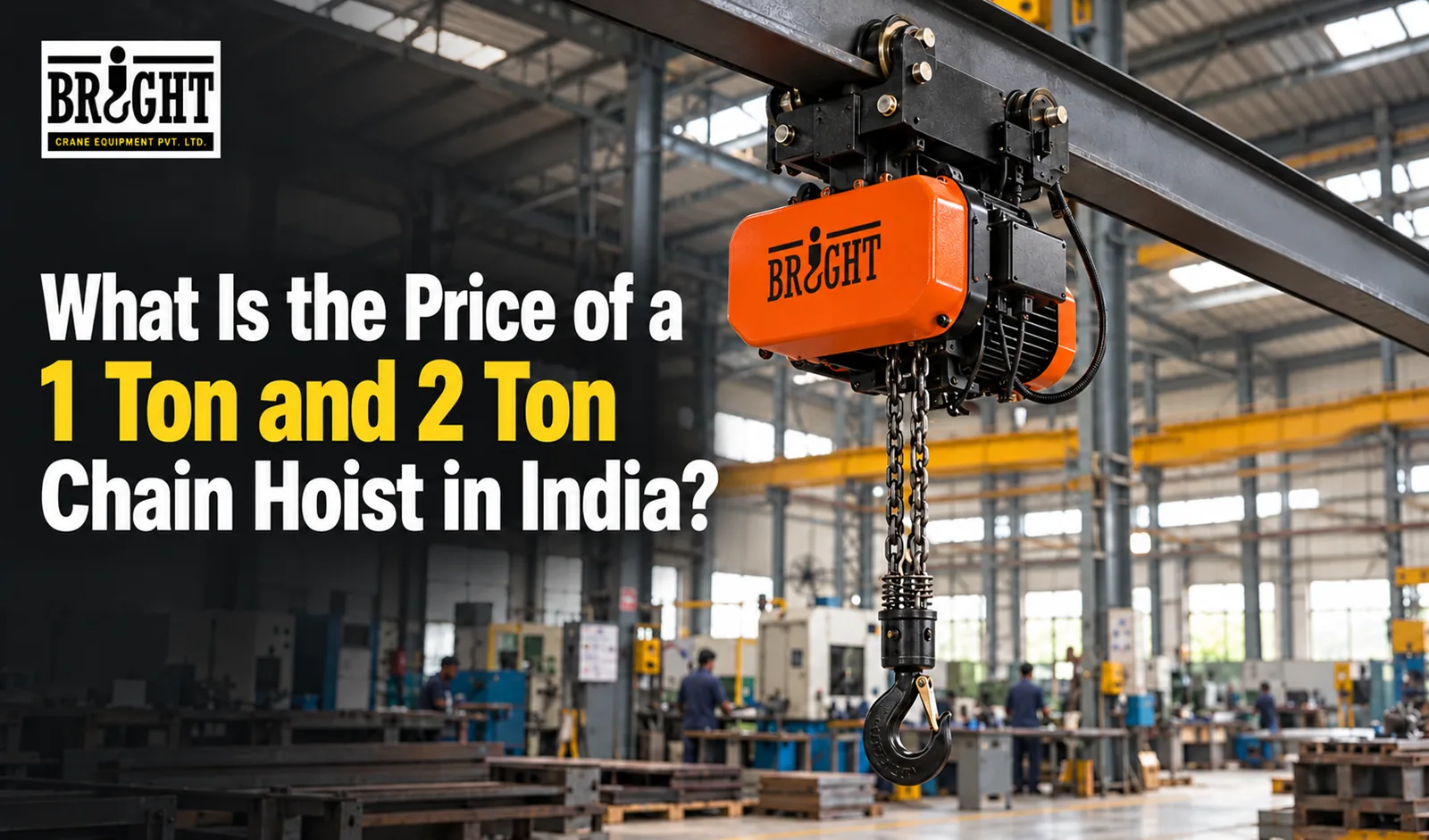
What Is the Price of a 1 Ton and 2 Ton Chain Hoist in India?
What Is the Price of a 1 Ton and 2 Ton Chain Hoist in India?
Ask three suppliers for a 1 ton chain hoist quote and you can easily get three prices that are ₹30,000 apart. That is not because one of them is cheating. It is because one quote is a bare hoist with 3 metres of chain, another includes a motorised trolley and 6 metres of lift, and the third is a branded unit with dual speed. The capacity is the same, so the price looks comparable when it is not.
A chain hoist is a lifting device that raises and lowers a load using a load chain that runs over a chain wheel. It is either pulled by hand (a manual chain hoist, also called a chain pulley block) or driven by a motor (an electric chain hoist). If you are not sure how it differs from other lifting units, our guide on what a crane hoist is covers the basics.
This guide gives you current price ranges for 1 ton and 2 ton hoists, shows what moves the price, and explains how to compare quotes properly. It is written by the engineering team at Bright Crane Equipment, an Ahmedabad-based manufacturer of hoists and cranes. Prices were checked against supplier listings in October 2026.
Key Takeaways
- A 1 ton manual chain hoist costs roughly ₹2,500–₹12,000; a 2 ton manual one ₹3,500–₹15,000.
- A 1 ton electric chain hoist typically costs ₹20,000–₹68,000; a 2 ton electric one ₹22,000–₹65,000.
- The 1 ton and 2 ton ranges overlap, so lifting height, trolley, phase and brand move the price more than the capacity does.
- Choose capacity from your heaviest regular load plus rigging, not from the cheapest quote.
- Always compare quotes on the same specification, not on the headline price.
In This Guide
What Is the Chain Hoist Price in India for 1 Ton and 2 Ton?
For a 1 ton hoist, expect about ₹2,500–₹12,000 if it is manual and about ₹20,000–₹68,000 if it is electric. For a 2 ton hoist, expect about ₹3,500–₹15,000 manual and ₹22,000–₹65,000 electric. Special-duty or premium electric units go well above these ranges, sometimes past ₹1 lakh.
These are indicative ranges drawn from supplier and marketplace listings, so treat them as a budgeting guide and not as a quotation. Final prices change with city, brand, lifting height and what is included in the package.
| Type | 1 Ton | 2 Ton | What Usually Pushes It Higher |
|---|---|---|---|
| Manual chain hoist (chain pulley block) | ₹2,500 – ₹12,000 | ₹3,500 – ₹15,000 | Branded build, heavy-duty gearing, longer chain |
| Electric chain hoist (standard industrial) | ₹20,000 – ₹68,000 | ₹22,000 – ₹65,000 | Motorised trolley, more lifting height, three-phase motor |
| Electric chain hoist (premium or special duty) | Up to about ₹90,000 | ₹80,000 – ₹1.2 lakh or more | Dual speed, branded components, special duty rating |
How Much Does a Manual Chain Hoist Cost?
A manual chain hoist is the cheapest way to lift one to two tons, and the price gap between a basic and a heavy-duty unit is wider than most buyers expect. A plain local-make 1 ton block sits at the bottom of the range. A forged-hook, hardened-chain unit built to Indian standard IS 3832 for hand-operated chain pulley blocks costs more, and it is the one that holds up if you use it daily.
The 2 ton version costs more mainly because of heavier gearing and a stronger chain, not because it is a different product. Manual hoists make sense when lifts are occasional, there is no power point near the work, or you need a portable unit for maintenance jobs. If you lift every day, the operator's time costs more than the electric hoist would. Our comparison of manual versus electric chain hoists goes deeper on that trade-off.
What Is the Price of a 1 Ton and 2 Ton Electric Chain Hoist?
A 1 ton electric chain hoist usually costs ₹20,000–₹68,000, and a 2 ton one ₹22,000–₹65,000. Notice how much those ranges overlap. A basic 2 ton hoist can cost less than a well-specified 1 ton hoist, so the capacity on its own tells you very little about the price.
What actually separates a ₹25,000 listing from a ₹65,000 one is the package. Lifting height is the first thing. Most standard listings assume roughly 3 to 6 metres of chain, and every extra metre adds chain and a chain bag. Then comes the trolley: a hoist hung from a hook is the cheapest, a push-pull or geared trolley costs more, and a motorised trolley costs the most. A single-phase motor suits small workshops, while three-phase is standard in factories.
Speed matters too. Single-speed hoists cost less; dual-speed models let the operator position the load slowly and cost more. If you are looking at higher capacities, our guide to the 5 ton electric chain hoist shows where the same price drivers go as capacity climbs.
Why Do Two Quotes for the Same Chain Hoist Differ So Much?
Quotes differ because suppliers price different packages under the same capacity label. Lifting height, trolley type, motor phase, speed, chain quality and brand each change the price, and one supplier may include items another leaves out. Comparing only the headline number is how buyers end up paying for a hoist that needs another ₹15,000 of additions.
| Factor | What Changes | Effect on Price |
|---|---|---|
| Lifting height | Length of load chain and chain bag | Rises with every extra metre |
| Trolley | None, push-pull, geared or motorised | Rises from hook-mounted to motorised |
| Power supply | Single-phase or three-phase motor | Varies with motor and starter |
| Speed | Single speed or dual speed | Dual speed costs more |
| Chain and hook | Alloy load chain grade, forged hook with latch | Better materials cost more and last longer |
| Brand and warranty | Branded components, service support, warranty | Higher for established brands |
| Test certificate | Load test and inspection paperwork | Reputable suppliers include it; ask |
Treat the cheapest quote with some suspicion until you know what is in it. A hoist that arrives without a trolley, a pendant or a proper hook latch is not cheaper, it is unfinished.
Should You Buy a 1 Ton or a 2 Ton Chain Hoist?
Buy the capacity your heaviest regular load needs, including slings, hooks and any lifting beam, and then add a sensible margin. Most buyers jump a size up "to be safe" and pay for gearing and a motor they never use. Others do the opposite and run a 1 ton hoist at its limit every day, which wears out the brake and chain fast.
Here is how I would decide:
- Heaviest regular load under about 700 kg: a 1 ton hoist is enough.
- Regular loads between 700 kg and 1.5 tons: go for 2 tons, because a hoist working near its rated limit all day ages quickly.
- Rare heavy lift of 1.5 to 2 tons: a 2 ton hoist, but check the duty rating, not only the capacity.
- Loads that may grow: buy the 2 ton now. In listings, the price jump from 1 ton to 2 ton is smaller than the jump caused by trolley and lifting height.
Never use a hoist above its rated capacity, even once. If your loads regularly cross two tons, you are in wire rope hoist or small crane territory, and our breakdown of wire rope hoist cost will help you plan that budget.
How Do You Compare Two Chain Hoist Quotations?
Put both quotes on the same specification before you compare prices. The easiest way is to ask each supplier to confirm the same eight points in writing: capacity, lifting height, speed, motor phase and voltage, trolley type, control type, warranty and whether a load test certificate is included.
Once those match, the price comparison is fair, and the remaining differences come down to build quality and after-sales support. If you are shortlisting makers rather than models, our note on how to choose an electric chain hoist manufacturer in India lists what to check at the factory level.
| Check | What to Confirm in Writing |
|---|---|
| Capacity and duty | Safe working load and duty rating |
| Lifting height | Metres of chain supplied, and chain bag included or not |
| Speed | Single or dual speed |
| Electrical | Phase, voltage, frequency and control voltage |
| Trolley | Type and beam size it fits |
| Control | Pendant or remote, cable length |
| Paperwork | Load test certificate and warranty terms |
| Commercials | GST, transport and installation, included or extra |
What Mistakes Do Buyers Make When Budgeting for a Chain Hoist?
Most budgeting mistakes come from reading the headline price as the final price. Buyers forget the trolley, accept a standard chain length when the real lift is higher, and ignore that the supplier's price excludes GST and transport. Some also pick a hoist by price alone and discover the duty rating is wrong for daily use.
- Comparing a bare hoist against a hoist with a trolley.
- Not measuring the real lifting height before ordering.
- Choosing single-phase when the shop has three-phase supply, or the other way round.
- Skipping the load test certificate to save a small amount.
- Ignoring spares and service support, especially for imported or no-name hoists.
For bigger material-handling budgets, the same discipline applies. Our guide to EOT crane price in India shows how the specification drives cost on a full crane.
Frequently Asked Questions About Chain Hoist Prices
What does it cost to keep a chain hoist running after you buy it?
Running costs are low compared with the purchase price. You will pay for periodic chain and hook inspection, brake and contactor replacement over the years, and a competent person's examination at least once every 12 months under Section 29 of the Factories Act, 1948, with the result recorded. Keeping the chain lubricated and never overloading the hoist are the two habits that cut spare-part costs the most.
Can a chain hoist be fitted on an existing beam or jib crane, and does that add to the price?
Usually yes, as long as the beam is strong enough for the hoist and load, and the trolley matches the beam flange. If you need a trolley, a supporting beam or a small jib crane to carry the hoist, that is extra on top of the hoist price. Share the beam size or a photo of the site when you ask for a quote so the supplier can confirm the fit.
How long does it take to get a chain hoist after ordering?
Standard-capacity hoists are often available within a few weeks, and custom configurations such as special lifting heights, dual speed or motorised trolleys take longer. Sharing the full specification at the enquiry stage is the easiest way to shorten the lead time.
Does a chain hoist for outdoor or dusty areas cost more?
Yes, usually. A hoist used outdoors, near heat, dust or moisture needs better protection for the motor, brake and electricals than one used in a clean indoor workshop. Tell the supplier about the environment up front so the quote includes the right protection, and not a standard indoor unit that fails early.
Need a Chain Hoist Quote Built to Your Specification?
Every powered hoist at Bright Crane Equipment is built to your requirement, so we quote against your lifting height, power supply and trolley type and not against a catalogue price.
If you are looking for a chain hoist manufacturer in Ahmedabad, explore our range of chain hoists or contact our engineers with your load, lifting height and site details. We will recommend the right 1 ton, 2 ton or higher-capacity configuration.
Contact Our Engineers →Explore our Chain Hoist Range for more information about our lifting solutions.